WHITEPAPER
Discover the power skills that will transform your company

Brain
The first AI trained to teach

Author
The #1 AI-powered authoring tool on the market

Factory
Custom e-learning content factory

Skills
Comprehensive power skills course catalog

LMS
All-in-one LMS platform with AI

Engage
App for managing frontline teams
FEATURES

AINew
Unlock your full potential and speed up course creation with artificial intelligence.

Accessibility
Automatically meet accessibility guidelines—without sacrificing interactivity!

Interactivity
Boost engagement with interactive, ready-to-use activities that make learning fun.

Course Creation
Reduce the time it takes to create your e-learning courses with our authoring tool.

Distribution
We offer you different distribution options, so that nothing can stop you.

SCORM
Publish your course in SCORM format and share it on any LMS.
SERVICES

Instrucional Design
Surprise your students with multimedia and interactive content.

Custom Courses
We create e-learning courses for you—tailored to your needs and hassle-free!

Virtual Reality
Turn learning into an immersive experience.

Custom Avatars
Give your courses and videos a unique touch with personalized avatars.

Audiovisual FactoryNew
Turn training into something dynamic and visual with engaging videos.
CATALOG

Course catalog
Over 600 skills and competency courses to help you adapt to your team's needs.
Microsoft Copilot AcademyNew
Your professionals will learn how to apply Copilot AI to key processes within your organization.

Artificial Intelligence Academy
Train your teams in the practical use of AI to boost productivity and innovation in your company.

Cybersecurity Academy
Capacita a tu empresa con el catálogo más completo en seguridad digital corporativa.

Use cases
Choose the solution that best fits your needs

Industries
Solutions for all types of industries
USE CASES

Onboarding
Facilitate the onboarding process, productivity and engagement of your new employees.

Upskilling
Boost your team's skills and prepare them for the challenges of the future with upskilling.

Microlearning
Discover all the advantages of microlearning and boost your training results.

Gamification
Enjoy addictive training that will get your professionals hooked.

Internal Communication
Improve communication in your company and enjoy an aligned and committed team.

Mobile learning
Agile, flexible, and interactive learning—built for today’s digital-first workforce.
INDUSTRIES

Banking and financial services
Training in compliance, cybersecurity, customer service, and key skills development.

Pharmaceuticals and healthcare
Digital onboarding, regulatory updates, and ongoing training for healthcare staff.

Retail and consumer
Agile and scalable training for in-store, operational, and customer service teams.

Industry and manufacturing
Training in processes, safety, and corporate culture for distributed teams.

Education and training
Digital solutions for training centers, internal academies, and corporate universities.

Technology and telecommunications
Development of technical talent, digital skills, and upskilling and reskilling programs.
CLIENTS

MAPFRE
How MAPFRE turn e-learning into sales with isEazy

Pepco
A personalised learning experience for a growing team.

BBVA
Digitisation and creation of high quality e-learning content.

Shiseido
We increase the engagement of the training with a social and gamified app.

Telefónica
Large-scale reskilling for the company's digital transformation.

Vodafone
A personalised learning experience for a growing team.
More than 1,000 companies already rely on isEazy.


MEET ISEAZY

Events
Discover our upcoming events and connect with the future of e-learning.

News
Find out the latest news about isEazy: press releases, partnerships, updates...

Contact
Leave us your personal details and we will contact you as soon as possible.
About isEazyNew
Find out more about our company.

Careers
We are looking for the best talent, join our team!

Partners
Become our partner and grow your business.
INTERESTING RESOURCES

Blog
The best content on e-learning: trends, tools and key strategies.

Whitepapers
Gain valuable insights and stay ahead of industry trends.

Product releases
The latest news and releases of our e-learning products and solutions.

Glossary
Definitions of the most commonly used terms and key industry concepts.

Guides
Discover the best step-by-step tips and tricks to optimize your L&D strategy.

Webinars
Video sessions on our products, trends and more

Comparatives
Compare e-learning solutions available on the market and choose the most suitable one.

Create professional courses in minutes, now for less.

Stay up to date with all our latest news
 Subscribe to our newsletter
Stay up to date with all our latest news

November 6, 2026

CONTENT CREATED BY:

Table of contents
Building employee loyalty means getting the people who already work with you to decide to stay because they want to, not because they can’t find anything else. It’s the other half of talent management: HR departments put a lot of effort into attracting the best talent, but attracting it counts for little if it leaves after eighteen months.
It isn’t a soft issue, either. According to Gallup, replacing a single person costs between half and twice their annual salary, and more than half of those who leave say their company could have prevented it.
In this article you’ll see what employee loyalty actually means, how much not working on it is costing you, how to spot in time who is about to leave, the four strategies that work and how to measure whether they really are working.
It’s the set of strategies and actions a company takes to build a bond of loyalty and commitment with its workforce. One of its main goals is to foster a positive working climate that sustains satisfied, motivated professionals.
Across the transformation of the world of work it has been shown that keeping teams comfortable in a company has a direct effect on its results. The sector doesn’t matter: paying attention to employee wellbeing naturally generates loyalty among the people who make up the organization.
Employee loyalty can be built along different routes. There isn’t one exact path, because people are complex. But there are routes that work consistently: driving talent development, rewards and recognition, and real opportunities for professional growth.
When someone isn’t comfortable at a company, or is demotivated, the normal thing is to look for new opportunities. It’s more common than it seems and, when it repeats, it’s known as a talent drain: several qualified professionals leave the company to join another, with consequences such as lower productivity, financial losses and reduced competitiveness.
Building employee loyalty is a necessity for any company that wants to improve its competitiveness and build a positive employer brand. This doesn’t mean the turnover rate should be zero, but that when a significant exodus happens a domino effect appears that:
There’s a common confusion between the two terms. Retention is about stopping something from leaving, about interrupting or slowing the normal course of something; loyalty is about getting the people at a company to stay committed to it of their own accord.
And what really matters to a company isn’t stopping someone who has already decided to go, but that the people who are there feel comfortable, valued and motivated so that those who contribute something good stay with it. The difference isn’t semantic: a retention strategy kicks in when someone hands in their resignation, and by then it’s almost always too late.

Loyalty usually gets discussed in terms of climate and culture, and framed that way it struggles to win a budget. It’s worth translating it into money, because the numbers are blunt: Gallup estimates that replacing a person costs between half and twice their annual salary, and notes that this is a conservative range.
That cost isn’t just the recruitment process. It includes what almost never gets counted: the months the new person takes to perform at the level of the one who left, the extra load the team carries in the meantime, the mistakes of the first few months and, above all, the knowledge that walks out of the door and wasn’t written down anywhere.
The formula for estimating it at your company fits on one line:
Voluntary departures per year × average gross salary × (0.5 to 2) = annual cost of turnover
Use 0.5 for roles that are easy to fill and 2 for qualified or scarce profiles. Here’s how it looks with worked figures:
| Headcount and average salary | Voluntary departures per year | Estimated annual cost |
|---|---|---|
| 50 people, $30,000 average salary | 5 departures (10%) | Between $75,000 and $300,000 |
| 200 people, $30,000 average salary | 24 departures (12%) | Between $360,000 and $1.4 million |
| 500 people, $35,000 average salary | 75 departures (15%) | Between $1.3 and $5.2 million |
The most uncomfortable thing about the figure above is that a good part of that spend is avoidable. In the same study, Gallup found that 52% of those who leave voluntarily say their manager or the company could have done something to prevent it, and that 51% say nobody spoke to them about their satisfaction or their future in the three months before they left.
Put differently: half of the departures build up in plain sight and nobody asks. These are the signs that tend to appear first, what they actually mean and what you can do about them without waiting for the next engagement survey:
| Sign | What it usually means | What to do this week |
|---|---|---|
| They’ve stopped proposing things in meetings | It’s rarely disinterest: almost always, their last proposals went nowhere. | Ask them privately about the last idea they raised and tell them what happened to it. |
| More than two years without a change of responsibilities | They’ve stopped seeing a future inside and have started looking for one outside. | Put in writing what they’re missing for the next step and on what realistic timeline. |
| They do their job impeccably and nothing more | It’s the classic withdrawal: they fulfill the contract and pull back everything else. | Check whether the extra effort of recent months got any explicit recognition. |
| They’ve just changed direct manager | The bond with the company almost always runs through the immediate manager. | Schedule a check-in one month after the change, don’t wait for the annual review. |
| Their team recently lost someone | Departures pull others along: whoever stays recalculates their own situation. | Talk about how the workload is being split before the affected person raises it. |
| They request odd days off at short notice with no explanation | Sometimes it’s nothing. Sometimes it’s interviews. | Don’t ask about the days off: ask how they are and listen to the whole answer. |
None of these conversations works if you only have it when the alarm goes off. What sustains them is a routine of feedback between manager and team that already exists by the time you need to use it.
Before putting measures in place it’s worth knowing where you’re starting from. These are the seven points to look at, with the data each one gives you:
Companies that keep an open channel strengthen the relationship with their teams: being open, showing flexibility and listening to needs builds a real bond. What to look at: how many people have had a one-to-one with their manager in the past month. If you don’t know, that’s already your first finding.
A list of values pinned to the intranet isn’t enough. What counts is the set of actions that show what the company believes in, encourages and rewards, and it’s the degree of consistency between the two that produces a clear, effective culture. What to look at: whether someone outside the leadership team could state the values without looking them up.
This is essential for building loyalty effectively, so the L&D and HR team’s agenda should include ongoing programs to improve the climate. What to look at: how long passes between the survey and the first visible action that comes out of it. If it’s measured in months, the next survey will get worse participation.
One of the big reasons people resign is the feeling of stagnation, so mapping out a growth path is decisive. It can range from opening new roles to driving intellectual development: people need new challenges and incentives. What to look at: what percentage of last year’s vacancies was filled from within.
Making schedules flexible and creating an environment that looks after health and wellbeing encourages a healthy atmosphere. What to look at: what time the last email of the day goes out in your team, and who sends it. It usually says more than any written policy.
It’s worth stopping to acknowledge each person’s achievements: it isn’t just about completing endless tasks, but about underlining what went right, because that drives everyone else’s motivation. What to look at: if the last piece of recognition you can remember was collective and generic, it didn’t work as recognition.
As we were saying, you have to set aside time to review all of the above regularly and establish metrics and objectives for the short and medium term. What to look at: the four indicators we detail further down, in the measurement section.
With the diagnosis done, these are the four levers that move the needle most. None is immediate and all are cumulative: they work when they coexist.
To build employee loyalty you first have to know your company’s organizational climate, and getting an objective view takes a study. The indicators that weigh most are relationships between colleagues, the quality of leadership and the sense of belonging — that is, whether people identify with the company’s values.
Once you know that, you can work on creating an environment where people develop a good relationship with their colleagues and managers and, above all, where they feel valued. That’s where team building strategies and reinforcing a positive corporate culture come in.
Another effective route is improving the emotional salary: the non-monetary rewards that keep the workforce motivated. Flexible hours, remote or hybrid models, social activities and, above all, training for professional growth.
Effective communication, with regular meetings, helps people feel included and heard. But the group level isn’t enough: you have to talk to each person about their expectations within the company, get to know them better and understand their real level of satisfaction.
That channel also lets you learn their professional goals and help them map out a plan to reach them. If someone wants to move up, you can advise them on how long it makes sense to stay in their current role, which skills they would need to strengthen to take on another and what steps to take to acquire them.
Do your teams know how people get promoted at your company? Nobody wants to feel stuck in the same role for years, and a company that lets people grow and move up conveys far more confidence and therefore increases commitment and loyalty.
Designing a training plan helps meet the demands of the new generations and improves climate and performance. But beyond offering the possibility, you have to put training tools within reach of those who aren’t yet ready to take on new responsibilities, so that they can get there.
One of the big causes of turnover is a lack of support for professional growth: either because of the need to move up, or because people aren’t being given the right tools to meet their current responsibilities in a fast-changing environment. It happens at companies that don’t offer training.
It’s the responsibility of whoever leads to provide the means for people to acquire or improve the skills they need in their role and aspire to different ones. And today there are many ways to deliver it — in person, mentoring, on-the-job training — but e-learning courses are still among the best options: flexible timing, easy access and, above all, personalization. Because not everyone is the same, nor are their learning needs.
If you want to set it up properly from the start, this guide to the corporate training plan has everything you need to know.
“Improving the climate” can’t be defended to a board. These four indicators can, and the first three come from data your company already has:
And on top of the four, the turnover cost calculation you did above, repeated every year. That’s what translates this whole conversation into the only language budgets get approved in.
Building employee loyalty is what means you never have to retain anyone: a good environment, real growth opportunities and a sense of belonging that holds up. Of all the levers available, training is the one that shows results soonest and the easiest to get going, because it doesn’t depend on reorganizing the entire company.
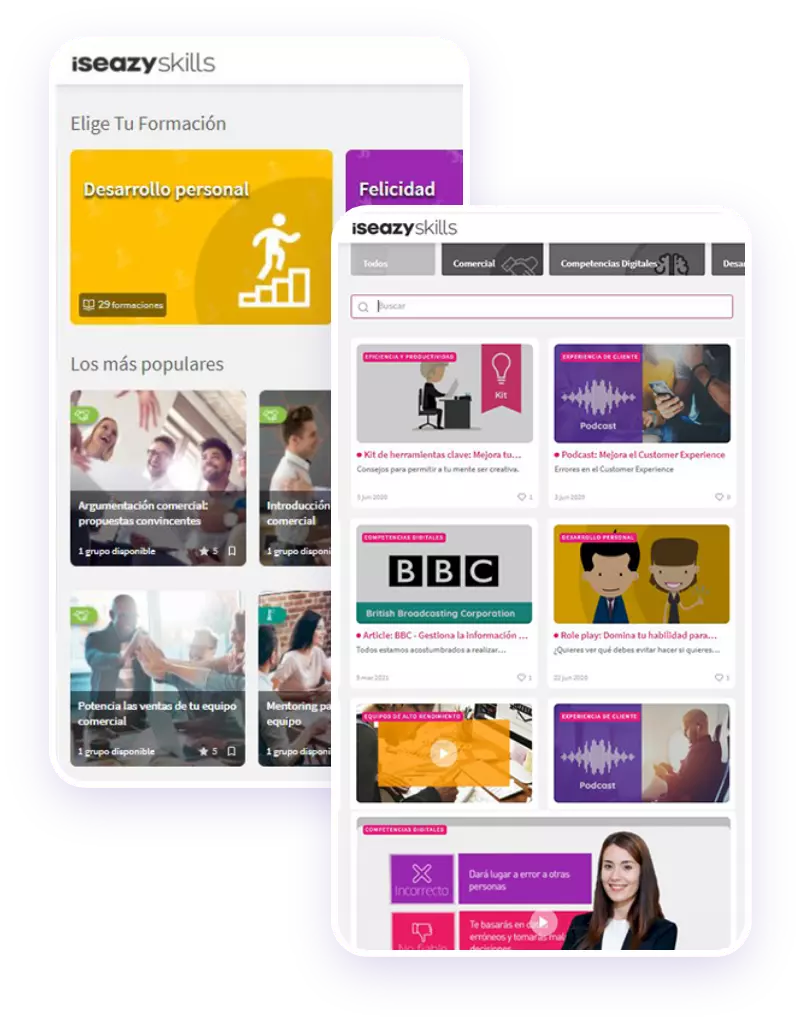
isEazy Skills is the most complete catalog of soft skills courses and programs on the market: ready-to-assign learning paths that help your teams reach their development goals while supporting your loyalty strategy. Compared with the cost of replacing a single person, the math does itself.
Train your team in the most in-demand skills, offer them growth opportunities and prepare them for a future inside your company. Request a demo!
Building employee loyalty means applying strategies that generate commitment, loyalty and motivation within the team. It is crucial because it helps reduce talent drain, improves productivity, strengthens corporate culture and lowers the costs that come from staff turnover.
Retention means preventing an employee from leaving, while loyalty focuses on creating an environment where the person wants to stay of their own accord. What matters isn’t stopping people from going, but building solid, satisfying working relationships that encourage them to stay.
Some key strategies include promoting a good working climate, keeping communication flowing, offering continuous training and designing internal promotion plans. It is also essential to recognize achievements, balance personal and working life, and reinforce the sense of belonging to the company.
isEazy Skills offers a complete catalog of soft skills courses that drives the professional growth of internal talent. Thanks to its flexibility, personalization and focus on the most in-demand skills, it is an ideal tool for strengthening your loyalty strategy and preparing employees to take on new challenges within the company.
According to Gallup, replacing a person costs between half and twice their annual salary, and it is a range the consultancy itself describes as conservative. The calculation isn’t just the recruitment process: it includes the months the new person takes to perform, the extra load the team carries in the meantime and the knowledge that leaves without being documented. To estimate it at your company: voluntary departures per year times average gross salary, multiplied by a factor of between 0.5 and 2 depending on how hard the role is to fill.
With four indicators almost any company can pull from data it already has: annual voluntary turnover compared with last year’s and the sector’s; first-year turnover, which if high points to a recruitment or onboarding problem rather than a loyalty one; the internal promotion rate, meaning how many vacancies are filled from within; and one specific climate question about whether the person sees themselves at the company two years from now.
Gallup found that 51% of those who leave say nobody spoke to them about their satisfaction or their future in the three months before they left. One individual conversation a month, even a short one, is enough for those signs to appear in time. What doesn’t work is concentrating everything into the annual review: by then the decision is usually made and the conversation becomes a goodbye.

Explore more than 600 courses and programs to develop your team's talent
Request a demoTry it free


The best companies are already using isEazy Skills in their training strategies
What are you waiting for to join them?


The best companies are already using isEazy Skills in their training strategies
What are you waiting for to join them?