


The first AI trained to teach

Brain
The first AI trained to teach

Author
The #1 AI-powered authoring tool on the market

Factory
Custom e-learning content factory

Skills
Comprehensive power skills course catalog

LMS
All-in-one LMS platform with AI

Engage
App for managing frontline teams
Discover isEazy Author


 See all features
FEATURES
AINew
Unlock your full potential and speed up course creation with artificial intelligence.
Accessibility
Automatically meet accessibility guidelines—without sacrificing interactivity!
Interactivity
Boost engagement with interactive, ready-to-use activities that make learning fun.
Course Creation
Reduce the time it takes to create your e-learning courses with our authoring tool.
Distribution
We offer you different distribution options, so that nothing can stop you.
SCORM
Publish your course in SCORM format and share it on any LMS.
Discover isEazy Factory


SERVICES
Instrucional Design
Surprise your students with multimedia and interactive content.
Custom Courses
We create e-learning courses for you—tailored to your needs and hassle-free!
Virtual Reality
Turn learning into an immersive experience.
Custom Avatars
Give your courses and videos a unique touch with personalized avatars.
Audiovisual FactoryNew
Turn training into something dynamic and visual with engaging videos.
Discover isEazy Skills


CATALOG
Course catalog
Over 600 skills and competency courses to help you adapt to your team's needs.
Microsoft Copilot AcademyNew
Your professionals will learn how to apply Copilot AI to key processes within your organization.
Artificial Intelligence Academy
Train your teams in the practical use of AI to boost productivity and innovation in your company.
Cybersecurity Academy
Capacita a tu empresa con el catálogo más completo en seguridad digital corporativa.

Use cases
Choose the solution that best fits your needs

Industries
Solutions for all types of industries
See all solutions


 See all solutions
USE CASES
Onboarding
Facilitate the onboarding process, productivity and engagement of your new employees.
Upskilling
Boost your team's skills and prepare them for the challenges of the future with upskilling.
Microlearning
Discover all the advantages of microlearning and boost your training results.
Gamification
Enjoy addictive training that will get your professionals hooked.
Internal Communication
Improve communication in your company and enjoy an aligned and committed team.
Mobile learning
Agile, flexible, and interactive learning—built for today’s digital-first workforce.
Discover our industries


 View all industries
INDUSTRIES
Banking and financial services
Training in compliance, cybersecurity, customer service, and key skills development.
Pharmaceuticals and healthcare
Digital onboarding, regulatory updates, and ongoing training for healthcare staff.
Retail and consumer
Agile and scalable training for in-store, operational, and customer service teams.
Industry and manufacturing
Training in processes, safety, and corporate culture for distributed teams.
Education and training
Digital solutions for training centers, internal academies, and corporate universities.
Technology and telecommunications
Development of technical talent, digital skills, and upskilling and reskilling programs.
CLIENTS

MAPFRE
How MAPFRE turn e-learning into sales with isEazy

Pepco
A personalised learning experience for a growing team.

BBVA
Digitisation and creation of high quality e-learning content.

Shiseido
We increase the engagement of the training with a social and gamified app.

Telefónica
Large-scale reskilling for the company's digital transformation.

Vodafone
A personalised learning experience for a growing team.
More than 1,000 companies already rely on isEazy.


MEET ISEAZY

Events
Discover our upcoming events and connect with the future of e-learning.

News
Find out the latest news about isEazy: press releases, partnerships, updates...

Contact
Leave us your personal details and we will contact you as soon as possible.
About isEazyNew
Find out more about our company.

Careers
We are looking for the best talent, join our team!

Partners
Become our partner and grow your business.
INTERESTING RESOURCES

Blog
The best content on e-learning: trends, tools and key strategies.

Whitepapers
Gain valuable insights and stay ahead of industry trends.

Product releases
The latest news and releases of our e-learning products and solutions.

Glossary
Definitions of the most commonly used terms and key industry concepts.

Guides
Discover the best step-by-step tips and tricks to optimize your L&D strategy.

Webinars
Video sessions on our products, trends and more

Comparatives
Compare e-learning solutions available on the market and choose the most suitable one.

Want to apply what you've learned to your training project?

November 6, 2026
AI agents in corporate training: what they are and how they’ll transform L&D

CONTENT CREATED BY:
Fernando González Zurita
User Acquisition Manager at isEazy

Table of contents
What is an AI agent in corporate training?
An AI agent is a system that, given a goal, decides for itself what steps to take and what tools to use to reach it, rather than simply answering whatever it’s asked. Applied to corporate training, that means moving from a tool that answers questions to a system that detects what each person needs, chooses how to help them, and delivers that help inside the learning flow itself.
The difference from a chatbot isn’t how well it writes, but who decides the path. A chatbot follows a route laid out in advance; an agent works out its own as it goes. That distinction looks technical, but it’s what changes the job of an L&D team: it’s no longer just about producing content, but about defining what a system is allowed to decide, with what information, and under what supervision.
In this guide we look at how learning agents work, what types exist, how they take part in learning, and what level of autonomy and supervision they need. If you’re after a broader view of this technology’s role, you can read our guide on AI for corporate training.
Why AI agents are transforming corporate training
For two years the conversation about artificial intelligence in training has revolved around content creation: generating courses faster, translating, producing video without filming. Agents open a different second phase, because they don’t speed up a task you were already doing: they take on decisions that only a person used to make.
That personalization works isn’t a hypothesis. In 1984, educational psychologist Benjamin Bloom compared a conventional class with students who each had their own tutor and measured a two-standard-deviation difference in favor of the second group: the average tutored student outperformed about 98% of the conventional class. The problem was never proving that personalized teaching works, but that there’s no way to put a tutor next to every employee. That’s exactly what an agent tries to solve.
AI in L&D: adoption, challenges and trends
This isn’t a theoretical or distant debate. According to LinkedIn’s Workplace Learning Report 2025, 71% of L&D professionals are already exploring, experimenting with or integrating AI into their work. And the brake isn’t budget: in Gartner’s survey of 750 HR leaders, the most cited obstacle to the HR technology and AI strategy is the lack of skills within the team itself, flagged by 45%. In other words, the function that trains the organization is the one declaring it isn’t ready for what’s coming.
Two pressures make that urgent. First, your workforce already has a different yardstick: 75% of knowledge workers already use generative AI and 78% do so with tools they bring themselves (Microsoft and LinkedIn, 2024). Second, the speed at which know-how expires: the World Economic Forum estimates that 39% of key skills will change before 2030. If updating a course takes weeks, training is always a step behind.
Chatbot, assistant and agent: the differences
The market calls almost everything an “agent”, and that makes any purchasing decision harder. There’s a technical criterion that sorts it out and that you can apply in a demo. Anthropic puts it this way: in a workflow, models and tools are orchestrated through predefined code paths; in an agent, the model dynamically directs its own process and tool usage.
Translated into training: don’t ask whether the system “uses AI”. Ask who decided the sequence of steps you just saw. If a product team wrote it in advance, it’s a workflow. If the system picked it in that moment, it’s an agent. The distinction matters because many organizations arrive at agents after trying a corporate chatbot and running into its limits: what that first layer solves and what it doesn’t is analyzed in chatbot for business.
It’s worth adding a fourth figure to the comparison that most training teams already have in place: the learning path by profile, which does personalize, but with every decision made in advance. And a second criterion that almost never comes up in a demo: what the system remembers from last time. A chatbot starts from scratch in every conversation; a path knows which modules you’ve completed; a learning agent remembers where you got it wrong and what level you’re at.
| Type of system | Who decides the path | What you see in training |
|---|---|---|
| Chatbot | Rules or routes defined in advance by whoever configured it | Answers FAQs and hands off to a person when the conversation leaves the script |
| Generative assistant | The person, with every request: the system responds but doesn’t act | Summarizes a document, drafts a test or rewrites a piece of content |
| Learning path | A designer, once and for a whole group; after that it applies by rules | Each profile gets its own itinerary, but within each segment it’s still the same for everyone |
| Agent | The system itself, choosing the steps and tools according to the goal | Spots the question, decides whether to explain, give an example or have you practice, and does it |
Workflows are systems where LLMs and tools are orchestrated through predefined code paths. Agents are systems where LLMs dynamically direct their own processes and tool usage, maintaining control over how they accomplish tasks.
Anthropic, "Building Effective Agents"
How AI agents work with corporate knowledge
This is the piece that decides whether a learning agent is worth anything in your organization, and the one most often taken for granted. A general-purpose language model knows a lot about the world and nothing about your company: it doesn’t know your client onboarding procedure, your security policy or the pitch you signed off last quarter. A useful learning agent isn’t the one that writes best: it’s the one that answers from the organization’s real documentation, and only from there.
The usual mechanism is to connect the model to a set of approved documents and require it to build its answers from them. That changes three things at once:
- The answer is verifiable. You can trace which document it came from, which is the difference between being able to use it in regulated training or not.
- The scope is bounded. If something isn’t in the documentation, the agent should say it doesn’t know instead of filling the gap.
- The quality of the agent becomes your responsibility. An agent connected to a repository with duplicate versions, ownerless documents and repealed procedures amplifies that mess and distributes it, with total confidence, to the whole workforce.
That’s why the right sequence is always the same: knowledge first, then the agent, and only then the learning experience. Inverting the order is the most expensive mistake in this category. How to organize and activate that internal documentation is covered in AI-powered knowledge management, and how to make it findable at scale, in enterprise search with AI.
| What the agent needs | Why | What happens if it’s missing |
|---|---|---|
| Documentation identified as the valid one | It’s the only source it should answer from | Contradictory answers depending on which document it lands on |
| Someone responsible for maintaining it | Knowledge expires: procedures, prices, regulations | The agent confidently teaches what is no longer done that way |
| Permissions and access levels | Not everyone should be able to see everything | Sensitive information exposed to the wrong people |
| Traceability of the answer | Being able to prove where each piece of training content came from | Impossible to audit the training if someone asks |
How a learning agent decides: diagnose, decide, act and evaluate
So far, “decides for itself” sounds like a black box. In practice it’s a four-step cycle fairly close to what a good trainer does, and it repeats in full with every interaction:
- It diagnoses. What this person already masters, where they went wrong before and what they’re trying to solve right now.
- It decides. Whether what they need is a simpler explanation, an example from their industry, a quick review or a hands-on exercise.
- It acts. It generates that specific experience from the company’s knowledge, not from the internet.
- It evaluates and remembers. It checks whether it worked and stores that for next time.
The fourth step is what separates a learning agent from a search engine with good conversation: without memory of what happened, every interaction starts from zero and no personalization is possible. And because the full cycle repeats every time, two people using the same agent can end up with very different experiences without anyone having designed a path for each of them.
What exactly gets personalized: five dimensions
Personalization often boils down to recommending the right course to the right person, and that assumes the course answers what they need right now. Genuinely personalized experiences work on five dimensions at once, and each one you leave out has an identifiable cost:
| Dimension | The question it answers | What happens if you ignore it |
|---|---|---|
| Level | What does this person already know, specifically? | They repeat what they’ve mastered or move on without the basics they’re missing |
| Pace | How much time do they need to absorb it? | You penalize both the people who go slower and the ones who could go faster |
| Format | How do they learn best right now? | A long read where practice was needed, or the other way round |
| Context | How does this apply to their role, their client, their product? | You force every employee to translate the generic into their own reality |
| Timing | When do they actually need it? | The knowledge arrives weeks early and is forgotten before it’s used |
Types of AI agents for training
“Learning agent” isn’t a single category: the name covers systems that solve different problems. Here’s the overview, with what each one solves and where it’s covered in detail.
One necessary note before going on: what follows describes what the category makes possible in the market today, not the feature list of any particular product. What’s available, what’s in development and what’s a future plan varies a lot from vendor to vendor, so it’s worth confirming with each of them before assuming anything.
| Type of agent | What problem it solves | When you need it |
|---|---|---|
| Contextual support | The learner gets stuck in a course and has no one to ask | Self-paced training at scale, especially with dense or compliance content |
| Practice and simulation | People learn the theory but have nowhere to rehearse the real conversation | Skills that only stick through practice: sales, leadership, customer care |
| Path personalization | Everyone gets the same training even though they start from different levels | Large, heterogeneous workforces, where a single course wastes time |
| Knowledge access | The answer exists inside the company but nobody knows where | Organizations with a lot of scattered documentation and high turnover |
Contextual support agents
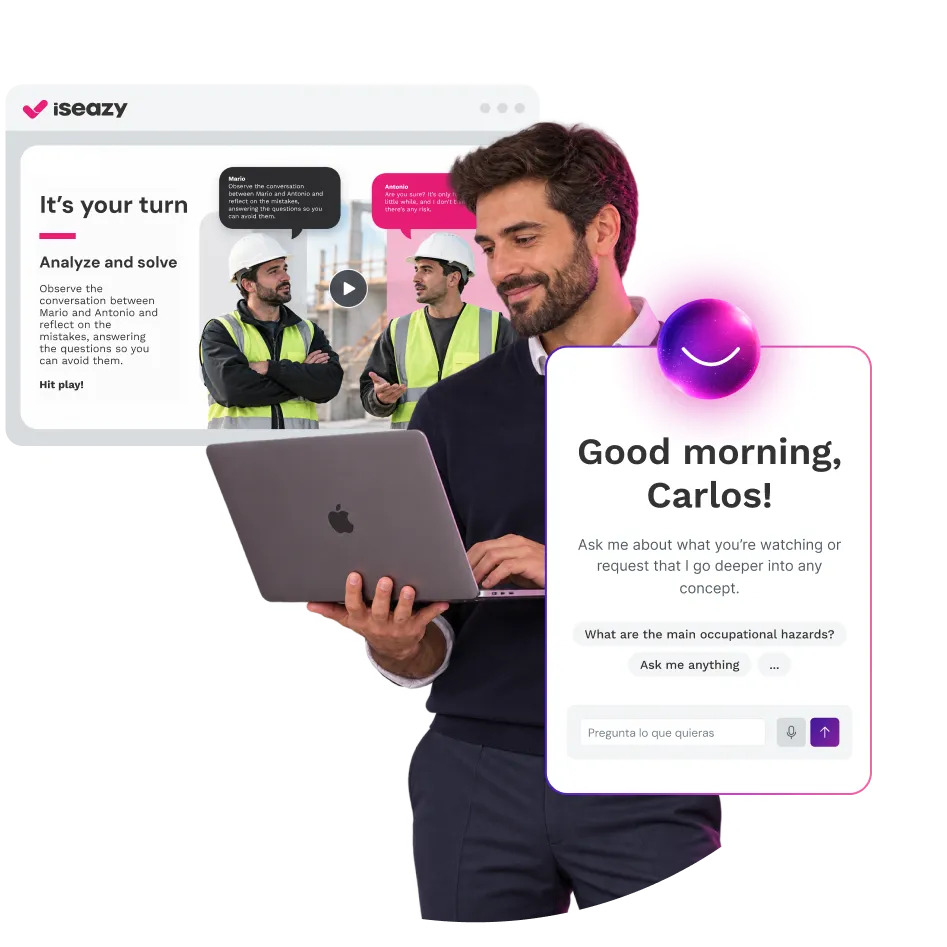
They solve an old problem: a linear course explains once and in one way, and when someone doesn’t understand something, their only option is to rewind or give up. Companion, isEazy Brain’s learning agent, is an example of how this is tackled: it lives inside the course itself and knows which module and which screen the person is on, so there’s no need to explain the context of the question. It identifies what they need in that moment —understanding a concept, placing it in their own reality, resolving a doubt or practicing— and answers only from the company’s documentation. It’s distributed inside the SCORM package, so progress, completion and scores keep being recorded in the LMS and the mandatory path doesn’t change. How it supports learners before, during and after the course is covered in AI Companion in corporate training.
Practice and simulation agents
They let people rehearse a difficult conversation —a client objection, a performance review, a complaint— with a counterpart that responds and gives immediate feedback. They solve the link that’s always missing between knowing something and knowing how to do it, and they’re especially useful for skills where a mistake in real life is expensive. The full methodology is in AI role play, and its application to human skills, in AI soft skills training.

Path personalization agents
They adjust what content each person receives based on what they already master and how they’re progressing, instead of serving the same route to the whole workforce. It’s the difference between a catalog and a path. How that adaptation works and what it requires is in adaptive learning.
Knowledge access agents
They don’t train: they answer. They’re the layer that turns internal documentation into immediate answers on the job, without going through a course. Covered in AI-powered knowledge management and enterprise search with AI.


How agents take part before, during and after learning
The types above don’t compete with each other: they occupy different moments in the cycle. Seeing them in sequence helps decide where to start, because almost no organization needs all four at once.
| Moment | What an agent brings | Type of agent involved |
|---|---|---|
| Before: diagnosis | Identifies gaps and proposes who to train on what, using LMS and performance data | Platform analytics, serving the L&D team |
| Before: preparation | Turns scattered internal documentation into usable training material | Knowledge access |
| During: support | Resolves questions inside the course and adapts the explanation to each person | Contextual support and personalization |
| During: practice | Lets people rehearse difficult conversations with immediate feedback | Practice and simulation |
| After: reinforcement and measurement | Detects what hasn’t stuck and feeds the data back to the L&D team | Path personalization |
Producing the content that feeds all this is a separate field, with its own tools: AI avatars and generative AI applied to e-learning cover that part, and the guide to creating e-learning courses with AI, the full process.
Levels of autonomy and human supervision
Two products can go by the same name and give the system completely different permissions. Autonomy, here, means one thing only: how much the agent can do without a person approving it first. Knowing that is what lets you decide which task to trust to each one, and it won’t come up in any demo unless you ask.
It’s worth clearing up a misconception: autonomy isn’t lack of control. A well-built agent is autonomous and supervised at the same time. It decides its own path, but within a scope you define, answering only from the documentation your organization has approved and leaving a record of everything it does. What changes from one level to the next isn’t how much control you have, but when you exercise it: before every action, only at critical points, or when reviewing what has already been done.
That’s why the useful question isn’t “is this an agent?”, which any answer can satisfy, but which level of this scale it operates at and what you still decide at each one:
| Level | What the system does | What the person still decides |
|---|---|---|
| 1. Suggests | Proposes content, answers or actions and leaves them in view | Everything: what gets used, when and with whom. The system touches nothing |
| 2. Prepares | Leaves the work done: the draft, the assignment, the report | Review and publish. Nothing reaches the learner without going through a person |
| 3. Executes with approval | Acts on the system, but asks for confirmation at critical points | Defines what counts as critical and approves or rejects each of those points |
| 4. Executes and reports | Acts autonomously within an agreed scope and reports afterwards | Sets the scope and the limits, and reviews the log of what was done |
The practical rule for L&D is simple: match the level to what a mistake costs, not the other way round. Where being wrong is cheap —proposing supplementary content, leaving a draft ready, cross-referencing data to spot a gap— high autonomy is exactly where it gives you the most time back, and holding it back out of caution is wasting it. Where compliance is involved —marking a mandatory course as passed, issuing a certificate— the last word stays with a person, and that isn’t a limitation of the system: it’s how it has to work. The normal outcome is living with several levels at once, one per type of task.
The other side: which part of L&D’s work AI can take off your plate
Almost everything published about AI in training looks at the learner. But the work that eats an L&D team’s weeks isn’t teaching: it’s cross-referencing spreadsheets, chasing completions, reviewing which content has gone stale and preparing the report nobody reads. That’s where AI changes most, and where it makes sense to start experimenting, because the risk is lower: if it gets something wrong, a professional sees it before it reaches anyone.
With one important caveat: this doesn’t yet come packaged. It’s the part of the category with the most room and the least solved today, so the table points at where the gap is, not at what you can deploy next quarter.
| L&D task | How it’s done today | Where AI comes in |
|---|---|---|
| Detecting skills gaps | Annual surveys and performance reviews that arrive too late | Cross-referencing LMS activity, performance and profiles to flag gaps as they appear |
| Assigning learning paths | Manual rules by department, reviewed once or twice a year | Proposing the path per person and keeping it current when the role changes |
| Tracking mandatory training | Email reminders and a spreadsheet of expiry dates | Spotting who’s about to expire, warning in advance and escalating what doesn’t move |
| Keeping content alive | Periodic reviews that get postponed until something breaks | Comparing courses against current documentation and flagging what has gone out of date |
| Reporting to leadership | Exporting LMS data and building the deck by hand | Drafting the report with the data already cross-referenced, for you to review |
What changes in the L&D professional’s job
The uncomfortable question underneath is whether agents replace the training team. They replace tasks, not the function, but they change the profile of the person doing it. Hand-crafted content production, the administrative management of assignments and the manual building of reports all lose weight. Everything an agent can’t do for you gains weight:
- Deciding what’s worth training on. An agent detects patterns; it doesn’t know what’s strategic for your business next year.
- Curating and validating the knowledge the agent draws on, which as we’ve seen is the basis for everything else.
- Designing the experience. What gets assessed, what gets certified and what path makes pedagogical sense.
- Governing. Defining what the system can decide, what requires approval and how it’s audited.
It’s a shift from “doing” to “deciding and verifying”. In short:
| What changes | Until now | With learning agents |
|---|---|---|
| Design | Anticipate every scenario and build a path for each one | Define goals and criteria; the agent adapts the path |
| Updating | Changing a piece of content takes weeks | You update the source and the experience aligns itself |
| Timing | Training before the task | Training before, during and after the task |
| Measurement | Hours and completions | Where each person gets stuck and what they need |
| Scale | More personalization requires more team | More personalization without multiplying the operation |
The skills that underpin this are in AI skills and how to build them in your company, and the broader impact on the people function, in the role of AI in HR.
Benefits and risks of learning agents
The benefits come down to three: availability, because support no longer depends on someone being on the other end; personalization at scale, because each person gets the explanation they need without multiplying the cost; and hours freed up for the L&D team, which gets admin time back to spend on judgment.
The risks are just as concrete and worth writing down before the first pilot: incorrect answers delivered with confidence, vendor lock-in, exposure of sensitive information, bias in path personalization and loss of traceability over what was taught. The full analysis, with a three-layer governance framework, is in risks of using AI in corporate training.
There’s also an obligation that tends to get overlooked: the EU AI Act requires organizations deploying these systems to ensure a sufficient level of AI literacy among the people operating them, and in practice that answer falls to training. Who it affects and what deadlines it sets is in the guide to European AI regulation. This guide is informational and does not replace legal advice.
How to implement AI agents in a company
Most projects that don’t work don’t fail because of the technology, but because an agent was placed on top of a foundation that wasn’t ready. These are the three foundations, in order:
1. Knowledge first
We’ve already seen why: the agent answers from the company’s documentation, so identifying which documentation is valid and who maintains it is step zero. If this isn’t sorted, nothing else matters. Where to start, in AI-powered knowledge management.
2. A platform that records what happens
If the agent acts outside your learning platform, you lose traceability exactly where you need it most. Check how it returns data to the LMS and whether the mandatory path remains auditable. The underlying decision —an LMS with AI features or a native AI solution— is compared in AI LMS vs. native AI learning solution and in what an AI LMS is and how to choose one.
3. A written governance framework
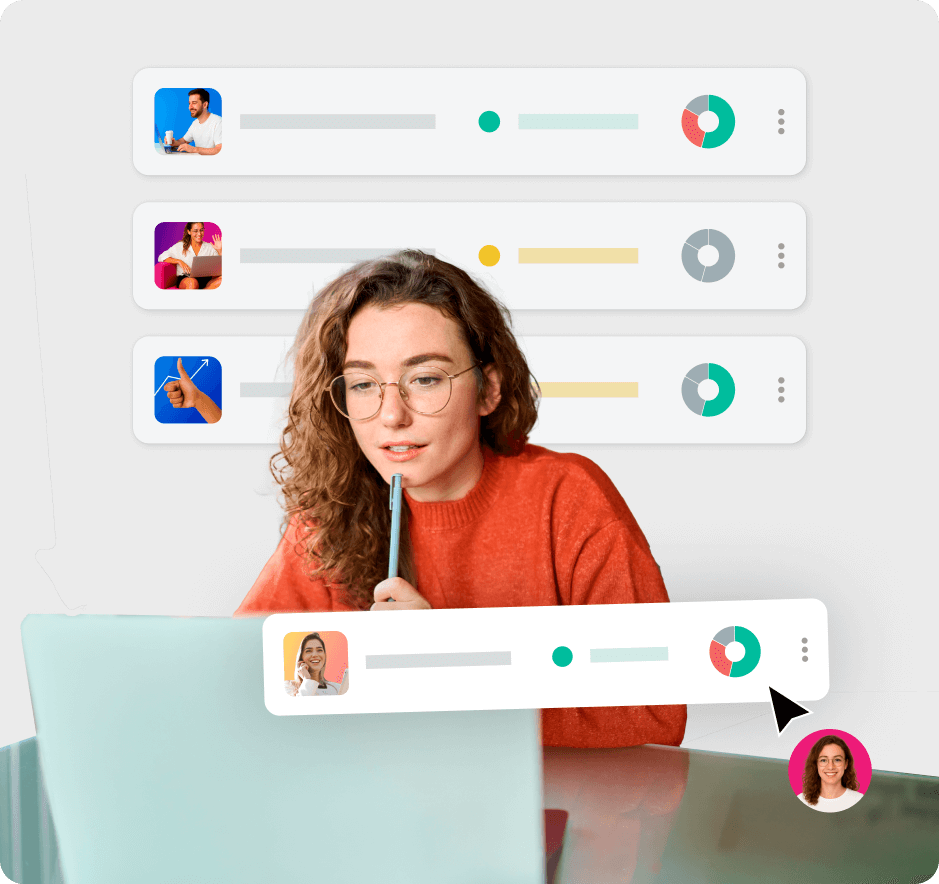
Who approves the agent’s scope, what decisions it can never make, how its answers are reviewed and who’s accountable when it gets something wrong. If it isn’t written down before the first pilot, it won’t be written down afterwards.
And start where a mistake is cheap
The practical recommendation: start with what works for your team before what talks to the workforce. A badly drafted report you fix yourself; a wrong answer about a safety procedure has already reached a hundred people.
What to look for when choosing a learning agent solution
Six questions to take to any demo. All six are uncomfortable to answer with marketing:
- Where exactly do the answers come from? If the answer includes “from the internet” or “from the model”, it won’t do for a compliance context. It has to answer only from your documentation, identifiable and updatable.
- What can it execute without anyone approving it? Ask for the specific list and place it on the autonomy scale. If that list doesn’t exist, the product isn’t ready for production.
- What happens to our data? Whether corporate knowledge stays isolated, whether it’s used to train external models, and what happens to employees’ conversations.
- How is what it did audited? There has to be a queryable log of what it answered, from which source and to whom. Without that you can’t prove anything in an audit.
- What happens when it doesn’t know? The right answer is “it says so and hands off”, not “it tries anyway”. An agent that never admits its limit is a risk, not a feature.
- Who keeps control? Your team has to be able to define the agent’s goals, sources and criteria, and see what’s happening without asking the vendor. If that configuration lives out of your reach, you’ve outsourced the pedagogical judgment.
And a seventh that isn’t technical: is this available today or is it a roadmap? In a category moving this fast, it pays to distinguish what you can deploy this quarter from what is still a plan.
Conclusion: the decision isn’t whether to use agents, but how much autonomy to give them
AI agents are the step from an AI that helps you produce to an AI that takes part in the learning process. For an L&D team, the underlying change isn’t technological: it’s that a layer of decisions appears —what a system can resolve on its own, with what information and under what supervision— that didn’t exist before and that nobody is going to make for you.
If you take away three ideas: knowledge comes before the agent, because an agent connected to disorganized documentation distributes that disorder at scale; tell them apart by who decides the path and not by what the product is called; and start where a mistake is cheap, with what works for your team before what talks to the workforce.
isEazy Brain is the native AI platform that generates adaptive, contextual and conversational training. It turns corporate knowledge into learning agents that adapt, in real time, to each member of the team, always under human control.
One example is Companion, which integrates directly into courses to resolve questions, adapt explanations and provide contextual support to each professional, without altering the mandatory path or the traceability of training in the LMS. That way, Brain makes it possible to turn company knowledge into personalized learning experiences while the L&D team stays in control. If you’d like to see how it works, request a demo.

x
Frequently asked questions about AI agents in training
What’s the difference between an AI agent and a chatbot?
The difference isn’t the quality of the writing, but who decides the path. A chatbot follows routes laid out in advance by whoever configured it: when the conversation leaves those routes, it hands off to a person. An agent works out for itself what steps to take and what tools to use to reach a goal, and it can chain several actions together without anyone walking it through them. In a demo, the question that separates one from the other is simple: who decided the sequence I just saw, the product team or the system in that moment?
Can an AI agent replace the training team?
It replaces tasks, not the function. Hand-crafted content production, the administrative management of assignments and reminders, and the manual building of reports all lose weight. Everything an agent can’t do gains weight: deciding what’s worth training on according to business strategy, curating and validating the documentation the agent draws on, designing what gets assessed and certified, and governing which decisions the system can make on its own. The profile shifts from doing to deciding and verifying, and that second part requires more judgment, not less.
How much autonomy should a learning agent be given?
It depends on the consequences of a mistake. A practical scale distinguishes four levels: suggesting, preparing the work for someone to review, executing with approval at critical points, and executing autonomously within an agreed scope. The rule for corporate training is that the top level is only acceptable where being wrong has no compliance impact: an agent can recommend supplementary content on its own, but it shouldn’t mark a mandatory course as passed without supervision. It’s worth remembering that autonomy isn’t lack of control: even at the highest level the agent works within a scope the organization defines, answers only from approved documentation and leaves a record of what it does. What changes between levels isn’t how much control exists, but when it’s exercised.
Do AI agents comply with GDPR and the EU AI Act?
It depends entirely on how each system is built and deployed, not on the category. What you can require of any vendor is that corporate knowledge stays isolated within the company environment, that the data isn’t used to train external models, and that there’s an auditable record of what was answered, from which source and to whom. On the organization’s side, Article 4 of the EU AI Act has required measures for sufficient AI literacy among the people using these systems since 2 February 2025. Any decision here should be checked with legal advice.
Where should you start with AI agents in training?
Where a mistake is cheap: with what works for your team before what talks to the workforce, because there a professional catches an error before it reaches anyone. Using AI to detect gaps, prepare draft learning paths or write the leadership report are good first cases. In parallel, organize the internal documentation: an agent answers from the company’s knowledge, so a repository with duplicate versions and ownerless documents will produce contradictory answers with complete confidence. The third step, once the foundation is solid, is support inside the course.
What happens to certification if an agent supports the course?
Nothing has to change, and this is one of the criteria for choosing a tool. A well-integrated agent is distributed inside the SCORM package itself, so progress, completion and scores keep being recorded in the LMS, and the mandatory path, the assessment and the certification remain intact. The agent supports the course and resolves questions, but it doesn’t replace the learning journey or alter what an audit is going to review. If a tool forces you to take the learner out of the LMS or breaks the traceability of the path, it stops being viable for regulated training.


Discover more e-learning guides

Antonio González Pozo
June 1, 2026
LMS Implementation: a strategic guide for organisations
Read more

Sara De la Torre
June 19, 2025
The Ultimate LMS Migration Guide: When and How to Switch Learning Platforms Successfully
Read more

Yolanda Amores
August 31, 2026
LMS (Learning Management System): Complete Guide 2026
Read more
