WHITEPAPER
Discover the power skills that will transform your company

Brain
The first AI trained to teach

Author
The #1 AI-powered authoring tool on the market

Factory
Custom e-learning content factory

Skills
Comprehensive power skills course catalog

LMS
All-in-one LMS platform with AI

Engage
App for managing frontline teams
Product

What is Brain?
Everything you need to know about the first AI trained to teach.

How does it work?
Adaptive, conversational, and contextual. That’s learning with Brain.

Security
Why your company’s knowledge never leaves your environment or trains other models.

Comparison
Discover what sets isEazy Brain apart from other AI solutions.

Frequently Asked Questions
Want to learn more? Find answers to all your questions about isEazy Brain here.
FEATURES

AINew
Unlock your full potential and speed up course creation with artificial intelligence.

Accessibility
Automatically meet accessibility guidelines—without sacrificing interactivity!

Interactivity
Boost engagement with interactive, ready-to-use activities that make learning fun.

Course Creation
Reduce the time it takes to create your e-learning courses with our authoring tool.

Distribution
We offer you different distribution options, so that nothing can stop you.

SCORM
Publish your course in SCORM format and share it on any LMS.
SERVICES

Instrucional Design
Surprise your students with multimedia and interactive content.

Custom Courses
We create e-learning courses for you—tailored to your needs and hassle-free!

Virtual Reality
Turn learning into an immersive experience.

Custom Avatars
Give your courses and videos a unique touch with personalized avatars.

Audiovisual FactoryNew
Turn training into something dynamic and visual with engaging videos.
CATALOG

Course catalog
Over 600 skills and competency courses to help you adapt to your team's needs.
Microsoft Copilot AcademyNew
Your professionals will learn how to apply Copilot AI to key processes within your organization.

Artificial Intelligence Academy
Train your teams in the practical use of AI to boost productivity and innovation in your company.

Cybersecurity Academy
Capacita a tu empresa con el catálogo más completo en seguridad digital corporativa.
FEATURES

Learning platform
Manage all your training from one place

Analitycs
Measure the impact of your training

Learning Experience
Offer a unique learning experience to your team
Content Library
Choose from hundreds of expert-created courses
Authoring Tool
Create your own content—faster than ever

Use cases
Choose the solution that best fits your needs

Industries
Solutions for all types of industries
USE CASES

Onboarding
Facilitate the onboarding process, productivity and engagement of your new employees.

Upskilling
Boost your team's skills and prepare them for the challenges of the future with upskilling.

Microlearning
Discover all the advantages of microlearning and boost your training results.

Gamification
Enjoy addictive training that will get your professionals hooked.

Internal Communication
Improve communication in your company and enjoy an aligned and committed team.

Mobile learning
Agile, flexible, and interactive learning—built for today’s digital-first workforce.
INDUSTRIES

Banking and financial services
Training in compliance, cybersecurity, customer service, and key skills development.

Pharmaceuticals and healthcare
Digital onboarding, regulatory updates, and ongoing training for healthcare staff.

Retail and consumer
Agile and scalable training for in-store, operational, and customer service teams.

Industry and manufacturing
Training in processes, safety, and corporate culture for distributed teams.

Education and training
Digital solutions for training centers, internal academies, and corporate universities.

Technology and telecommunications
Development of technical talent, digital skills, and upskilling and reskilling programs.
CLIENTS

MAPFRE
How MAPFRE turn e-learning into sales with isEazy

Pepco
A personalised learning experience for a growing team.

BBVA
Digitisation and creation of high quality e-learning content.

Shiseido
We increase the engagement of the training with a social and gamified app.

Telefónica
Large-scale reskilling for the company's digital transformation.

Vodafone
A personalised learning experience for a growing team.
More than 1,000 companies already rely on isEazy.





MEET ISEAZY

Events
Discover our upcoming events and connect with the future of e-learning.

News
Find out the latest news about isEazy: press releases, partnerships, updates...

Contact
Leave us your personal details and we will contact you as soon as possible.
About isEazyNew
Find out more about our company.

Careers
We are looking for the best talent, join our team!

Partners
Become our partner and grow your business.
INTERESTING RESOURCES

Blog
The best content on e-learning: trends, tools and key strategies.

Whitepapers
Gain valuable insights and stay ahead of industry trends.

Product releases
The latest news and releases of our e-learning products and solutions.

Glossary
Definitions of the most commonly used terms and key industry concepts.

Guides
Discover the best step-by-step tips and tricks to optimize your L&D strategy.

Webinars
Video sessions on our products, trends and more

Comparatives
Compare e-learning solutions available on the market and choose the most suitable one.


WEBINAR
Master AI in isEazy Author in under an hour.




September 21, 2026

CONTENT CREATED BY:

Table of contents
Do you know what skills your team actually has? And which ones your company needs to grow? Talking about talent today means talking about skills — from the most technical to the so-called Power Skills: the competencies that make a difference when it comes to communicating, adapting, and solving problems.
The reality is clear: more and more companies are adopting a skills-based approach because they can no longer afford to make decisions blindly. According to the World Economic Forum in its Future of Jobs 2025 report, 39% of current skills will become obsolete within the next five years. A shortage of people with the right competencies holds back growth, limits innovation, and leaves high-potential profiles out of the market.
That is where a key concept comes in: skills taxonomy. More than a simple list, it is an organized structure for identifying, classifying, and managing your team’s skills. In an environment that changes at breakneck speed, having a skills taxonomy can make the difference between adapting and falling behind.
In this guide, we explain what a skills taxonomy is, why it matters, how to build one step by step, and what mistakes to avoid so it actually works.
A skills taxonomy is an organized map of the skills that exist within your company. It is a structured way to classify and categorize your employees’ skills, grouping them by area, level, and relevance.
That might sound technical, but in practice it is very straightforward. Imagine you have a category called digital skills. Within it, you might have subcategories like: office tools, data analysis, process automation, and collaborative platform management. At the same time, each skill can have proficiency levels (beginner, intermediate, advanced) and be assigned to specific roles within the organization. That classification process is a skills taxonomy.
Unlike a simple skills inventory, a taxonomy does not just list what your employees can do — it establishes relationships between competencies, defines maturity levels, and connects each skill to roles and business goals.
Although these terms are often used interchangeably, they serve different functions within skills management:
| Concept | Main purpose | When to use it |
|---|---|---|
| Skills Taxonomy | Create a shared language about the organization's talent. | When you need to organize and classify all skills across the company. |
| Skills Framework | Define the skills required for each role or career path. | When you want to build competency-based job profiles. |
| Skills Mapping | Detect gaps between existing skills and those required. | When you need to understand your team's current state and find gaps. |
| Skills Ontology | Power AI systems and talent recommendation engines. | When you have an advanced talent platform with AI capabilities. |
Having a skills taxonomy is not just about being organized — it is the foundation for making smarter, more agile, and fairer decisions about talent. According to McKinsey (2023), 87% of organizations already identify skill shortages or expect them in the near term. Without a taxonomy, that gap is nearly impossible to manage systematically.
A taxonomy gives you an accurate, up-to-date picture of your team’s real capabilities — beyond the CV. That means you can respond quickly to changes, restructuring, or new priorities without relying on gut feelings.
Knowing what you have and what you are missing is essential for growth. A solid skills structure lets you spot critical gaps before they become bottlenecks. Companies that proactively identify skill gaps reduce their response time to business changes by up to 40%, according to the Institute for Corporate Productivity (i4cp).
When you know which skills need developing, you can design upskilling and reskilling development plans with a clear purpose aligned to the organization’s goals. No more training just to tick a box.
Move beyond intuition-based decisions. A skills taxonomy lets you match people to roles and projects based on what they can genuinely contribute — not seniority or visibility.
Talent changes, evolves, and transforms. Companies that manage it as a living, measurable asset have a clear competitive advantage. A taxonomy is the infrastructure that makes skills management based on real data possible.
With a clear skills map, you can identify which employees have the right profile to fill an internal vacancy, join a talent marketplace, or follow a development path toward a new role. Strategic internal mobility always starts by knowing what talent you already have.
You now know why a skills taxonomy matters, but how does it translate into concrete actions? Here are the main areas where it makes a real difference:
You do not have to build your taxonomy from scratch. There are global frameworks developed by international organizations that you can use as a base and adapt to your company’s reality. Here are the most relevant ones:
Important: these frameworks are starting points, not templates to copy. Your taxonomy must reflect your organization’s reality: your sector, specific roles, culture, and strategic objectives.
| Reference framework | Organization | Ideal for |
|---|---|---|
| ESCO | European Commission | Companies in Europe; standard for skills and occupations (13,890 skills, 4 levels). |
| WEF Global Skills Taxonomy | World Economic Forum | Global skills benchmarking across sectors and industries. |
| SFIA | SFIA Foundation | IT departments, digital transformation, and cybersecurity (120+ skills, 7 levels). |
| O*NET | U.S. Dept. of Labor | Defining competency-based job profiles (1,000+ occupations). |
You do not need an army of consultants or complicated jargon. Here is a practical guide to building your skills taxonomy from scratch — one that actually works:
What will you use the taxonomy for? Do you want to map talent across the entire company, or start with a key area like IT, sales, or customer service? Defining the scope prevents the project from becoming unmanageable and keeps you focused on what matters most. If it is your first taxonomy, start with the area that has the greatest strategic impact or the most urgent skill gaps.
Decide whether to build from scratch or start from a reference framework (ESCO, SFIA, WEF). The most efficient approach is usually to take an existing framework as a base structure and adapt it to your sector and organizational culture. This saves months of initial cataloguing work.
Keep it simple — do not start with an endless list. Divide by skill type, for example:
It is not enough to know “who has what”. You need to know how well they do it. Define at least three levels per skill:
Every profile within the organization should have an assigned set of skills and expected levels. This helps plan training, identify internal talent, and approach recruiting more strategically. A sales profile does not need the same skills as an IT or operations one.
The market changes, roles evolve, and tools do too. That is why you should involve managers and teams in reviewing and updating the taxonomy regularly. Ideally, review it every six months in fast-moving sectors (tech, digital, banking) and annually in more stable ones.
Do not let all this work end up as a nice-looking document. Integrate your taxonomy into your LMS, performance management system, or any HR tool. That way, everything learned turns into action: automatic learning pathways, assessments, and internal mobility.
A taxonomy that is not measured becomes a forgotten document. Define tracking indicators such as:
CASE STUDY
How Telefónica trained its employees in new skills with a large-scale reskilling plan


Many companies start with good intentions and end up with a document gathering dust. Here are the most frequent mistakes and how to avoid them:
AKRON Group is a great example of how an industrial company can transform its talent strategy by betting on systematic upskilling and reskilling. With isEazy Skills, they implemented a competency-based approach that allowed them to identify gaps, personalize learning journeys, and track team development from a single platform. Find out how they did it →

CASE STUDY
Learn how we helped AKRON Group promote upskilling and reskilling of their workforce

Building a skills taxonomy is the first step. The second — and most important — is connecting it to the real training and development of your employees. That is where isEazy comes in.
isEazy Skills is the tool designed to make sure your taxonomy does not just sit in a document. With it, you can map your team’s skills, automatically detect gaps, and assign personalized learning content based on each person’s profile and level. Everything connected, everything measurable, everything actionable.
And with isEazy LMS, you transform that information into complete learning experiences: competency-based personalized pathways, real progress tracking, and impact measurement at every stage. Our platform combines the power of a Learning Management System with the experience of a Learning Experience Platform to deliver an integrated, visual, agile, and user-centered solution.
Strategic, agile training that is 100% aligned with the talent you want to build. Request a demo and discover how to turn your skills taxonomy into real results.
A skills taxonomy is an organized structure that classifies and groups the skills an organization needs to achieve its goals. It is not just a list — it is a strategic tool that allows you to visualize, manage, and develop talent in a structured way.
It helps identify skill gaps, plan training processes, improve talent selection, and align professional development with real business needs. It is a solid foundation for any upskilling, reskilling, or internal mobility strategy.
A taxonomy organizes and categorizes skills, while a framework adds layers such as proficiency levels, associated behaviors, or measurement criteria. In short, the taxonomy is the map and the framework is the user guide.
By knowing the current skills and those needed in the future, you can design personalized learning paths, create relevant content, and measure the real impact of training. A skills taxonomy turns learning into a growth lever, not just another cost.
Some of the key benefits include: greater talent visibility, improved decision-making, more effective training, capability-based selection processes, and a more agile organization that is ready for change.
Start by defining your objectives and the project scope. Then identify the key skills, organize them by category, define proficiency levels, and map them to specific roles. Finally, integrate this structure into your LMS or talent management tool to bring it to life.
Solutions such as isEazy LMS combine learning management (LMS) with an engaging user experience (LXP), allowing you to activate and maintain your taxonomy in a visual, integrated, and results-oriented way.

Streamline your training management
Experience the power of AI in an LMS that has it all


Automate processes, access 600+ ready-to-use courses, or create your own content with the help of AI.
Request a demoContact us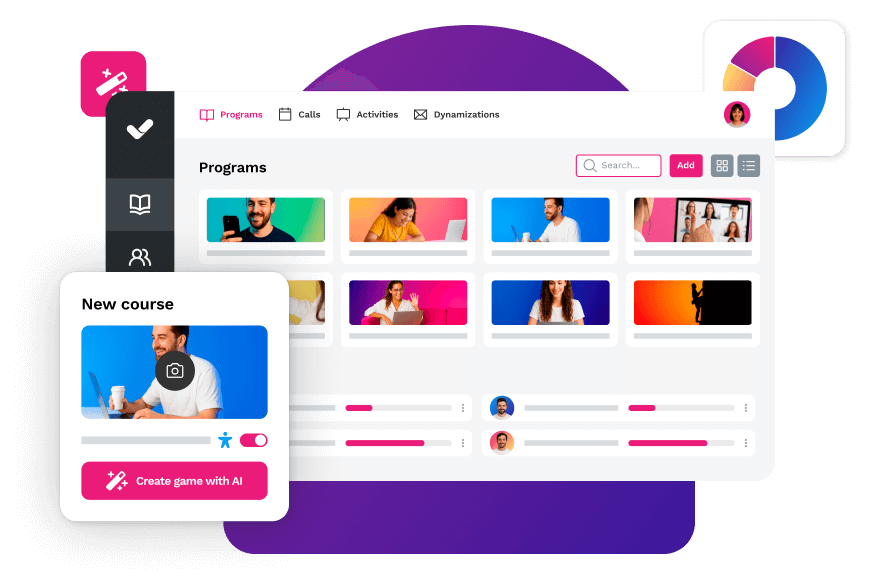
Streamline your training management
Experience the power of AI in an LMS that has it all