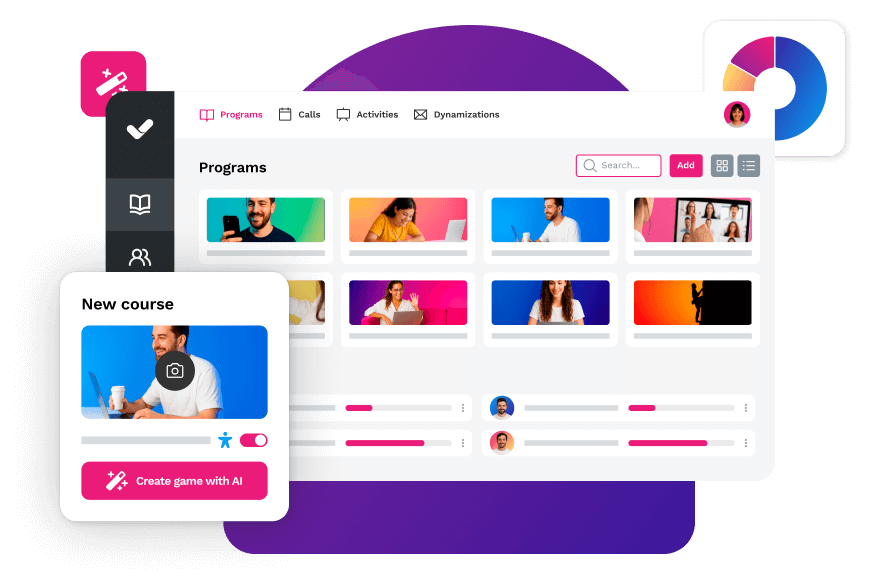
A LXP (learning experience platform) is an employee-centric learning platform that uses AI to recommend personalized content and combines internal, external, and social learning resources. The best LXPs of 2026 stand out for their recommendation engines, content curation capabilities, skills analytics, and integration with everyday work tools.
An LXP (learning experience platform) is a corporate learning platform that puts employees at the center of the learning experience. It uses AI to personalize content based on each user's profile, combines internal and external sources, encourages social learning, and provides an experience as intuitive as Netflix or LinkedIn.
x
Do you need a pure LXP or an LMS+LXP platform?
Before comparing providers, it’s important to make one decision first: what type of solution does your organization need? An LMS focuses on managing learning from the company’s perspective (learning paths, compliance, tracking). An LXP focuses on the employee experience (personalized recommendations, content from multiple sources, social learning). If you want to learn more, we’ve taken an in-depth look at the differences between an LMS and an LXP.
In practice, the choice usually comes down to three scenarios:
LMS+LXP platform: you want to manage compliance training and provide a personalized learning experience from a single tool, without maintaining two systems or duplicating costs. Examples: Docebo, Cornerstone, or isEazy LMS.
Pure LXP: your company already has an LMS for mandatory training and you’re looking to add an experience and upskilling layer on top. Examples from the ranking: Degreed, LinkedIn Learning, or 360Learning.
LMS with basic LXP features: you’re looking for fast implementation and a cost-effective solution, and advanced personalization isn’t a priority. Example: TalentLMS.
Knowing which scenario applies to your organization will help you narrow down the ranking below.
The best LXPs for 2026
You now have all the context you need to start evaluating your options. We’ve organized the ranking according to the three scenarios above, so you can go directly to the type of solution that best fits your organization. For each platform, you’ll find its key differentiators, estimated pricing, G2 rating, ideal customer profile, and main limitations.
All-in-one LMS+LXP platforms
These platforms combine the management, tracking, and compliance capabilities of an LMS with the personalized learning experience of an LXP. They are the most efficient option for organizations looking for a single tool to manage all their corporate learning.
1) isEazy LMS: the all-in-one solution with LXP capabilities
If you’re looking for a training platform that goes beyond the conventional, isEazy LMS is the solution designed for organizations that want the best of an LMS and an LXP in a single tool. With a modern interface and a very low learning curve, isEazy LMS allows you to manage all corporate training — from onboarding to continuous development — with a user experience that drives engagement.
isEazy LMS
The all-in-one LMS platform powered by AI
Features
Benefits
Subscription plans
Industries
Use cases
All-in-one AI-powered LMS: combines learning management and tracking, a library of over 600 ready-to-use courses, and an AI-powered authoring tool for creating proprietary content in one solution.
Engagement and collaboration: includes gamification, mobile learning, certificates, a knowledge library, social learning, and communication channels for sharing relevant news and content.
Integrations and compatibility: connects the LMS with other business tools through SSO, APIs, and custom integrations. It supports SCORM 1.2 and SCORM 2004.
End-to-end learning management: manages learners, groups, roles, permissions, courses, programs, and learning paths from one environment. It automates training campaigns and engagement actions and supports annual learning plans with dynamic filters by audience, department, or company. It can also support administrative requirements such as FUNDAE-funded training in Spain and DC3 and DC4 records in Mexico.
Analytics and reporting: turns learning data into actionable information through visual dashboards and detailed reports. Organizations can review activity, progress, and results by learner, department, audience, subsidiary, or company.
Learning experience: provides an intuitive, customizable interface with content cards for urgent, new, recommended, or pending courses. It also includes news, announcements, and an AI-powered recommender that helps learners discover relevant content.
Content library: provides unlimited access to over 600 ready-to-use courses covering leadership, compliance, soft skills, productivity, artificial intelligence, cybersecurity, and other key areas. Content is available in 8 languages, multiple formats, and is continuously updated.
Built-in AI authoring tool: enables teams to build courses from scratch or import PowerPoint presentations and turn them into interactive content. AI supports translations, voice-overs, subtitles, images, avatar videos, exercises, and final assessments. Courses can be exported in SCORM format.
One solution for the entire learning cycle: brings management, content creation, delivery, a ready-to-use course catalog, and measurement together in one system, reducing the need for separate tools at each stage.
Proven operational capacity: provides a modern environment that helps learners find, resume, and complete assigned training. Its track record includes more than 1.5 million users, 88 million training hours, 400 learning programs, and 94,000 learning activities.
Time and resource efficiency: automates campaigns, assignments, communications, reminders, and reporting, while its AI-powered authoring tool streamlines content creation and updates. Support, consulting, outsourcing, and LMS management services are also available.
Multi-device access: provides learning access from desktop computers, phones, and tablets. Its multi-format library, available in 8 languages, supports international learning programs.
Scalable and flexible: serves both small and medium-sized businesses and large enterprises, with segmentation by department, role, company, location, or audience and plans ranging from 100 learners to enterprise deployments.
Highly customizable: allows organizations to configure colors, logos, messages, login pages, domains, structures, permissions, and learning environments according to their brand and requirements.
International recognition: isEazy LMS was included in Training Industry’s 2025 Top LMS Companies Watch List and received eLearning Industry’s “Most Effective Implementation of AI for Talent Development and Management 2026” recognition.
Professional: up to 100 users, with unlimited courses, unlimited administrators, and unlimited learning environments.
Business: up to 200 users. Includes all Professional features and adds a dedicated manager dashboard.
Enterprise: from 201 users. Includes all Business features, communication channels, a BI reporting module, a dedicated Customer Success Manager, and custom integrations.
Included capabilities: all plans include support, automation, learning management tools, customization, learning experience features, gamification, mobile learning, certificates, reporting, a training catalog, and a course recommender.
Additional services: outsourcing, consulting, custom training, and Training as a Service can be added according to project requirements.
Banking and financial services: manages compliance, cybersecurity, customer service, sales training, and skills development programs for branches, networks, and corporate teams.
Pharmaceutical and healthcare: centralizes onboarding, regulatory updates, product training, and continuous learning for healthcare, sales, and corporate employees.
Retail and consumer goods: delivers agile, segmented learning to store employees, regional managers, sales networks, operations teams, and customer service staff.
Technology and telecommunications: develops technical and digital capabilities through continuous onboarding, certification, upskilling, and reskilling programs.
Manufacturing: manages training on processes, safety, quality, technical skills, and company culture for plants, factories, and distributed teams.
Transportation and logistics: centralizes onboarding, procedural updates, operational safety, and continuous training for drivers, warehouses, and logistics networks.
Consulting and professional services: supports knowledge updates, technical learning, onboarding, and skills development for project- and client-focused teams.
Education and training: manages training providers, internal academies, certification programs, and corporate universities from a customizable environment.
Government and public sector: supports the management, segmentation, and traceability of learning programs for public employees and complex government organizations.
Insurance: keeps sales networks, agents, and back-office teams up to date on regulations, products, processes, and commercial skills.
Energy: manages safety, regulatory, sustainability, operational, and technical learning for internal teams, contractors, and external networks.
Corporate academies: centralizes programs, learning paths, resources, communications, and learning communities to build an internal academy aligned with the organization’s goals and culture.
Onboarding: creates personalized welcome journeys, automates resource assignments, and ensures each new hire receives the required training from day one.
Mandatory training: manages health and safety, equality, compliance, and regulatory programs with automated assignments, certificates, reminders, and full traceability.
Talent development: creates programs and learning paths for different roles, departments, and responsibility levels to support upskilling and reskilling.
Product training: keeps sales teams, customers, partners, and distributors up to date with practical content about products, services, and procedures.
Skills development: combines LMS management with a library of over 600 courses covering leadership, communication, productivity, digital capabilities, and other professional skills.
Features
All-in-one AI-powered LMS: combines learning management and tracking, a library of over 600 ready-to-use courses, and an AI-powered authoring tool for creating proprietary content in one solution.
Engagement and collaboration: includes gamification, mobile learning, certificates, a knowledge library, social learning, and communication channels for sharing relevant news and content.
Integrations and compatibility: connects the LMS with other business tools through SSO, APIs, and custom integrations. It supports SCORM 1.2 and SCORM 2004.
End-to-end learning management: manages learners, groups, roles, permissions, courses, programs, and learning paths from one environment. It automates training campaigns and engagement actions and supports annual learning plans with dynamic filters by audience, department, or company. It can also support administrative requirements such as FUNDAE-funded training in Spain and DC3 and DC4 records in Mexico.
Analytics and reporting: turns learning data into actionable information through visual dashboards and detailed reports. Organizations can review activity, progress, and results by learner, department, audience, subsidiary, or company.
Learning experience: provides an intuitive, customizable interface with content cards for urgent, new, recommended, or pending courses. It also includes news, announcements, and an AI-powered recommender that helps learners discover relevant content.
Content library: provides unlimited access to over 600 ready-to-use courses covering leadership, compliance, soft skills, productivity, artificial intelligence, cybersecurity, and other key areas. Content is available in 8 languages, multiple formats, and is continuously updated.
Built-in AI authoring tool: enables teams to build courses from scratch or import PowerPoint presentations and turn them into interactive content. AI supports translations, voice-overs, subtitles, images, avatar videos, exercises, and final assessments. Courses can be exported in SCORM format.
Benefits
One solution for the entire learning cycle: brings management, content creation, delivery, a ready-to-use course catalog, and measurement together in one system, reducing the need for separate tools at each stage.
Proven operational capacity: provides a modern environment that helps learners find, resume, and complete assigned training. Its track record includes more than 1.5 million users, 88 million training hours, 400 learning programs, and 94,000 learning activities.
Time and resource efficiency: automates campaigns, assignments, communications, reminders, and reporting, while its AI-powered authoring tool streamlines content creation and updates. Support, consulting, outsourcing, and LMS management services are also available.
Multi-device access: provides learning access from desktop computers, phones, and tablets. Its multi-format library, available in 8 languages, supports international learning programs.
Scalable and flexible: serves both small and medium-sized businesses and large enterprises, with segmentation by department, role, company, location, or audience and plans ranging from 100 learners to enterprise deployments.
Highly customizable: allows organizations to configure colors, logos, messages, login pages, domains, structures, permissions, and learning environments according to their brand and requirements.
International recognition: isEazy LMS was included in Training Industry’s 2025 Top LMS Companies Watch List and received eLearning Industry’s “Most Effective Implementation of AI for Talent Development and Management 2026” recognition.
Subscription plans
Professional: up to 100 users, with unlimited courses, unlimited administrators, and unlimited learning environments.
Business: up to 200 users. Includes all Professional features and adds a dedicated manager dashboard.
Enterprise: from 201 users. Includes all Business features, communication channels, a BI reporting module, a dedicated Customer Success Manager, and custom integrations.
Included capabilities: all plans include support, automation, learning management tools, customization, learning experience features, gamification, mobile learning, certificates, reporting, a training catalog, and a course recommender.
Additional services: outsourcing, consulting, custom training, and Training as a Service can be added according to project requirements.
Industries
Banking and financial services: manages compliance, cybersecurity, customer service, sales training, and skills development programs for branches, networks, and corporate teams.
Pharmaceutical and healthcare: centralizes onboarding, regulatory updates, product training, and continuous learning for healthcare, sales, and corporate employees.
Retail and consumer goods: delivers agile, segmented learning to store employees, regional managers, sales networks, operations teams, and customer service staff.
Technology and telecommunications: develops technical and digital capabilities through continuous onboarding, certification, upskilling, and reskilling programs.
Manufacturing: manages training on processes, safety, quality, technical skills, and company culture for plants, factories, and distributed teams.
Transportation and logistics: centralizes onboarding, procedural updates, operational safety, and continuous training for drivers, warehouses, and logistics networks.
Consulting and professional services: supports knowledge updates, technical learning, onboarding, and skills development for project- and client-focused teams.
Education and training: manages training providers, internal academies, certification programs, and corporate universities from a customizable environment.
Government and public sector: supports the management, segmentation, and traceability of learning programs for public employees and complex government organizations.
Insurance: keeps sales networks, agents, and back-office teams up to date on regulations, products, processes, and commercial skills.
Energy: manages safety, regulatory, sustainability, operational, and technical learning for internal teams, contractors, and external networks.
Use cases
Corporate academies: centralizes programs, learning paths, resources, communications, and learning communities to build an internal academy aligned with the organization’s goals and culture.
Onboarding: creates personalized welcome journeys, automates resource assignments, and ensures each new hire receives the required training from day one.
Mandatory training: manages health and safety, equality, compliance, and regulatory programs with automated assignments, certificates, reminders, and full traceability.
Talent development: creates programs and learning paths for different roles, departments, and responsibility levels to support upskilling and reskilling.
Product training: keeps sales teams, customers, partners, and distributors up to date with practical content about products, services, and procedures.
Skills development: combines LMS management with a library of over 600 courses covering leadership, communication, productivity, digital capabilities, and other professional skills.
Pepco, the retail chain present in over 15 European countries, chose isEazy LMS to scale its training across thousands of store employees. With isEazy, Pepco was able to centralize all its training on a single platform, personalize content by country and language, and increase training engagement across its frontline teams. Find out how they did it →
CASE STUDY
How Pepco enhanced its training with a user-centric learning experience platform.
Docebo Learn is an LMS-LXP platform that combines learning management capabilities with user experience features. It stands out for its intuitive interface, integrations with enterprise tools (Salesforce, Teams, BambooHR), and AI engine for content personalization. It is particularly valued in companies that need a balance between centralized management and personalized experience. Price: on request. G2 rating: 4.4/5.
Ideal for: mid-sized and large companies looking for an integrated LMS+LXP solution with strong customization options.
Limitation: price scales quickly and initial implementation can be complex.
Docebo Learn
Designed for large-scale corporate training
Features
Benefits
Pricing/Plans
Learning management (LMS): creation, organization, and tracking of courses and training programs for employees, customers, and partners from a single platform.
Content creation: tools to develop interactive learning materials, with an AI assistant to speed up content production.
Content marketplace: access to over 30,000 courses and certifications from external providers covering areas from leadership to digital skills.
Learning intelligence: AI algorithms to analyze user behavior and deliver personalized recommendations.
E-commerce: sell courses and training programs directly through the platform.
Integrations: with Salesforce, Microsoft Teams, Zoom, HRIS, CRM, and enterprise tools. Compatible with SSO, SCORM, and xAPI.
Customization: AI-driven learning experience tailored to each user, with learning paths based on profile and objectives.
Scalability: designed for large organizations, with the ability to manage multiple audiences from a single platform.
Automation: reduces administrative workload by automating tasks such as enrollments, progress tracking, and report generation.
User experience: intuitive interface with a native mobile app for access from any device.
Pricing based on annual active users and selected product tier. Rates are not publicly listed — contact the sales team for a personalized quote.
Features
Learning management (LMS): creation, organization, and tracking of courses and training programs for employees, customers, and partners from a single platform.
Content creation: tools to develop interactive learning materials, with an AI assistant to speed up content production.
Content marketplace: access to over 30,000 courses and certifications from external providers covering areas from leadership to digital skills.
Learning intelligence: AI algorithms to analyze user behavior and deliver personalized recommendations.
E-commerce: sell courses and training programs directly through the platform.
Integrations: with Salesforce, Microsoft Teams, Zoom, HRIS, CRM, and enterprise tools. Compatible with SSO, SCORM, and xAPI.
Benefits
Customization: AI-driven learning experience tailored to each user, with learning paths based on profile and objectives.
Scalability: designed for large organizations, with the ability to manage multiple audiences from a single platform.
Automation: reduces administrative workload by automating tasks such as enrollments, progress tracking, and report generation.
User experience: intuitive interface with a native mobile app for access from any device.
Pricing/Plans
Pricing based on annual active users and selected product tier. Rates are not publicly listed — contact the sales team for a personalized quote.
3) Cornerstone OnDemand
Cornerstone is one of the most comprehensive talent and learning management platforms on the market, aimed at large global enterprises. Its Cornerstone Learn module combines LMS and LXP with AI for personalization, skills tracking, and workforce planning. It is the most robust solution for enterprise environments with complex compliance requirements, multiple languages, and global talent management needs. Price: on request. G2 rating: 4.1/5.
Ideal for: large corporations with global teams and complex talent management requirements.
Limitation: high implementation complexity, elevated cost, and mobile experience below that of competitors.
Cornerstone on demand
Key features
Ratings
Plans and pricing
Workflows: automation of training processes, enrollments, and compliance tracking to keep the organization always audit-ready.
Talent management tools: personalized learning paths by role, department, or individual, with integrated skills management and career development.
Report generation: customizable dashboards with visibility into training progress, skill gap detection, and compliance tracking.
Exclusive content subscriptions: access to external content catalogs to complement internal training with specialized resources.
Mobile learning and gamification: training accessible from any device, with motivation mechanics to drive engagement and course completion.
Native LXP: personalized learning experience with AI-powered content recommendations tailored to each user’s profile, skills, and career aspirations.
Easy-to-use interface: platform designed to facilitate adoption by both administrators and learners.
Social learning: collaboration and knowledge-sharing tools between employees.
Compliance tracking: management and traceability of regulatory compliance, with automatic workflows and reporting for audits.
SaaS. Compatible with SCORM and xAPI for integration with any standard e-learning content.
Integrations with Salesforce, Microsoft Teams, Workday, and other enterprise HRIS, CRM, and ATS applications.
Capterra Rating: 4.3/5 stars.
G2 Rating: 4.1/5 stars.
Plans vary by institution, features, and number of users. Contact the sales team for a personalized quote.
Key features
Workflows: automation of training processes, enrollments, and compliance tracking to keep the organization always audit-ready.
Talent management tools: personalized learning paths by role, department, or individual, with integrated skills management and career development.
Report generation: customizable dashboards with visibility into training progress, skill gap detection, and compliance tracking.
Exclusive content subscriptions: access to external content catalogs to complement internal training with specialized resources.
Mobile learning and gamification: training accessible from any device, with motivation mechanics to drive engagement and course completion.
Native LXP: personalized learning experience with AI-powered content recommendations tailored to each user’s profile, skills, and career aspirations.
Easy-to-use interface: platform designed to facilitate adoption by both administrators and learners.
Social learning: collaboration and knowledge-sharing tools between employees.
Compliance tracking: management and traceability of regulatory compliance, with automatic workflows and reporting for audits.
SaaS. Compatible with SCORM and xAPI for integration with any standard e-learning content.
Integrations with Salesforce, Microsoft Teams, Workday, and other enterprise HRIS, CRM, and ATS applications.
Ratings
Capterra Rating: 4.3/5 stars.
G2 Rating: 4.1/5 stars.
Plans and pricing
Plans vary by institution, features, and number of users. Contact the sales team for a personalized quote.
Pure LXPs and content libraries
Platforms focused on the employee experience, skills development, and access to learning content. They are particularly well suited as a complementary layer on top of an existing LMS.
4) Degreed
Degreed is an LXP specialized in long-term skills tracking and development. Its strength lies in its ability to map each employee’s competencies, identify skill gaps, and recommend training resources aligned with individual and organizational objectives. It uses AI to curate content from multiple sources and automate learning workflows. Price: on request. G2 rating: 4.1/5.
Ideal for: large organizations that want to build skills frameworks at scale.
Limitation: complex configuration and a dashboard that may feel dense for users without an L&D background.
Degreed
Designed for continuous learning and development
Key features
Ratings
Pricing
Easy-to-use browser experience, mobile app, and integrations with Microsoft Teams and Slack.
Career mobility functionality.
Global skills data.
Flexible and open learning ecosystem.
Personalized and self-directed learning.
Content management lists, learning content sequences, and browsing experiences built around specific topics or skills.
Experiential learning with external content (videos, podcasts, courses, and more).
Multilingual support.
Intuitive interface.
G2 rating: 4.2/5 stars.
Degreed LXP
Degreed LXP+
Plans vary depending on the organization, features, and number of users.
Key features
Easy-to-use browser experience, mobile app, and integrations with Microsoft Teams and Slack.
Career mobility functionality.
Global skills data.
Flexible and open learning ecosystem.
Personalized and self-directed learning.
Content management lists, learning content sequences, and browsing experiences built around specific topics or skills.
Experiential learning with external content (videos, podcasts, courses, and more).
Multilingual support.
Intuitive interface.
Ratings
G2 rating: 4.2/5 stars.
Pricing
Degreed LXP
Degreed LXP+
Plans vary depending on the organization, features, and number of users.
5) 360Learning
360Learning is a collaborative learning platform built around the peer learning model. Its key differentiator is that it enables internal subject matter experts to create and share content quickly, turning the organization’s tacit knowledge into training that’s accessible to everyone. It stands out for its collaboration tools (forums, reactions, in-course comments) and its AI-powered content creation features. Indicative price: from €8/user/month. G2 rating: 4.6/5.
Ideal for: organizations that want to leverage internal knowledge and foster a collaborative learning culture.
Limitation: value diminishes if internal experts don’t actively contribute content.
360Learning
Designed for internal expert-led content co-creation
Strengths
Ideal use cases
Plans
Agile and decentralized authoring: any internal subject matter expert can create courses without instructional design knowledge, accelerating the production and update of internal training content.
Peer collaboration: tools that facilitate knowledge sharing, active participation, and continuous content improvement by the teams themselves.
L&D team automation: built-in AI to reduce administrative tasks such as enrollments, tracking, and reporting, freeing up time for strategic initiatives.
Integration ecosystem: compatible with Microsoft 365/Teams, Google Workspace, Salesforce, SAP SuccessFactors, Zoom, Slack, LinkedIn Learning, Go1, and OpenSesame, among others. API and webhooks available for custom integrations.
Gamification: motivation mechanics to drive engagement and course completion rates.
Analytics and reporting: progress and performance metrics by groups, users, courses, and learning paths, with data export and automated weekly reports.
Internal content co-creation: companies looking to scale training creation by leveraging subject matter experts (SMEs) for fast and continuous updates.
Training agility: organizations that prioritize launching and maintaining training at the pace of the business, with automations and built-in authoring.
Onboarding and operational training: accelerating ramp-up and standardizing practices, including frontline team training.
External training: academies for customers, partners, and sales teams to drive adoption and message consistency.
Team: $8 per registered user per month, up to 100 users. Includes collaborative authoring, learning paths, gamification, integrations, and support with monthly collective onboarding sessions. Optional add-ons at $2/user/month: Coaching, Live (instructor-led training with Zoom/Teams), and Globalization (automatic multilingual support).
Business: custom pricing for large organizations. Includes all Team plan features plus enterprise capabilities, multiple audiences (employees, customers, partners), and dedicated professional services.
Strengths
Agile and decentralized authoring: any internal subject matter expert can create courses without instructional design knowledge, accelerating the production and update of internal training content.
Peer collaboration: tools that facilitate knowledge sharing, active participation, and continuous content improvement by the teams themselves.
L&D team automation: built-in AI to reduce administrative tasks such as enrollments, tracking, and reporting, freeing up time for strategic initiatives.
Integration ecosystem: compatible with Microsoft 365/Teams, Google Workspace, Salesforce, SAP SuccessFactors, Zoom, Slack, LinkedIn Learning, Go1, and OpenSesame, among others. API and webhooks available for custom integrations.
Gamification: motivation mechanics to drive engagement and course completion rates.
Analytics and reporting: progress and performance metrics by groups, users, courses, and learning paths, with data export and automated weekly reports.
Ideal use cases
Internal content co-creation: companies looking to scale training creation by leveraging subject matter experts (SMEs) for fast and continuous updates.
Training agility: organizations that prioritize launching and maintaining training at the pace of the business, with automations and built-in authoring.
Onboarding and operational training: accelerating ramp-up and standardizing practices, including frontline team training.
External training: academies for customers, partners, and sales teams to drive adoption and message consistency.
Plans
Team: $8 per registered user per month, up to 100 users. Includes collaborative authoring, learning paths, gamification, integrations, and support with monthly collective onboarding sessions. Optional add-ons at $2/user/month: Coaching, Live (instructor-led training with Zoom/Teams), and Globalization (automatic multilingual support).
Business: custom pricing for large organizations. Includes all Team plan features plus enterprise capabilities, multiple audiences (employees, customers, partners), and dedicated professional services.
6) LinkedIn Learning
LinkedIn Learning is one of the most widely recognized LXP platforms globally. It combines an extensive library of over 22,000 video courses with personalized recommendations based on each user’s LinkedIn professional profile. It stands out for the quality of its instructors and the constant updating of its catalog across technology, business, and creative skills. Indicative price: from €39.99/month for individuals; corporate pricing on request. G2 rating: 4.4/5.
Ideal for: professional development and upskilling in transversal competencies.
Limitation: limited depth in team reporting and assessment; content cannot be customized by the company.
Linkedin Learning
Funcionalidades
Benefits
Ratings
Content library: provides video-based courses covering business, artificial intelligence, technology, creative, leadership, and professional development skills.
Structured courses: organizes content into chapters and videos so employees can progress step by step.
Learning paths: enables organizations to use LinkedIn Learning paths or create custom journeys with selected courses, videos, and resources.
Content collections: allows administrators to group related courses and videos without requiring a specific completion order.
User and group management: enables organizations to organize employees into different audiences and manage access to learning content.
Assignments and recommendations: courses, paths, and collections can be assigned or recommended to specific users or groups.
Due dates: allows administrators to set completion deadlines for assigned content and send reminders to learners.
Tracking and reporting: provides reports on activity, viewing hours, progress, started content, and completions.
Downloadable reports: enables administrators to customize and export reports filtered by date range, group, learner, or content provider.
LMS integration: allows selected learning management systems to deliver paths and collections and synchronize tracking data.
Web and mobile access: provides access through web browsers and mobile applications for iOS and Android devices.
Offline viewing: enables learners to download courses and videos through the mobile app for offline access.
Certificates of Completion: selected courses and learning paths provide certificates after all required content is completed. These certificates are not equivalent to an external professional accreditation.
On-demand learning: enables learners to access content and progress according to their availability and preferred pace.
Range of topics: includes training on business, technical, digital, creative, and leadership skills.
Different content lengths: combines complete courses with short videos focused on specific concepts or tasks.
Skill-based organization: enables organizations to structure learning through paths and collections related to different development areas.
Audience-based distribution: supports content assignments to individual users, groups, or the entire organization.
Centralized administration: allows administrators to manage users, assignments, recommendations, and learning activity from one environment.
Segmented tracking: provides information by learner, group, content, and reporting period.
Multi-device access: allows learners to continue training from desktop computers, phones, and tablets.
Corporate learning ecosystem integration: content can be distributed through selected LMS solutions with synchronized tracking data.
Capterra: 4.6/5 stars, based on 170 reviews.
G2: 4.4/5 stars, based on approximately 720 reviews.
Rating updates: ratings and review counts may change as new user reviews are published.
Funcionalidades
Content library: provides video-based courses covering business, artificial intelligence, technology, creative, leadership, and professional development skills.
Structured courses: organizes content into chapters and videos so employees can progress step by step.
Learning paths: enables organizations to use LinkedIn Learning paths or create custom journeys with selected courses, videos, and resources.
Content collections: allows administrators to group related courses and videos without requiring a specific completion order.
User and group management: enables organizations to organize employees into different audiences and manage access to learning content.
Assignments and recommendations: courses, paths, and collections can be assigned or recommended to specific users or groups.
Due dates: allows administrators to set completion deadlines for assigned content and send reminders to learners.
Tracking and reporting: provides reports on activity, viewing hours, progress, started content, and completions.
Downloadable reports: enables administrators to customize and export reports filtered by date range, group, learner, or content provider.
LMS integration: allows selected learning management systems to deliver paths and collections and synchronize tracking data.
Web and mobile access: provides access through web browsers and mobile applications for iOS and Android devices.
Offline viewing: enables learners to download courses and videos through the mobile app for offline access.
Certificates of Completion: selected courses and learning paths provide certificates after all required content is completed. These certificates are not equivalent to an external professional accreditation.
Benefits
On-demand learning: enables learners to access content and progress according to their availability and preferred pace.
Range of topics: includes training on business, technical, digital, creative, and leadership skills.
Different content lengths: combines complete courses with short videos focused on specific concepts or tasks.
Skill-based organization: enables organizations to structure learning through paths and collections related to different development areas.
Audience-based distribution: supports content assignments to individual users, groups, or the entire organization.
Centralized administration: allows administrators to manage users, assignments, recommendations, and learning activity from one environment.
Segmented tracking: provides information by learner, group, content, and reporting period.
Multi-device access: allows learners to continue training from desktop computers, phones, and tablets.
Corporate learning ecosystem integration: content can be distributed through selected LMS solutions with synchronized tracking data.
Ratings
Capterra: 4.6/5 stars, based on 170 reviews.
G2: 4.4/5 stars, based on approximately 720 reviews.
Rating updates: ratings and review counts may change as new user reviews are published.
7) Udemy Business
Udemy Business provides access to more than 24,000 courses from its global marketplace, covering everything from programming and data to leadership skills and wellbeing. It includes personalized learning paths, cohort options, and tools to measure training impact. Its strength is the breadth of its catalog and the variety of languages available. Price: on request for businesses. G2 rating: 4.5/5.
Ideal for: companies that need training in technical and digital skills with a wide catalog offering.
Limitation: content quality varies as it’s an open marketplace; content cannot be customized for the company.
Udemy for Business
An online course library
Features
Advantages
Ratings
Udemy for Business Features
User and group management: allows administrators to add or remove users, organize employees into groups, and manage access to content.
Content assignment: enables organizations to assign courses and learning paths to specific employees or teams.
Extensive course library: provides access to a curated collection of courses covering artificial intelligence, technology, business, leadership, compliance, and other professional skills.
Curated and updated content: offers courses selected according to demand, ratings, and subject relevance. Content freshness may vary by course.
Customized learning paths: allows organizations to build learning journeys using Udemy Business courses, proprietary content, and external links.
Progress tracking: includes tools for reviewing employee adoption, activity, engagement, and course progress.
Learning analytics: provides reports on user activity, course performance, and skill development. Advanced capabilities depend on the selected plan.
Web and mobile interface: courses can be accessed through a web browser and mobile applications for iOS and Android.
Corporate tool integrations: the Enterprise Plan supports selected LMS and LXP integrations, single sign-on, and user, course, and reporting APIs.
Udemy for Business Advantages
Centralized administration: supports user, group, assignment, and learning activity management from a single environment.
Assessment resources: selected courses include quizzes, practice tests, and assessments for checking knowledge.
On-demand learning: enables participants to access content and progress according to their availability and preferred learning pace.
Continuous knowledge development: provides access to training focused on in-demand professional and technology skills.
Technical and soft skills development: includes content covering technology, business, leadership, communication, and other workplace skills.
Continuous learning: provides content and recommendations that can support ongoing employee development programs.
Learning tracking: reports and progress data help organizations review participation and completed content.
Adaptability for different organizations: offers separate plans for small teams and larger organizations.
Learning investment analysis: adoption, activity, and progress data help organizations review the use of their subscribed content.
Udemy for Business Ratings
Capterra: 4.5/5 stars, based on 164 reviews.
G2: 4.5/5 stars, based on 712 reviews.
Features
Udemy for Business Features
User and group management: allows administrators to add or remove users, organize employees into groups, and manage access to content.
Content assignment: enables organizations to assign courses and learning paths to specific employees or teams.
Extensive course library: provides access to a curated collection of courses covering artificial intelligence, technology, business, leadership, compliance, and other professional skills.
Curated and updated content: offers courses selected according to demand, ratings, and subject relevance. Content freshness may vary by course.
Customized learning paths: allows organizations to build learning journeys using Udemy Business courses, proprietary content, and external links.
Progress tracking: includes tools for reviewing employee adoption, activity, engagement, and course progress.
Learning analytics: provides reports on user activity, course performance, and skill development. Advanced capabilities depend on the selected plan.
Web and mobile interface: courses can be accessed through a web browser and mobile applications for iOS and Android.
Corporate tool integrations: the Enterprise Plan supports selected LMS and LXP integrations, single sign-on, and user, course, and reporting APIs.
Advantages
Udemy for Business Advantages
Centralized administration: supports user, group, assignment, and learning activity management from a single environment.
Assessment resources: selected courses include quizzes, practice tests, and assessments for checking knowledge.
On-demand learning: enables participants to access content and progress according to their availability and preferred learning pace.
Continuous knowledge development: provides access to training focused on in-demand professional and technology skills.
Technical and soft skills development: includes content covering technology, business, leadership, communication, and other workplace skills.
Continuous learning: provides content and recommendations that can support ongoing employee development programs.
Learning tracking: reports and progress data help organizations review participation and completed content.
Adaptability for different organizations: offers separate plans for small teams and larger organizations.
Learning investment analysis: adoption, activity, and progress data help organizations review the use of their subscribed content.
Ratings
Udemy for Business Ratings
Capterra: 4.5/5 stars, based on 164 reviews.
G2: 4.5/5 stars, based on 712 reviews.
LMS platforms with LXP features
Learning management systems that incorporate LXP features such as gamification, social learning, or recommendations. They are a good option for fast implementation or for organizations with a strong focus on compliance.
8) TalentLMS
TalentLMS is one of the most popular platforms on the market for its ease of use and accessibility for companies of any size. In 2026 it has strengthened its capabilities with TalentCraft, its AI-powered course creation tool that automates the generation of course outlines, content, and quizzes. Price from €119/month (Starter plan, up to 40 users). G2 rating: 4.6/5.
Ideal for: companies that need a functional, quick-to-deploy platform with a strong price-to-value ratio.
Limitation: advanced LXP features (adaptive personalization, deep social learning) are more limited than in pure LXP solutions.
TalentLMS
Designed for small businesses
Features
Benefits
Technology, compatibility, and integration
Pricing
Learning paths: step-by-step journeys with connected courses, unlockable in sequence to personalize learning and reinforce knowledge over time.
Detailed reports: real-time, scheduled, and custom reports on learner progress, completions, and certifications. Includes an activity timeline for audit purposes.
Social learning, mobile learning, and gamification: built-in discussion forums, native iOS and Android app with offline access, and gamification mechanics with points, badges, levels, and leaderboards.
Mass actions: update multiple users or courses in just a few clicks, including enrollments, deactivations, and group assignments.
Platform customization: white-labeling with custom logo, colors, and domain. Option for a custom mobile app with your company’s branding.
Blended learning: combine self-paced courses with in-person or virtual instructor-led training. Compatible with integrated videoconferencing tools.
E-commerce: sell individual courses or subscriptions with support for discounts, coupons, and payments via PayPal and Stripe.
Responsive design and intuitive interface: quick setup with no complex configuration, accessible from any device.
Scalability: flexible plans with a Flex option for unlimited users, with no hard limits on Pro and Enterprise plans.
Compatible with SCORM, xAPI, and cmi5 for full compatibility with standard e-learning content.
Integrations with HRIS, CRM, and communication tools via native connectors, REST API, and Zapier.
SSO for simplified access using existing corporate credentials.
SaaS, cloud-based.
Core: from $69 USD/month for up to 100 users.
Grow: from $109 USD/month for up to 500 users.
Pro: from $139 USD/month for up to 1,000 users.
Enterprise: from 1,000 users, custom plan.
Free plan available with basic features, no time limit.
Features
Learning paths: step-by-step journeys with connected courses, unlockable in sequence to personalize learning and reinforce knowledge over time.
Detailed reports: real-time, scheduled, and custom reports on learner progress, completions, and certifications. Includes an activity timeline for audit purposes.
Social learning, mobile learning, and gamification: built-in discussion forums, native iOS and Android app with offline access, and gamification mechanics with points, badges, levels, and leaderboards.
Mass actions: update multiple users or courses in just a few clicks, including enrollments, deactivations, and group assignments.
Platform customization: white-labeling with custom logo, colors, and domain. Option for a custom mobile app with your company’s branding.
Benefits
Blended learning: combine self-paced courses with in-person or virtual instructor-led training. Compatible with integrated videoconferencing tools.
E-commerce: sell individual courses or subscriptions with support for discounts, coupons, and payments via PayPal and Stripe.
Responsive design and intuitive interface: quick setup with no complex configuration, accessible from any device.
Scalability: flexible plans with a Flex option for unlimited users, with no hard limits on Pro and Enterprise plans.
Technology, compatibility, and integration
Compatible with SCORM, xAPI, and cmi5 for full compatibility with standard e-learning content.
Integrations with HRIS, CRM, and communication tools via native connectors, REST API, and Zapier.
SSO for simplified access using existing corporate credentials.
SaaS, cloud-based.
Pricing
Core: from $69 USD/month for up to 100 users.
Grow: from $109 USD/month for up to 500 users.
Pro: from $139 USD/month for up to 1,000 users.
Enterprise: from 1,000 users, custom plan.
Free plan available with basic features, no time limit.
9) Absorb LMS
Absorb is a platform focused on compliance training and managing distributed teams. It offers a clean interface, advanced training workflow automation, and detailed analytics for compliance tracking. Its AI engine, Absorb Amplify, enables intelligent curation of external content. Price: on request. G2 rating: 4.7/5.
Ideal for: regulated industries (banking, healthcare, manufacturing) and organizations that prioritize compliance training.
Limitation: advanced customization is limited; price increases significantly as the number of users scales.
Absorb LMS
Designed for an intuitive user experience
Features
Advantages
Technology
Pricing
Absorb LMS Features
Built-in authoring tool.
Learning paths.
Reporting and analytics.
Learner and course dashboards.
Mobile learning and gamification.
Advantages of Absorb LMS
Content library.
Ready-to-use learning content.
User-friendly interface.
Personalized learning experiences.
Absorb LMS Technology
SaaS (Software as a Service).
SCORM compliant.
Support.
Integration with HCM software, CRM systems, or other applications.
Absorb LMS Pricing
Custom pricing. Varies by institution and number of users.
Features
Absorb LMS Features
Built-in authoring tool.
Learning paths.
Reporting and analytics.
Learner and course dashboards.
Mobile learning and gamification.
Advantages
Advantages of Absorb LMS
Content library.
Ready-to-use learning content.
User-friendly interface.
Personalized learning experiences.
Technology
Absorb LMS Technology
SaaS (Software as a Service).
SCORM compliant.
Support.
Integration with HCM software, CRM systems, or other applications.
Pricing
Absorb LMS Pricing
Custom pricing. Varies by institution and number of users.
Key features of the best LXPs
Not all learning experience platforms are equal. These are the capabilities that set the best on the market apart — and that you should demand when evaluating your options:
AI-driven personalization: the platform automatically recommends content based on each user’s role, interests, learning history, and goals. The more the platform is used, the more precise the recommendations become.
Interactivity and gamification: incorporates game elements such as badges, leaderboards, and challenges that sustain motivation and increase completion rates. According to the LinkedIn Workplace Learning Report 2024, 94% of employees would stay longer at a company that invests in their development.
Social and collaborative learning: forums, learning groups, comments, and peer-generated content. Knowledge no longer flows only from company to employee — it flows between colleagues.
Native mobile experience: employees access training from any device, at any time, without compromising the quality of the experience.
Integration with business tools: native connections to HRIS, LMS, CRM, and productivity platforms to synchronize data and eliminate information silos.
Advanced analytics: engagement metrics, skills progression, most-consumed content, and program effectiveness — not just completion rates.
Adaptive learning pathways: paths that dynamically adjust to each user’s progress and performance, accelerating competency development.
AI-powered LXPs: trends transforming corporate training in 2026
The integration of artificial intelligence into learning experience platforms is accelerating a profound transformation in how organizations manage talent development. These are the most relevant trends shaping the LXP landscape in 2026:
Real-time adaptive personalization: AI engines analyze user behavior during training and dynamically adjust content, pace, and format. This isn’t about assigning a predefined path — it’s about continuously adapting it based on progress.
Generative recommendations: large language models (LLMs) enable platforms to generate content summaries, adaptive quizzes, and micro-content on the fly, reducing the dependency on instructional design teams for constant catalog updates.
AI learning agents: beyond support chatbots, AI learning agents act as virtual tutors that accompany employees throughout their learning journey, answer contextual questions, reinforce knowledge, and propose adaptive challenges. This is the most significant qualitative leap in L&D in recent years.
Predictive skills analytics: the most advanced platforms cross-reference learning data with performance metrics and internal mobility data to anticipate which skills the organization will need in 6–12 months, enabling more proactive talent planning.
Learning in the flow of work: training is no longer consumed in a separate environment, but integrated into everyday tools (Teams, Slack, Salesforce) at the precise moment employees need the knowledge.
According to MarketsandMarkets, the global LXP market is projected to reach $24 billion by 2027, driven by AI adoption and the growth of self-directed learning in corporate environments.
How to choose the right LXP for your organization
With so many options available, the selection process can feel overwhelming. Here are the key criteria to evaluate before making a decision:
Personalization and user experience
Personalized learning is the heart of a good LXP. Evaluate whether the platform adapts its recommendations dynamically based on each user’s profile, behavior, and goals. An intuitive, attractive interface that is accessible from any device is equally critical to ensuring adoption by employees.
Integration with your technology ecosystem
A good LXP cannot live in isolation. Verify that the platform integrates with your current systems: HRIS, CRM, collaboration tools (Teams, Slack), and — if you have one — your existing LMS. Native integrations are preferable to generic connectors, which can create friction and require maintenance. If you already use an LMS, consider whether an integrated LMS+LXP solution could simplify your learning stack.
Scalability and customization
The platform must grow with you. Evaluate whether it can handle a growing number of users without compromising the experience, and whether it allows you to customize the environment (colors, domain, content structure) to align with your brand. Scalability also includes multilingual support if you have international teams.
Intuitive interface for end users
An LXP that employees don’t use is worthless. Ease of use and speed of adoption are critical factors. Always request a trial period or a demo with real users before making your final decision.
Analytics and reporting
Dashboards must go beyond completion rates. Look for platforms that offer engagement metrics, skills progression, most-consumed content, and the correlation between training and performance. A solid learning analytics system is fundamental to justifying the ROI of your L&D investment.
Does it perform the same with 100 as with 10,000 users?
The platform must grow with you
Analytics
Does it measure engagement and progression, not just completion?
Necessary to justify ROI
LXPs are redefining corporate training — are you ready?
Learning experience platforms have gone from being an emerging trend to becoming a strategic tool for organizations committed to continuous talent development. In an environment where skill half-lives are shrinking and employees expect training experiences as personalized as their entertainment platforms, investing in a good LXP — or in a solution that integrates LMS and LXP — is a decision that directly impacts retention, performance, and organizational competitiveness.
The key isn’t choosing the most feature-rich platform, but the one that best fits your goals, your learning culture, and your technology ecosystem. And if you’d like to explore how isEazy LMS can fill that role in your organization, talk to our team or request a no-commitment demo.
An LXP, or learning experience platform, is a training platform focused on the user experience. Unlike a traditional LMS, which manages and organizes training in a top-down manner, an LXP puts the employee at the center: it delivers personalized content based on their interests and behaviors, combines internal and external sources, encourages social learning, and uses AI to recommend relevant resources. The goal is to make learning feel as natural and intuitive as consuming content on streaming platforms or social media.
What is the difference between an LXP and an LMS?
The main difference lies in their focus. An LMS (Learning Management System) is a management tool: it organizes training in a structured, company-controlled way, with predefined learning paths and compliance tracking. An LXP (Learning Experience Platform) focuses on the user experience: it delivers personalized recommendations, enables self-directed learning, and combines internal and external content. While the LMS answers “what should the employee learn?”, the LXP answers “what does the employee want to learn and how do they learn best?” Many organizations use both in a complementary way, or opt for solutions that integrate LMS and LXP capabilities into a single platform.
How does an LXP improve employee engagement?
LXPs improve learning engagement in several ways. First, personalization: by recommending content based on each employee’s role, interests, and learning history, the material becomes more relevant and useful. Second, user experience: the best LXPs feature intuitive, attractive interfaces similar to consumer platforms, reducing friction when accessing training. Third, gamification and social learning: badges, leaderboards, learning groups, and forums drive motivation and a sense of community. According to the LinkedIn Workplace Learning Report 2024, 94% of employees say they would stay longer at a company that invests in their professional development, underscoring the importance of delivering high-quality learning experiences.
What features should I look for in an LXP?
The most important features to evaluate in an LXP are: (1) AI-powered learning personalization that automatically adapts recommended content to each user. (2) Multi-format, multi-source content curation, enabling integration of internal and external resources (videos, podcasts, courses, articles). (3) Social and collaborative learning, with forums, groups, and peer-generated content. (4) Native mobile experience, allowing access from any device at any time. (5) Advanced analytics, with engagement metrics, skills progression tracking, and completion rates by user and team. (6) Integration with the company’s technology ecosystem (HRIS, LMS, CRM). (7) An intuitive interface with a low learning curve for end users. (8) Multilingual support, especially relevant for organizations with international teams.
Is an LXP suitable for small businesses?
Yes, although it depends on the size and needs of the organization. LXPs deliver the highest ROI in medium to large organizations (100–200+ employees), where scale justifies the investment and personalization adds the most value. For smaller teams, it may be more efficient to start with an LMS that includes enhanced user experience features, and gradually move toward a more comprehensive LXP solution as the business grows. In any case, there are now solutions that combine LMS and LXP capabilities in a single platform, giving companies of any size access to the best of both worlds without the need to maintain two separate tools.
How much does it cost to implement an LXP?
The cost of an LXP varies greatly depending on the platform, the number of users, and the features included. As a general reference: entry-level or small-business solutions can start from $5–25/user/month; platforms for mid-sized companies typically fall in the $30–75/user/month range; and enterprise solutions with advanced personalization can exceed $100/user/month. On top of these figures, you need to factor in initial setup costs, content migration, admin team training, and ongoing technical support. This is why many organizations opt for all-in-one solutions that integrate LMS and LXP in a single platform — simplifying management and reducing the total cost of ownership compared to maintaining two separate tools.
Streamline your training management
Experience the power of AI in an LMS that has it all
Here you can assess and customize the services that we'd like to use on this website. You're in charge! Enable or disable services as you see fit. To learn more, please read our .
We have to include them in order for certain web pages to function securely. These cookies are strictly necessary, so they cannot be rejected or modified.
Cookie
Duration
Description
_ga
2 years
The _ga cookie, installed by Google Analytics, calculates visitor, session and campaign data and also keeps track of site usage for the site's analytics report. The cookie stores information anonymously and assigns a randomly generated number to recognize unique visitors.
_ga_YW3LY84JY6
2 years
This cookie is installed by Google Analytics.
_gat_gtag_UA_90425332_3
1 minute
Set by Google to distinguish users.
_gat_UA-26043609-7
1 minute
A variation of the _gat cookie set by Google Analytics and Google Tag Manager to allow website owners to track visitor behaviour and measure site performance. The pattern element in the name contains the unique identity number of the account or website it relates to.
_gat_UA-90425332-3
1 minute
A variation of the _gat cookie set by Google Analytics and Google Tag Manager to allow website owners to track visitor behaviour and measure site performance. The pattern element in the name contains the unique identity number of the account or website it relates to.
_gcl_au
3 months
Provided by Google Tag Manager to experiment advertisement efficiency of websites using their services.
_gid
1 day
Installed by Google Analytics, _gid cookie stores information on how visitors use a website, while also creating an analytics report of the website's performance. Some of the data that are collected include the number of visitors, their source, and the pages they visit anonymously.
_icl_visitor_lang_js
1 day
This cookie is stored by WPML WordPress plugin. The purpose of the cookie is to store the redirected language.
Bootstrap
11 months
Bootstrap code
cookielawinfo-checkbox-advertisement
1 year
Set by the GDPR Cookie Consent plugin, this cookie is used to record the user consent for the cookies in the "Advertisement" category .
cookielawinfo-checkbox-analytics
11 months
This cookie is set by GDPR Cookie Consent plugin. The cookie is used to store the user consent for the cookies in the category "Analytics".
cookielawinfo-checkbox-functional
11 months
The cookie is set by GDPR cookie consent to record the user consent for the cookies in the category "Functional".
cookielawinfo-checkbox-nece
1 year
Cookie law info
cookielawinfo-checkbox-necessary
11 months
This cookie is set by GDPR Cookie Consent plugin. The cookies is used to store the user consent for the cookies in the category "Necessary".
cookielawinfo-checkbox-others
11 months
This cookie is set by GDPR Cookie Consent plugin. The cookie is used to store the user consent for the cookies in the category "Other.
cookielawinfo-checkbox-performance
11 months
This cookie is set by GDPR Cookie Consent plugin. The cookie is used to store the user consent for the cookies in the category "Performance".
CookieLawInfoConsent
1 year
Records the default button state of the corresponding category & the status of CCPA. It works only in coordination with the primary cookie.
Google Font API
11 months
Google Font API
IDE
1 year 24 days
Google DoubleClick IDE cookies are used to store information about how the user uses the website to present them with relevant ads and according to the user profile.
Pardot
11 months
The pardot cookie is set while the visitor is logged in as a Pardot user. The cookie indicates an active session and is not used for tracking.
test_cookie
15 minutes
The test_cookie is set by doubleclick.net and is used to determine if the user's browser supports cookies.
viewed_cookie_policy
11 months
The cookie is set by the GDPR Cookie Consent plugin and is used to store whether or not user has consented to the use of cookies. It does not store any personal data.
wp-wpml_current_language
session
Language cookies
wpml_browser_redirect_test
session
This cookie is set by WPML WordPress plugin and is used to test if cookies are enabled on the browser.
They collect information in order to measure, evaluate performance, and improve the quality of your experience on our site.
Cookie
Duration
Description
_ga
2 years
The _ga cookie, installed by Google Analytics, calculates visitor, session and campaign data and also keeps track of site usage for the site's analytics report. The cookie stores information anonymously and assigns a randomly generated number to recognize unique visitors.
_ga_YW3LY84JY6
2 years
This cookie is installed by Google Analytics.
_gat_gtag_UA_90425332_3
1 minute
Set by Google to distinguish users.
_gat_UA-26043609-7
1 minute
A variation of the _gat cookie set by Google Analytics and Google Tag Manager to allow website owners to track visitor behaviour and measure site performance. The pattern element in the name contains the unique identity number of the account or website it relates to.
_gat_UA-90425332-3
1 minute
A variation of the _gat cookie set by Google Analytics and Google Tag Manager to allow website owners to track visitor behaviour and measure site performance. The pattern element in the name contains the unique identity number of the account or website it relates to.
_gcl_au
3 months
Provided by Google Tag Manager to experiment advertisement efficiency of websites using their services.
_gid
1 day
Installed by Google Analytics, _gid cookie stores information on how visitors use a website, while also creating an analytics report of the website's performance. Some of the data that are collected include the number of visitors, their source, and the pages they visit anonymously.
_icl_visitor_lang_js
1 day
This cookie is stored by WPML WordPress plugin. The purpose of the cookie is to store the redirected language.
wpml_browser_redirect_test
session
This cookie is set by WPML WordPress plugin and is used to test if cookies are enabled on the browser.
We use them to provide you with efficient and personalized advertisements that we believe are relevant to your interests. You may see them on other sites that you visit.
Cookie
Duration
Description
IDE
1 year 24 days
Google DoubleClick IDE cookies are used to store information about how the user uses the website to present them with relevant ads and according to the user profile.
test_cookie
15 minutes
The test_cookie is set by doubleclick.net and is used to determine if the user's browser supports cookies.