WHITEPAPER
The power skills shaping the future of your company. Are you developing them?

BrainNew
The first AI trained to teach

Author
The #1 AI-powered authoring tool on the market

Factory
Custom e-learning content factory

Skills
Comprehensive power skills course catalog

LMS
All-in-one LMS platform with AI

Engage
App for managing frontline teams
Product

What is Brain?
Everything you need to know about the first AI trained to teach.

How does it work?
Adaptive, conversational, and contextual. That’s learning with Brain.

Security
Why your company’s knowledge never leaves your environment or trains other models.

Comparison
Discover what sets isEazy Brain apart from other AI solutions.

Frequently Asked Questions
Want to learn more? Find answers to all your questions about isEazy Brain here.
FEATURES

AINew
Unlock your full potential and speed up course creation with artificial intelligence.

Accessibility
Automatically meet accessibility guidelines—without sacrificing interactivity!

Interactivity
Boost engagement with interactive, ready-to-use activities that make learning fun.

Course Creation
Reduce the time it takes to create your e-learning courses with our authoring tool.

Distribution
We offer you different distribution options, so that nothing can stop you.

SCORM
Publish your course in SCORM format and share it on any LMS.
SERVICES

Instrucional Design
Surprise your students with multimedia and interactive content.

Custom Courses
We create e-learning courses for you—tailored to your needs and hassle-free!

Virtual Reality
Turn learning into an immersive experience.

Custom Avatars
Give your courses and videos a unique touch with personalized avatars.

Audiovisual FactoryNew
Turn training into something dynamic and visual with engaging videos.
CATALOG

Course catalog
Over 600 skills and competency courses to help you adapt to your team's needs.
Microsoft Copilot AcademyNew
Your professionals will learn how to apply Copilot AI to key processes within your organization.

Artificial Intelligence Academy
Train your teams in the practical use of AI to boost productivity and innovation in your company.

Cybersecurity Academy
Capacita a tu empresa con el catálogo más completo en seguridad digital corporativa.

Use cases
Choose the solution that best fits your needs

Industries
Solutions for all types of industries
USE CASES

Onboarding
Facilitate the onboarding process, productivity and engagement of your new employees.

Upskilling
Boost your team's skills and prepare them for the challenges of the future with upskilling.

Microlearning
Discover all the advantages of microlearning and boost your training results.

Gamification
Enjoy addictive training that will get your professionals hooked.

Internal Communication
Improve communication in your company and enjoy an aligned and committed team.

Mobile learning
Agile, flexible, and interactive learning—built for today’s digital-first workforce.
INDUSTRIES

Banking and financial services
Training in compliance, cybersecurity, customer service, and key skills development.

Pharmaceuticals and healthcare
Digital onboarding, regulatory updates, and ongoing training for healthcare staff.

Retail and consumer
Agile and scalable training for in-store, operational, and customer service teams.

Industry and manufacturing
Training in processes, safety, and corporate culture for distributed teams.

Education and training
Digital solutions for training centers, internal academies, and corporate universities.

Technology and telecommunications
Development of technical talent, digital skills, and upskilling and reskilling programs.
CLIENTS

MAPFRE
How MAPFRE turn e-learning into sales with isEazy

Pepco
A personalised learning experience for a growing team.

BBVA
Digitisation and creation of high quality e-learning content.

Shiseido
We increase the engagement of the training with a social and gamified app.

Telefónica
Large-scale reskilling for the company's digital transformation.

Vodafone
A personalised learning experience for a growing team.
More than 1,000 companies already rely on isEazy.





MEET ISEAZY

News
Find out the latest news about isEazy: press releases, partnerships, updates...

Contact
Leave us your personal details and we will contact you as soon as possible.
About isEazyNew
Find out more about our company.

Careers
We are looking for the best talent, join our team!

Partners
Become our partner and grow your business.
INTERESTING RESOURCES

Blog
The best content on e-learning: trends, tools and key strategies.

Whitepapers
Gain valuable insights and stay ahead of industry trends.

Product releases
The latest news and releases of our e-learning products and solutions.

Glossary
Definitions of the most commonly used terms and key industry concepts.

Guides
Discover the best step-by-step tips and tricks to optimize your L&D strategy.

Webinars
Video sessions on our products, trends and more

Comparatives
Compare e-learning solutions available on the market and choose the most suitable one.


GUIDE
Prepare your organization to comply with the new AI regulations

Stay up to date with all our latest news
 Subscribe to our newsletter
 Stay up to date with all our latest news

December 10, 2025

CONTENT CREATED BY:

Table of contents
Understanding what your team knows—and what they need to learn—has become one of the most important tasks for any HR or L&D department. But the reality is that, in many companies, the skills inventory list is still a static document that gets updated from time to time… and becomes outdated just a few months later.
Today, the skills landscape changes much faster: new roles appear, digitalization accelerates processes, and business needs evolve almost daily. For this reason, a modern approach is no longer just about “collecting skills,” but about having a system that allows you to evaluate them, update them, connect them with real training, and make data-driven decisions.
In this context, the skills inventory has stopped being a one-off task and has become a necessary, ongoing practice that helps organizations understand their talent more effectively, anticipate needs, and plan training with greater precision. In this article, we will explore what a skills inventory is, how this approach has evolved, why it is key for people strategy, and what elements it should include.
Traditionally, the skills inventory has been understood as a list: a document where technical abilities, soft skills, and some previous experience were noted down. However, it is actually a systematic compilation of employees’ skills, experiences, and training.
Unlike a simple list, a skills inventory provides a comprehensive profile of what your workforce can contribute. It tracks everything from technical capabilities to soft skills needed in different roles, creating a holistic view of the organization’s talent. Think of it as a map that informs talent management decisions by aligning employee skills with business objectives. While this is not an incorrect approach, it no longer works today—not because it’s wrong, but because it falls short given the speed at which companies now change.
Today, a skills inventory is not a static snapshot: it’s a system that helps you see what your team knows now, what they should know in the future, and what steps you can take to close that gap. And to make this work, having information is not enough; you need to connect data with training, follow-up, and real impact. This shift requires three major changes:
Skills are no longer measured once a year. They update every time someone completes training, passes an assessment, or changes roles. The inventory is fed by everyday activity.
It’s not just about cataloging competencies, but about understanding whether the team is ready for upcoming objectives—and, if not, what learning path can help.
Doing evaluations in one place, storing data in another, and assigning courses somewhere else only complicates the process. A unified tool simplifies everything: it evaluates, detects gaps, assigns training, and shows results.
Put simply: a useful skills inventory is not the one that collects the most information, but the one that most effectively enables action.
Although the terms skills inventory and skills audit are often used interchangeably, they represent different concepts. A skills inventory is a proactive, ongoing collection of skills data, while a skills audit typically happens at specific intervals to evaluate current skill levels against organizational demands. Understanding this distinction ensures that your skills management approach is both strategic and continuous, while also helping you choose a methodology that addresses both needs in a single process.
WHITEPAPER
The power skills shaping the future of your company. Are you developing them?


For a long time, building a skills inventory followed a similar pattern in most companies. The first step was deciding which skills to measure: technical skills, soft skills, leadership, languages… This usually involved meetings with managers or internal workshops to agree on what should be included.
Next came the evaluation phase, typically through surveys, self-assessments, or peer reviews. Once all information was collected, it needed to be launched as an “internal campaign” to ensure participation—something that often took longer than expected.
With the results in hand, the next step was to build a matrix: a document showing which skills each person had and which they needed to develop. From there, skill gaps could be identified, training could be planned, or even hiring needs could be detected.
Finally, everything had to be kept up to date, which was not easy. The data had to be reviewed regularly, assessments reopened, and matrices adjusted every time a role changed or a new tool was introduced.
At the time, this process made sense—but it also required a lot of manual work, disconnected tools, and data that became outdated far too quickly.
o begin with, skills evolve much faster than the ability to update them manually. Every new tool, process, or shift in business strategy requires reviewing competencies—and it’s impossible to keep an inventory up to date if it depends on sporadic updates.
In addition, traditional inventories often stop at data collection, without connecting that information to what truly matters: how the team is developing, how they are receiving and applying new knowledge, what capabilities are missing to achieve objectives, or which development plans will make a real difference.
Another common issue is that information tends to be spread across multiple sources: evaluations in one place, training data in another, role documentation in different folders… Getting a clear picture becomes difficult, and using that data to make decisions is even harder.
Lastly, there’s the human factor: when the process is manual, lengthy, or unintuitive, participation drops, the data loses quality, and the inventory stops reflecting reality.
Because of all this, the classic model falls short. Today, companies need an approach that allows them to obtain continuous information, connect skills with actionable steps, and keep knowledge updated without relying on heavy processes or one-off campaigns.
Today, organizations that want to truly understand their team’s capabilities need a more dynamic approach—one that connects information, training, and professional development continuously.
A modern inventory is based on a simple principle: skills change, and the system that manages them must change too. This means shifting from collecting data once a year to maintaining a living process that updates every time someone learns something new, changes roles, or acquires relevant experience.
Furthermore, it’s no longer enough to know “what each person knows.” The key lies in connecting this information to the real needs of the business: which skills are critical, which teams have the most gaps, which roles are evolving, and what training can close those gaps.
Another important aspect is traceability. A modern approach allows organizations to see how talent moves internally, which competencies are growing faster, and which areas need additional support. This turns the inventory into a useful tool not only for HR, but also for managers and team leaders.
In short, a current skills inventory is not a list nor a one-time campaign—it’s a continuous system that combines evaluation, updates, and action. A system that not only describes reality but helps improve it.
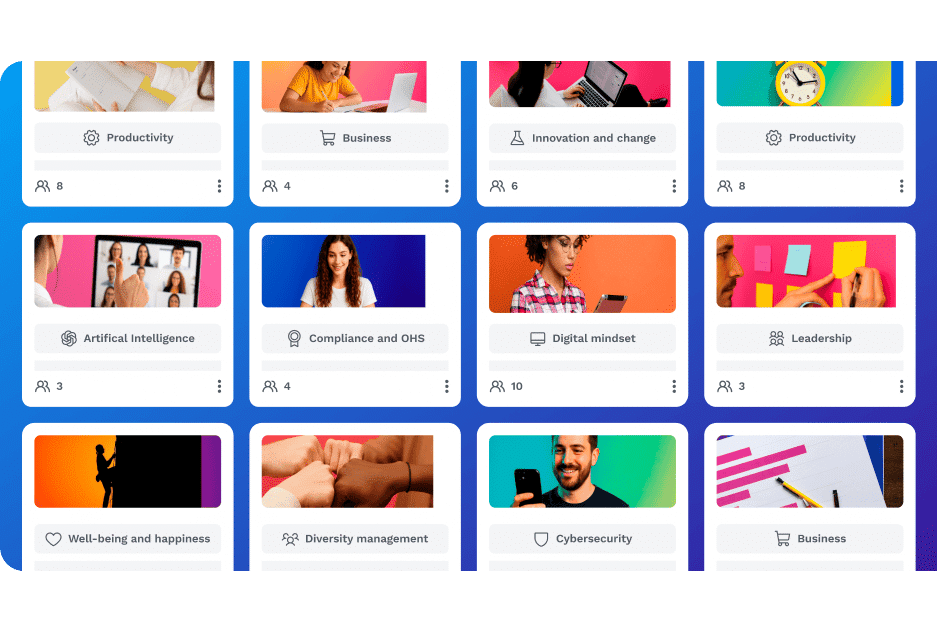
If we consider how we work today, it’s clear that a good skills inventory cannot be limited to collecting information. It needs to offer a complete—and above all, actionable—view. To achieve this, several elements have become essential in any modern approach.
Self-assessments are still useful, but no longer enough. Organizations need to combine different sources of information: practical assessments, manager feedback, training results, and even day-to-day performance data. The more perspectives, the more accurate the skills map.
It’s not about listing hundreds of skills, but identifying which ones are truly critical to the business and how they connect to each role. A solid competency framework helps compare, prioritize, and understand what truly impacts results.
An inventory is not very useful if, once a gap is identified, there is no clear path to resolve it. Having updated, varied, and accessible content—ranging from soft skills to digital capabilities—is essential to turn data into real development.
Skills change constantly. For this reason, a modern inventory needs information to update naturally, without relying on one-off campaigns. Every completed training, evaluation, or role change should be automatically reflected.
Beyond the list of skills, HR and L&D teams need to see trends, patterns, and risk levels: which teams have the most gaps, which roles are evolving fastest, which competencies are becoming obsolete. A good system turns data into stories you can interpret—and actions you can plan.
If the process is complicated or tedious, participation drops and data loses quality. For an inventory to work, it must be easy to use for both employees and managers, with clear evaluations, visible development paths, and communication that encourages engagement.
Together, these elements allow the skills inventory to move beyond a static document and become a strategic tool that accompanies the organization’s daily activity.
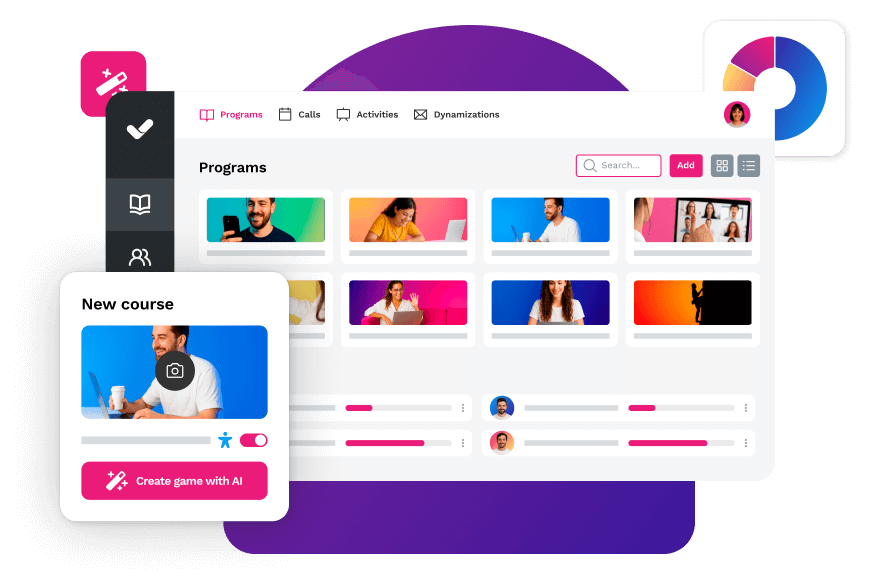
When we look at everything a skills inventory needs today—reliable evaluations, quality content, updated data, automation, and a simple user experience—it’s easy to understand why so many teams are moving away from isolated tools. In the end, an inventory only works when everything is connected: what you evaluate, what you detect, and what you act upon.
This is where an all-in-one LMS makes the difference, bringing together in one place all the components that give meaning to the inventory in everyday practice. In a single environment, organizations can:
This type of platform turns the skills inventory into a continuous cycle: evaluate, detect, train, re-evaluate. A living process that accompanies talent evolution and gives organizations something previously almost impossible: an updated, actionable, fully connected view of their workforce’s capabilities.
Instead of working with disconnected pieces, an integrated LMS helps the inventory flow, stay up to date, and—most importantly—be used to make decisions with real impact.
When an organization starts working with a more complete skills inventory, a common challenge arises: knowing where to start. Identifying gaps is important, but turning that information into concrete action requires time, judgment, and a good selection of content. This is where AI can provide very practical value.
Having tools that, instead of forcing you to browse an entire catalog or sift through hundreds of options, suggest which courses or resources can help develop the skills your team needs is a major advantage in everyday work.
For example, if a manager needs to strengthen communication, critical thinking, or any other soft skill, AI can automatically suggest the most suitable courses from the catalog—without searching, without guesswork, and without wasting time.
This same logic applies to more specific needs: simply describe the skill you want to work on, and the system provides a quick selection of relevant content. It works like an assistant that saves time and speeds up decision-making.
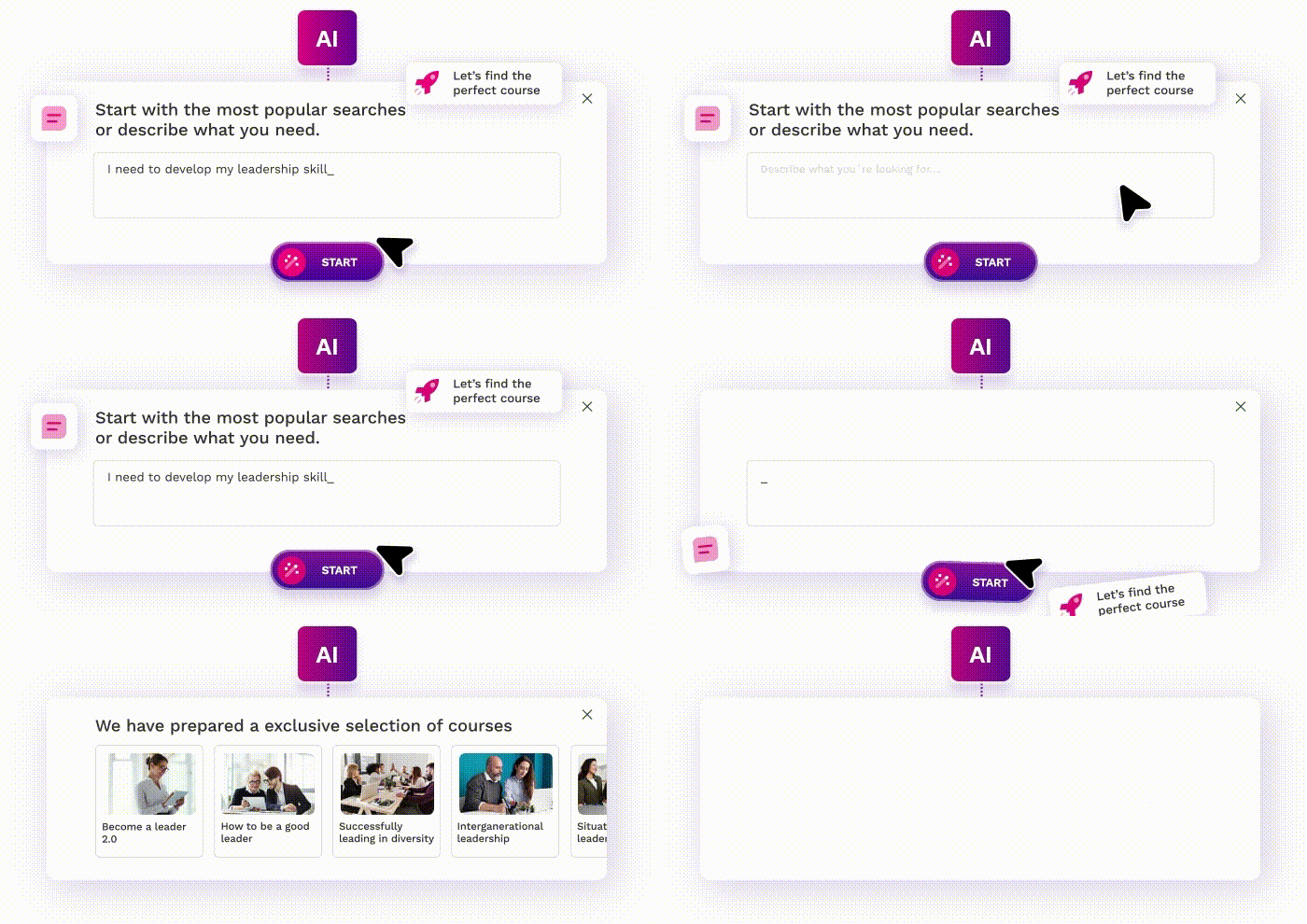
With the widespread adoption of AI, it may seem obvious to talk about the advantages of using this technology to simplify training-related tasks. However, if there are three key benefits to highlight, they are:
Understanding the skills inventory as a living system is an important shift, but it doesn’t happen on its own. For this approach to work in daily operations, organizations need an environment that connects evaluation, training, and data in a single flow—a space where each advancement is recorded, where gaps turn into concrete actions, and where talent can develop without manual processes or disconnected tools.
This is exactly what an all-in-one platform like isEazy LMS enables: bringing together in one place everything that used to be scattered across different systems. A learning platform, a content catalog, tracking, automation… all integrated so that the skills inventory stays alive and updated with no extra effort. Plus, an AI-powered authoring tool to create custom resources whenever the organization needs specific content.
Such a system allows HR, L&D, and managers to work with clear information, training aligned to real needs, and processes that flow naturally
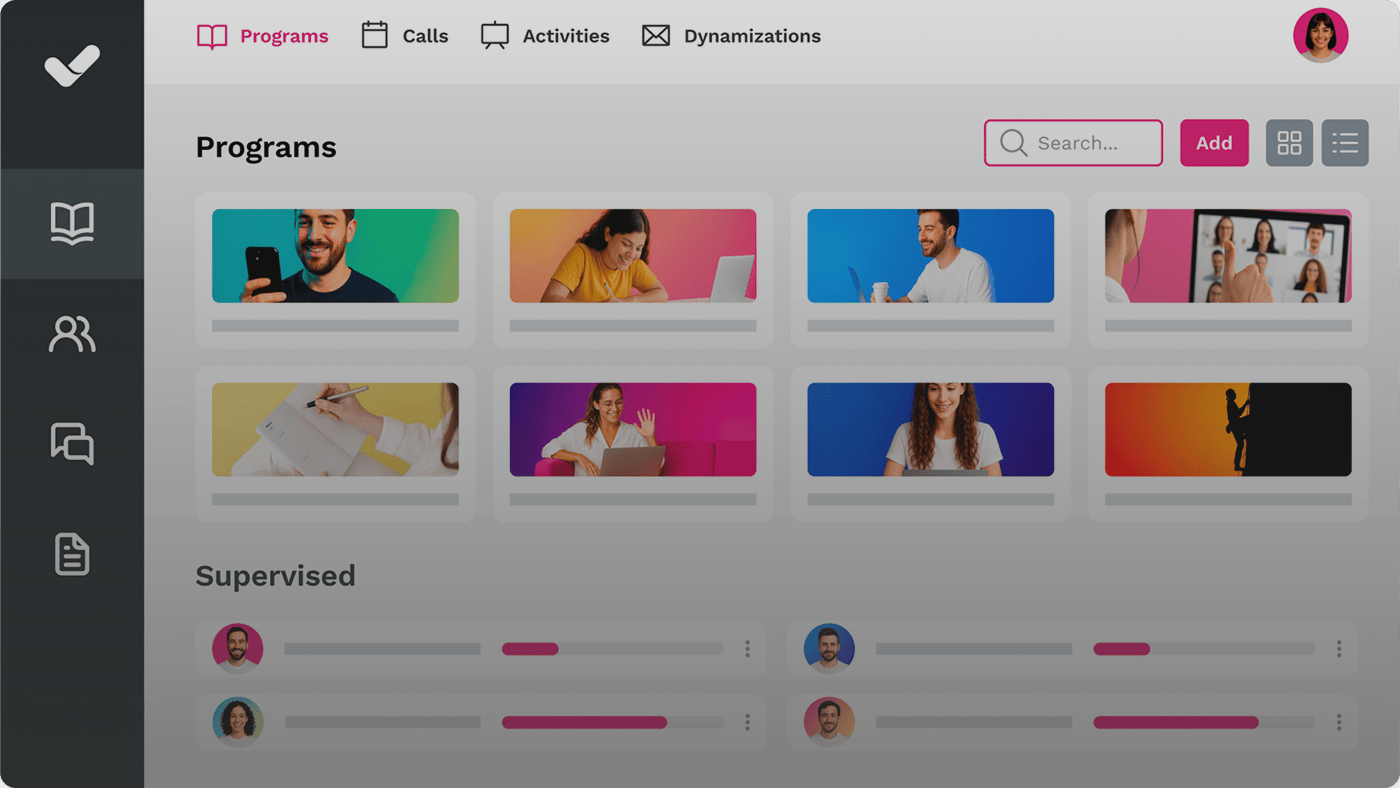
A clear example of this approach is the case of the Puerto de Cartagena Group. In an industry as technical and fast-evolving as the port sector, they needed to ensure their teams could acquire the skills needed to grow and respond to day-to-day challenges.
By centralizing evaluation, training content, and the creation of internal resources into a single platform, they achieved something that was previously very difficult: clearly identifying their skills gaps and acting on them immediately. Their teams gained access to relevant content, better-aligned learning pathways, and custom materials developed for highly specific roles.
The result was a more coherent learning experience, higher engagement, and far more visible talent development. A case that shows how a well-managed skills inventory stops being a diagnosis and becomes a true development engine.
Skills change, roles evolve, and business needs transform faster than ever. That’s why the skills inventory can no longer be a static document—it must be a living system that evolves alongside the organization. And only an integrated platform can make that possible.
With isEazy LMS, your skills inventory becomes a dynamic resource that updates naturally as your teams learn, get evaluated, and grow. AI works in the background to simplify skills mapping, identify needs, and suggest training aligned with each profile—helping HR and L&D anticipate change and make clearer decisions.
In addition, isEazy LMS brings together everything your strategy needs in a single environment:
This means less time managing disconnected tools and more time developing talent.
Ready to transform your skills inventory with isEazy LMS? Request a demo today and discover how our all-in-one, AI-enhanced platform can unify learning management, skills development, and content creation into an intuitive, scalable solution designed to support your organization’s growth.
A skills inventory is an organized compilation of a workforce’s skills, knowledge, and competencies. Its purpose is to help organizations understand what capabilities they currently have, which ones they need to develop, and how to align talent with business objectives. Instead of being a static list, a modern inventory should function as a living system that updates as people learn and evolve.
Having a clear inventory helps identify skill gaps, plan training, support internal mobility, and anticipate future needs. It also improves decision-making in HR and L&D, helps prioritize resources, and enables the design of learning pathways that are better aligned with the organization’s real challenges.
In traditional models, it was reviewed once or twice a year—but today that approach falls short. Skills change very quickly, so ideally the inventory should be updated continuously. This is only possible when assessments, training, and data coexist in a single platform that automatically reflects every advancement or change.
AI can help accelerate decision-making and make it easier to connect organizational needs with the available training content. For example, it can suggest relevant courses based on the skills you want to strengthen or help managers identify priorities. It doesn’t replace human strategy, but it does provide clarity and saves time.
Because it brings together in one environment everything that used to be scattered: assessments, content, analytics, learning pathways, automations, and the creation of custom resources. This allows the inventory to stay updated without extra effort and ensures that identified gaps can be transformed into immediate training actions. An integrated LMS turns the inventory into a living, actionable process.

Streamline your training management
Experience the power of AI in an LMS that has it all


Streamline your training management
Experience the power of AI in an LMS that has it all