WHITEPAPER
Discover the power skills that will transform your company

Brain
The first AI trained to teach

Author
The #1 AI-powered authoring tool on the market

Factory
Custom e-learning content factory

Skills
Comprehensive power skills course catalog

LMS
All-in-one LMS platform with AI

Engage
App for managing frontline teams
FEATURES

AINew
Unlock your full potential and speed up course creation with artificial intelligence.

Accessibility
Automatically meet accessibility guidelines—without sacrificing interactivity!

Interactivity
Boost engagement with interactive, ready-to-use activities that make learning fun.

Course Creation
Reduce the time it takes to create your e-learning courses with our authoring tool.

Distribution
We offer you different distribution options, so that nothing can stop you.

SCORM
Publish your course in SCORM format and share it on any LMS.
SERVICES

Instrucional Design
Surprise your students with multimedia and interactive content.

Custom Courses
We create e-learning courses for you—tailored to your needs and hassle-free!

Virtual Reality
Turn learning into an immersive experience.

Custom Avatars
Give your courses and videos a unique touch with personalized avatars.

Audiovisual FactoryNew
Turn training into something dynamic and visual with engaging videos.
CATALOG

Course catalog
Over 600 skills and competency courses to help you adapt to your team's needs.
Microsoft Copilot AcademyNew
Your professionals will learn how to apply Copilot AI to key processes within your organization.

Artificial Intelligence Academy
Train your teams in the practical use of AI to boost productivity and innovation in your company.

Cybersecurity Academy
Capacita a tu empresa con el catálogo más completo en seguridad digital corporativa.

Use cases
Choose the solution that best fits your needs

Industries
Solutions for all types of industries
USE CASES

Onboarding
Facilitate the onboarding process, productivity and engagement of your new employees.

Upskilling
Boost your team's skills and prepare them for the challenges of the future with upskilling.

Microlearning
Discover all the advantages of microlearning and boost your training results.

Gamification
Enjoy addictive training that will get your professionals hooked.

Internal Communication
Improve communication in your company and enjoy an aligned and committed team.

Mobile learning
Agile, flexible, and interactive learning—built for today’s digital-first workforce.
INDUSTRIES

Banking and financial services
Training in compliance, cybersecurity, customer service, and key skills development.

Pharmaceuticals and healthcare
Digital onboarding, regulatory updates, and ongoing training for healthcare staff.

Retail and consumer
Agile and scalable training for in-store, operational, and customer service teams.

Industry and manufacturing
Training in processes, safety, and corporate culture for distributed teams.

Education and training
Digital solutions for training centers, internal academies, and corporate universities.

Technology and telecommunications
Development of technical talent, digital skills, and upskilling and reskilling programs.
CLIENTS

MAPFRE
How MAPFRE turn e-learning into sales with isEazy

Pepco
A personalised learning experience for a growing team.

BBVA
Digitisation and creation of high quality e-learning content.

Shiseido
We increase the engagement of the training with a social and gamified app.

Telefónica
Large-scale reskilling for the company's digital transformation.

Vodafone
A personalised learning experience for a growing team.
More than 1,000 companies already rely on isEazy.


MEET ISEAZY

Events
Discover our upcoming events and connect with the future of e-learning.

News
Find out the latest news about isEazy: press releases, partnerships, updates...

Contact
Leave us your personal details and we will contact you as soon as possible.
About isEazyNew
Find out more about our company.

Careers
We are looking for the best talent, join our team!

Partners
Become our partner and grow your business.
INTERESTING RESOURCES

Blog
The best content on e-learning: trends, tools and key strategies.

Whitepapers
Gain valuable insights and stay ahead of industry trends.

Product releases
The latest news and releases of our e-learning products and solutions.

Glossary
Definitions of the most commonly used terms and key industry concepts.

Guides
Discover the best step-by-step tips and tricks to optimize your L&D strategy.

Webinars
Video sessions on our products, trends and more

Comparatives
Compare e-learning solutions available on the market and choose the most suitable one.

Create professional courses in minutes, now for less.
Stay up to date with all our latest news
 Subscribe to our newsletter
Stay up to date with all our latest news

October 29, 2026

CONTENT CREATED BY:

Table of contents
Generation Z is no longer the cohort that’s “about to enter” the workforce: they’ve been in it for years and are starting to take on positions of responsibility. What has changed isn’t just who works, but the conditions they work under and what they expect in return.
Self-taught, digitally native and used to immediacy, this generation forces a rethink of how companies communicate, lead and train. But it’s worth approaching the topic carefully: generational labels attract a lot of clichés and plenty of outdated data. In this guide you’ll find current figures with their source, the differences that are actually documented, and what to do with them.
Also known as post-millennials, centennials or iGen, they’re the demographic group born between the mid-nineties and the early 2010s. There’s no academic consensus on the exact boundaries: the Pew Research Center places the start in 1997, while other sources move it back to 1994 or forward to 1997-1998, and the end date ranges between 2010 and 2012.
Taking the most widely used definition —born between 1997 and 2012— in 2026 they’re between 14 and 29 years old, and the portion already working is concentrated in the 18 to 29 bracket. They’re the first generation that has never known a world without the internet, and that’s the trait that best explains the rest.
Their characteristics have as much to do with the historical period they’ve lived through as with their age. These are the best documented ones:
While millennials lived through the digital transformation, Generation Z has never known the world before the internet. They’ve grown up immersed in digital technology from an early age, with a natural command of platforms and social media.
A good share of them joined the workforce right as remote and hybrid work became normal, so they take for granted a level of digitalization that many companies still don’t have. The clash isn’t that they can’t adapt: it’s that they expect tools their employer doesn’t have.
Their flexibility and digital skills make them a good fit for agile, fast-changing environments. They can switch tasks across platforms and devices: start something on the office computer, continue on a laptop and review it on their phone.
One caveat, though: research on multitasking is consistent in finding that task switching hurts performance on cognitive work, including among people who see themselves as good multitaskers. Being comfortable doing it doesn’t mean they perform better that way.
This is where most of the clichés live. According to the study Claves laborales – Generación Z by Randstad Spain (September 2025), the main reason they leave a job is pay that’s too low (40%), far ahead of a lack of flexibility (13%) or misaligned values (11%).
Flexibility does matter —it’s the second factor in their ideal job, at 15%— but it sits behind adequate pay (36%). Any retention policy that leans on work-life balance while neglecting the salary band is solving the wrong problem.
They’re the clearest expression of do it yourself culture. Many have an entrepreneurial mindset and consider launching their own projects, which is why they appreciate creative environments that encourage innovation and constructive feedback from their managers.
According to the Pew Research Center survey published in 2021, Generation Z stands out for its levels of engagement with climate change: nearly seven in ten express anxiety about the future and most feel not enough is being done.
Along the same lines, they expect their employers to sustain an inclusive environment. That said, the Randstad figure puts the real weight of this factor into perspective when it comes to staying or leaving: misaligned values account for 11% of departures, behind pay.
Most articles about Generation Z describe personality traits without a single figure, or recycle US studies from a decade ago. These are the numbers for Spain, with source and date, which is what actually helps you make decisions.
The headline is turnover: 41% have left a job of their own accord in under a year, against an average of 32% across all workers. The gap with other generations is considerable, and it defines the real problem HR teams face today.
| Indicator | Generation Z | Source |
|---|---|---|
| Leave a job voluntarily in under 1 year | 41% (average across workers: 32%) | Randstad, Claves laborales – Generación Z, 2025 |
| Voluntary turnover in other generations | Millennials 29% · Generation X 23% · Baby boomers 11% | Randstad, 2025 |
| Plan to change jobs within 1 year | 35%. Only 11% expect to stay indefinitely | Randstad, 2025 |
| Top reason for leaving a job | Pay that’s too low (40%) | Randstad, 2025 |
| Factor no. 1 in their ideal job | Adequate pay (36%), ahead of flexible hours (15%) | Randstad, 2025 |
| Work full time | 45%, against an average of 52% | Randstad, 2025 |
| Use AI to solve problems at work | 64%, third highest in the world after India and Brazil | Randstad, 2025 |
| Openings for profiles with 0-2 years of experience | Down 29 percentage points since January 2024 (global figure) | Randstad, 2025 |
Both groups have been shaped by different contexts. Millennials, or Generation Y, were born roughly between the early eighties and 1996. They share traits through generational proximity, but there are differences worth keeping in mind. This summary sorts them out before we go into detail:
| Dimension | Generation Z | Millennials |
|---|---|---|
| Relationship with technology | Digital natives: they’ve never known the world without the internet | Lived through the transition; learned alongside the technology |
| What they prioritize at work | Pay, flexibility and fast progression | Security, stability and a culture of collaboration |
| Content consumption | Platforms and social media; heavy on user-generated content | Lived through the era before streaming and social media |
| Preferred workspace | Flexible, hybrid or fully remote | Collaborative in-person, with break and social areas |
| Activism | Highly vocal; they use social media as a tool for causes | Committed, with less public exposure |
| Learning | Experiential, online and flexible | Formal and oriented toward long-term goals |
Millennials grew up with the arrival of the internet and the development of mobile devices. Their knowledge of the web advanced in parallel with the technology itself. They aren’t digital natives like Generation Z, who were born into a world defined by the omnipresence of smartphones and the explosion of social media.
Each generation entered the labor market under a different economic context. For Generation Z, what weighs most is flexibility, growth opportunities and sustainability policies; although, as we’ve seen with the Randstad data, pay tops the list when the moment to decide arrives.
For Generation Y, the most important aspects when job hunting are security and stability, plus a culture that promotes teamwork and collaboration.
Millennials witnessed the shift from traditional media to digital platforms, but they lived through the era before streaming and social media. Generation Z grew up in a digitalized world, where content consumption happens on online platforms and user-generated content carries a lot of weight.
Generation Z prefers flexible, technologically advanced spaces, and favors hybrid or fully remote work. Generation Y prefers spaces that encourage collaboration and well-being, with break and social areas, although this has evolved since the pandemic.
Both groups show commitment to social and political issues, but Generation Z tends to be more active and vocal on gender equality, racial justice and climate change, and has turned social media into a tool for activism.
Millennials value education as a step toward professional success and set long-term goals. Generation Z values it too, but leans more toward experiential learning, online courses and flexible programs than toward traditional channels.
CASE STUDY
We boosted Shiseido’s training engagement with a social, gamified learning app.


Before redesigning anything, it’s worth knowing about a debate that almost no article on the subject mentions: a good deal of academic research questions whether generational differences at work are as large as people assume.
The meta-analysis by Costanza, Badger, Fraser, Severt and Gade (2012) on work attitudes found that the relationship between generational membership and work outcomes was practically nil. Lyons and Kuron (2014) reviewed the literature and described it as fragmented and contradictory, with underlying methodological problems. And Rudolph, Rauvola, Costanza and Zacher (2020) published a critical review dedicated to dismantling ten common myths about generations in the workplace.
The central methodological problem is easy to grasp: when you compare a 25-year-old with a 45-year-old, you aren’t measuring their generation alone. You’re simultaneously measuring their age, their life stage and the specific economic context in which they entered the labor market. Separating those three effects is very difficult, and most popular studies don’t even try.
It’s worth not overcorrecting either: the debate isn’t settled and some work does find a signal. But the practical takeaway is clear, and it’s the one we recommend applying: treat generational data as a description of a context, not as personality traits of your employees. That 41% change jobs in under a year says a lot about the labor market they found —low entry salaries, 29 points fewer junior openings— and very little about their character.
The shifting dynamics of the workplace have created new challenges for leaders and HR professionals. This generation looks for leadership that adapts to their expectations, and their focus on continuous development forces a rethink of corporate training strategies.
Leading this group requires an adaptive approach and an understanding of what motivates them. These are the key guidelines:
Generation Z values authenticity and transparency. Leaders need to communicate clearly and directly, with honest information about expectations and goals. It’s worth applying this to the uncomfortable parts too: salary bands, promotion criteria and realistic timelines.
Giving them room to decide how they do their work increases their engagement. Letting them make decisions and contribute ideas builds a sense of ownership and responsibility.
They’re used to regular feedback. Leaders should give recognition and feedback promptly and often, acknowledging achievements and offering constructive guidance for professional growth.
Offering mentoring and professional development is essential to engaging and retaining them. In the Randstad data, taking on more responsibility carries more weight among them (7%) than across the average (5%): they want to advance, and they want it to show soon.
Making the most of digital tools for communication and collaboration helps connect with this generation. Remote collaboration and project management platforms make teamwork easier.
As the first generation raised in a digitalized world, they’ve experienced education very differently. These are the ways to adapt training:
Development opportunities are one of the main factors in choosing where to work. Today’s challenges call for processes that favor self-directed learning, with up-to-date content delivered in formats that fit their lifestyle.
Used to uninterrupted access to information, for Generation Z time is the main barrier when it comes to taking courses. That tendency carries over to e-learning and opens the door to a new generation of learning platforms with a fully responsive experience, accessible from any device.
The use of technology has produced a more social generation, one that needs to share ideas and knowledge. Hence the shift from formal learning —individual, linear and theoretical— toward social learning: informal learning that encourages practical application, collaboration and the autonomous pursuit of knowledge.
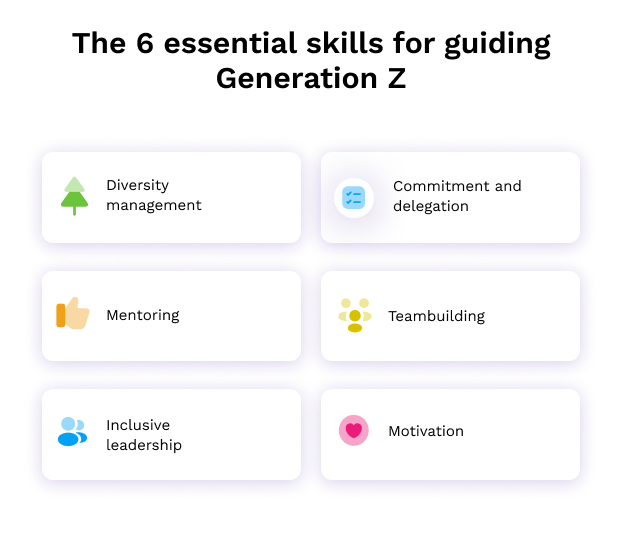
To meet this generation’s needs, team leads will need to develop a set of essential skills. These are the six basics:
Generation Z works alongside other generations of professionals. That means leading across generational, cultural, geographic and gender differences, while avoiding the mistake of treating each person according to the cliché of their cohort.
They have a high degree of autonomy, so it’s essential to offer them room to grow and advance. Securing their commitment means delegating tasks and processes so they take on new responsibilities and feel valued.
Generational change can open a gap between colleagues. Mentoring not only builds a sense of belonging to the team, it also supports the development of competencies such as leadership, assertiveness and achievement orientation.
Autonomy is good for taking ownership of tasks, but it can tip into individualism. Cooperation has to be encouraged so the team rows toward a shared goal.
An inclusive leader brings every employee into a solid team. That means knowing each member’s strengths and weaknesses and what they can contribute to the group.
To manage a team successfully it’s essential to keep it motivated: identify each person’s needs, convey a positive attitude and acknowledge both mistakes and successes.
If 41% leave in under a year, the critical point isn’t the three-year career plan: it’s the first few weeks. An onboarding designed for a hire who’ll stay a decade doesn’t work for someone who decides in three months whether this is a fit.
Promotion criteria, the role’s salary band, how performance is assessed and how often. In a generation whose top reason for leaving is pay, saving that conversation for the annual review means losing people who would have stayed.
A task with visible impact and immediate feedback. It’s the most effective way to turn the expectation of fast development into a concrete experience rather than a promise.
Short bites accessible from a phone, not a four-hour classroom course. This is where microlearning fits naturally with their consumption habits.
Someone they can ask without feeling evaluated reduces the friction of the first few weeks more than any welcome manual.
A short monthly conversation lets you correct course while there’s still room. At six months, whoever was going to leave has already decided.
These are the slip-ups that come up most often, and nearly all of them come from mistaking a statistical description for an individual portrait of the person in front of you.
The table sums up what to do in the situations that show up most in day-to-day work:
| Situation | What to do | Why |
|---|---|---|
| A junior asks for a pay review at six months | Explain the role’s salary band and the concrete criteria for moving within it | Pay is their top reason for leaving: ambiguity reads as a no |
| They turn down a half-day in-person course | Offer the same content in short, asynchronous bites | Time is the barrier they themselves identify as the main one |
| They ask for feedback constantly | Set a short recurring slot instead of responding on demand | It turns a vague demand into a sustainable habit for the manager |
| They openly question a team decision | Explain the reasoning, even if the decision doesn’t change | They value transparency; silence reads as disrespect, not hierarchy |
| They say they want to “grow fast” | Translate it into concrete responsibilities and verifiable timelines | Taking on more responsibility carries more weight among them (7%) than the average (5%) |
| A manager claims “Gen Z can’t take anything” | Look at the team’s own data before accepting the diagnosis | Academic evidence on generational traits is weak; the cliché hides real management problems |
To bridge the generational gap it’s worth being deliberate about how you connect with them. This generation engages better with quick, short content that fits new consumption patterns.
In that sense, methodologies such as microlearning —delivering knowledge through high-impact learning bites— help encourage learning and recall without competing with their schedule.
It’s also worth retiring the traditional idea of a corporate platform. These profiles expect a digital workspace accessible from any device. Approaches like gamification let them engage from an environment they already know, and its playful, social component fits their habits.
One note that saves a lot of grief: none of this works if the content isn’t good. Short, gamified formats speed up the consumption of useful training, but they also speed up the abandonment of training that isn’t.
Generation Z doesn’t require reinventing people management, but it does require revisiting assumptions that have aged badly. The data from Spain is fairly clear: they’re the generation with the highest voluntary turnover, their top reason for leaving is pay rather than work-life balance, and they’ve entered a market with far fewer entry-level openings than two years ago. And it’s worth remembering that academic research questions whether these differences are character traits at all: mostly they describe the context people have found. What’s useful, then, isn’t asking what they’re like, but what your company offers them and whether it holds up in comparison.
Where you can act starting tomorrow is training, which is both what they ask for and one of the cheapest retention levers there is. isEazy Skills is a catalog of courses on digital skills and competencies built precisely for these consumption patterns: quick, interactive content accessible from a phone, with a practical methodology aimed at transferring the skill to the job. If you want to start by understanding which competencies to prioritize, the power skills report is a good place to begin.
Generation Z includes individuals born from the mid-90s to the early 2010s. Although there’s no exact consensus on the starting and ending years, it is generally estimated to span from 1994-1997 to 2010-2012.
Generation Z is known for being digital natives, quickly adapting to new technologies, valuing workplace well-being and remote work, having an entrepreneurial spirit, and showing a strong awareness of diversity, inclusion, and environmental issues.
While both generations value technology, Millennials grew up during the digital transition, whereas Generation Z was born into an already digitalized world. Additionally, Generation Z places more importance on flexibility and work-life balance and has a stronger inclination towards social activism.
Technology is crucial to the formation of Generation Z. They prefer flexible learning methods accessible from any device, as well as the use of LMS platforms and methods like microlearning and gamification.
Leaders should focus on clear and transparent communication, provide flexibility and autonomy, offer instant recognition and feedback, create opportunities for professional development, and utilize digital tools to enhance collaboration and connection.

WHITEPAPER
Discover the power skills that will transform your company
Download whitepaper


Your team’s talent is your greatest asset. Grow it with isEazy Skills
Develop soft skills and key competencies with a comprehensive course catalog designed to accelerate your team’s growth.


Your team’s talent is your greatest asset. Grow it with isEazy Skills
Develop soft skills and key competencies with a comprehensive course catalog designed to accelerate your team’s growth.