CASE STUDY
How Pepco was able to comprehensively manage employee training with an LMS

Brain
The first AI trained to teach

Author
The #1 AI-powered authoring tool on the market

Factory
Custom e-learning content factory

Skills
Comprehensive power skills course catalog

LMS
All-in-one LMS platform with AI

Engage
App for managing frontline teams
Product

What is Brain?
Everything you need to know about the first AI trained to teach.

How does it work?
Adaptive, conversational, and contextual. That’s learning with Brain.

Security
Why your company’s knowledge never leaves your environment or trains other models.

Comparison
Discover what sets isEazy Brain apart from other AI solutions.

Frequently Asked Questions
Want to learn more? Find answers to all your questions about isEazy Brain here.
FEATURES

AINew
Unlock your full potential and speed up course creation with artificial intelligence.

Accessibility
Automatically meet accessibility guidelines—without sacrificing interactivity!

Interactivity
Boost engagement with interactive, ready-to-use activities that make learning fun.

Course Creation
Reduce the time it takes to create your e-learning courses with our authoring tool.

Distribution
We offer you different distribution options, so that nothing can stop you.

SCORM
Publish your course in SCORM format and share it on any LMS.
SERVICES

Instrucional Design
Surprise your students with multimedia and interactive content.

Custom Courses
We create e-learning courses for you—tailored to your needs and hassle-free!

Virtual Reality
Turn learning into an immersive experience.

Custom Avatars
Give your courses and videos a unique touch with personalized avatars.

Audiovisual FactoryNew
Turn training into something dynamic and visual with engaging videos.
CATALOG

Course catalog
Over 600 skills and competency courses to help you adapt to your team's needs.
Microsoft Copilot AcademyNew
Your professionals will learn how to apply Copilot AI to key processes within your organization.

Artificial Intelligence Academy
Train your teams in the practical use of AI to boost productivity and innovation in your company.

Cybersecurity Academy
Capacita a tu empresa con el catálogo más completo en seguridad digital corporativa.
FEATURES

Learning platform
Manage all your training from one place

Analitycs
Measure the impact of your training

Learning Experience
Offer a unique learning experience to your team
Content Library
Choose from hundreds of expert-created courses
Authoring Tool
Create your own content—faster than ever

Use cases
Choose the solution that best fits your needs

Industries
Solutions for all types of industries
USE CASES

Onboarding
Facilitate the onboarding process, productivity and engagement of your new employees.

Upskilling
Boost your team's skills and prepare them for the challenges of the future with upskilling.

Microlearning
Discover all the advantages of microlearning and boost your training results.

Gamification
Enjoy addictive training that will get your professionals hooked.

Internal Communication
Improve communication in your company and enjoy an aligned and committed team.

Mobile learning
Agile, flexible, and interactive learning—built for today’s digital-first workforce.
INDUSTRIES

Banking and financial services
Training in compliance, cybersecurity, customer service, and key skills development.

Pharmaceuticals and healthcare
Digital onboarding, regulatory updates, and ongoing training for healthcare staff.

Retail and consumer
Agile and scalable training for in-store, operational, and customer service teams.

Industry and manufacturing
Training in processes, safety, and corporate culture for distributed teams.

Education and training
Digital solutions for training centers, internal academies, and corporate universities.

Technology and telecommunications
Development of technical talent, digital skills, and upskilling and reskilling programs.
CLIENTS

MAPFRE
How MAPFRE turn e-learning into sales with isEazy

Pepco
A personalised learning experience for a growing team.

BBVA
Digitisation and creation of high quality e-learning content.

Shiseido
We increase the engagement of the training with a social and gamified app.

Telefónica
Large-scale reskilling for the company's digital transformation.

Vodafone
A personalised learning experience for a growing team.
More than 1,000 companies already rely on isEazy.





MEET ISEAZY

Events
Discover our upcoming events and connect with the future of e-learning.

News
Find out the latest news about isEazy: press releases, partnerships, updates...

Contact
Leave us your personal details and we will contact you as soon as possible.
About isEazyNew
Find out more about our company.

Careers
We are looking for the best talent, join our team!

Partners
Become our partner and grow your business.
INTERESTING RESOURCES

Blog
The best content on e-learning: trends, tools and key strategies.

Whitepapers
Gain valuable insights and stay ahead of industry trends.

Product releases
The latest news and releases of our e-learning products and solutions.

Glossary
Definitions of the most commonly used terms and key industry concepts.

Guides
Discover the best step-by-step tips and tricks to optimize your L&D strategy.

Webinars
Video sessions on our products, trends and more

Comparatives
Compare e-learning solutions available on the market and choose the most suitable one.


WEBINAR
Master AI in isEazy Author in under an hour.




GUIDE
Prepare your organization to comply with the new AI regulations

Stay up to date with all our latest news
 Subscribe to our newsletter
 Stay up to date with all our latest news

July 16, 2026

CONTENT CREATED BY:

Table of contents
When a company needs to digitize its training, the usual approach is to start looking for tools separately: one to create courses, another to manage them, another for engagement… The result is often a fragmented ecosystem that is costly to maintain and hard to scale. End-to-end learning proposes the opposite: covering the entire learning cycle from a single platform.
The term end-to-end describes solutions that cover a complete process without relying on external systems. Applied to corporate learning, end-to-end learning refers to a platform or ecosystem of tools that manages all phases of the learning cycle under a single provider.
This includes, at a minimum:
The key difference compared to combining tools from multiple providers is that in an end-to-end solution all components are designed to work together natively. This eliminates integration issues, reduces the learning curve for L&D teams, and guarantees a more consistent experience for the employee.
According to LinkedIn Learning’s Workplace Learning Report 2024, 90% of organizations face technology integration challenges in their training programs. Managing multiple vendors is one of the main factors that slows down training deployment and increases maintenance costs. An end-to-end solution addresses this problem at the root. Here are the four most relevant benefits:
Having a single company cover all your training needs means you avoid wasting time, money, and energy combining different solutions. End-to-end services are comprehensive and tailored to the company, saving the time spent searching for separate providers and allowing for better pricing than contracting tools individually. According to Brandon Hall Group data (2023), organizations that consolidate their training stack into a single platform reduce L&D-related technology management costs by between 20% and 30%.
When all e-learning solutions come from a single provider, it is easier for the tools to complement each other and cover every area your training plan requires. The L&D team also works with a single point of contact who understands the project in depth and can support it at every stage — from instructional design to results analytics. This speeds up decision-making and reduces misunderstandings that arise from coordinating multiple support teams.
When a single provider works with you at every stage, they get to know your organization and its needs first-hand, building a closer, more trusted relationship. The provider understands your learning culture, your talent objectives, and the specific challenges of your sector, which translates into more proactive support and recommendations better aligned with your organization’s reality.
When a single provider handles every part of the final solution, the tools complement each other more effectively and the result is far more cohesive and professional. New ideas emerge more naturally and innovation efforts are more likely to succeed, creating a unique and tailored solution that evolves with the needs of the business.
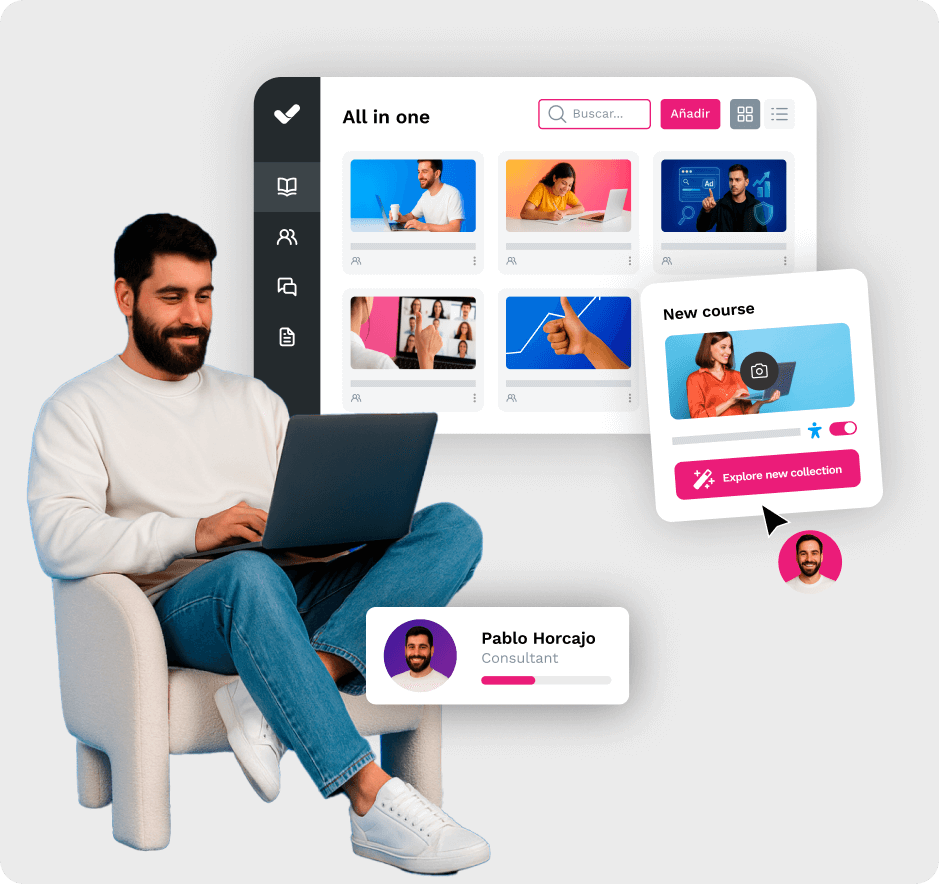
To fully understand the advantages of the end-to-end model, it helps to compare it directly with the most common alternative: combining tools from different providers.
| Aspect | Partial solutions | End-to-end solution |
|---|---|---|
| Technical integration | Requires complex integrations between systems | Native: all tools work together out of the box |
| Total cost | Multiple licenses + integration and support costs | A single subscription covering everything |
| Employee experience | Different interfaces and multiple logins | Unified, consistent experience |
| L&D management | Multiple vendors, dashboards, and contacts | A single provider and support point |
| Scalability | Hard to scale without new integrations | Grows with the company without additional friction |
| Learning curve | High: each tool has its own logic | Low: one platform, one way of working |
Not every platform that presents itself as an “all-in-one solution” truly is. Before making a decision, it is useful to evaluate the following criteria:
A good starting point is to download the isEazy end-to-end learning whitepaper, where you will find the key evaluation criteria and a guide to assessing the options available on the market. You may also find it helpful to explore how to build a successful learning and development strategy before choosing your platform.
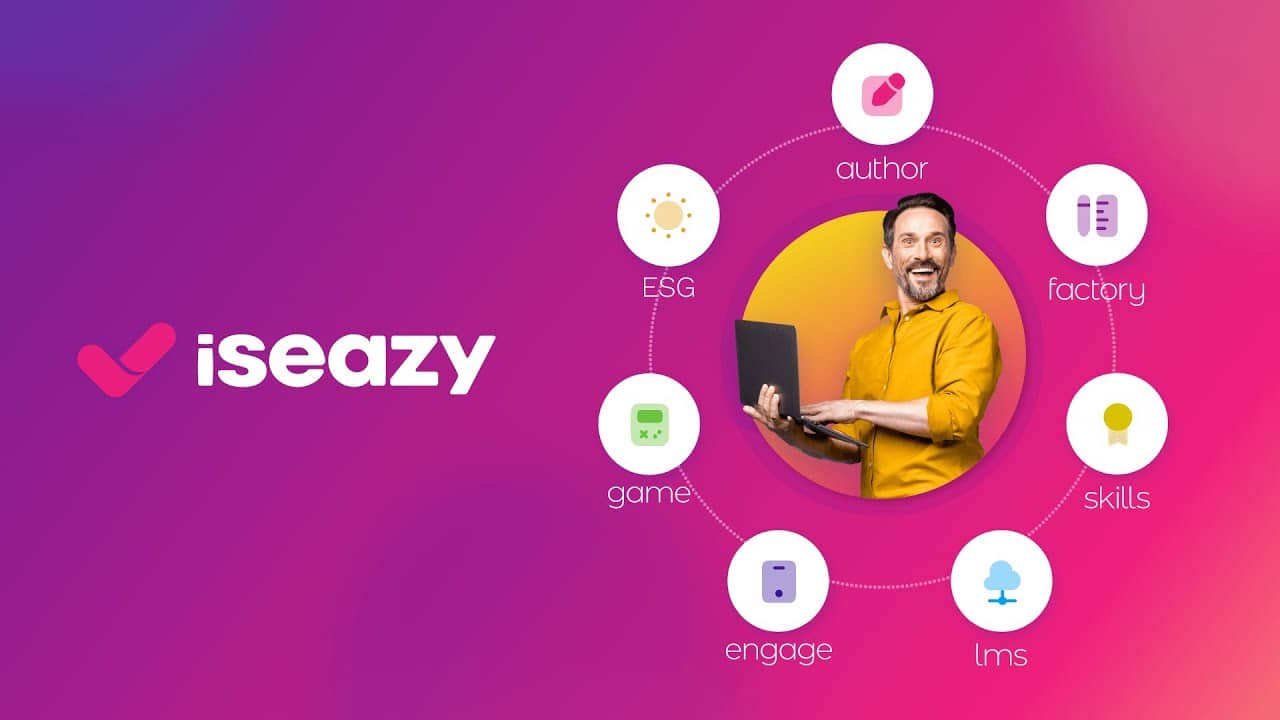
isEazy offers companies a complete end-to-end e-learning experience that covers all their training, communication, and corporate development processes from a single place. With over 20 years of experience, more than 10 million users, and a presence in 90 countries, isEazy is the platform chosen by organizations that need to scale their training without multiplying their technological complexity.
From a single subscription, you can access everything you need to cover the full learning cycle:
All tools are designed to work together natively, sharing interface, data, and user logic. This means the L&D team always works within the same environment, and the employee lives a consistent training experience from start to finish.
The natural next step for any end-to-end solution is to embed artificial intelligence not as an add-on, but as a structural layer of the learning experience. isEazy Brain is isEazy’s AI-native learning platform, transforming each company’s real corporate knowledge into learning agents that adapt to every professional in real time.
Built on pedagogical and behavioral models and backed by our extensive experience in e-learning, isEazy Brain adapts the learning experience to each user’s level, role, pace, context, and preferred format. It can also adjust the tone and role of the learning agent according to what the user needs at each stage of the experience.
Unlike general-purpose AI tools, Brain works with your organization’s real documentation, including manuals, policies, procedures, and product materials. It processes this knowledge and transforms it into adaptive, contextual, and conversational learning tailored to each employee’s level of expertise, context, and moment of need.
Brain also runs on infrastructure that is isolated for each customer. Your company’s knowledge never leaves your environment, is never shared with other customers, and is never used to train external models. Its architecture provides traceability, human oversight, and enterprise-level governance. What your company knows stays within your company.

Pepco, one of Europe’s fastest-growing retail chains, needed to scale its training to thousands of employees spread across multiple countries and points of sale, with content in several languages and formats tailored to store profiles. They chose isEazy as their end-to-end provider to cover both content creation and training management and tracking from a single platform.
Discover how Pepco scales its training with isEazy →
In an environment where companies need to train their teams faster, with greater personalization, and at lower management costs, end-to-end learning stops being a preference and becomes a competitive advantage. Consolidating the learning cycle into a single platform reduces technological friction, improves the employee experience, and allows L&D teams to focus on what truly matters: designing training with real impact.
If you want to explore how an integrated solution can transform training in your organization, discover isEazy LMS or download the end-to-end learning whitepaper.
End-to-end learning is a corporate training model in which a single platform or provider covers every stage of the learning cycle: content creation, learning management, distribution, tracking, and analytics. Unlike combining tools from different vendors, an end-to-end solution ensures all components are designed to work together, resulting in greater coherence, fewer technical friction points, and a smoother learning experience for employees and L&D teams alike.
A traditional LMS (Learning Management System) manages and delivers training, but it does not create content or cover other needs such as internal communication or adaptive learning. An end-to-end solution goes further: it integrates the LMS with an authoring tool, a ready-to-use content catalog, engagement tools, and — in the most advanced offerings — adaptive AI capabilities. The result is a complete learning ecosystem under a single subscription and a single point of support.
The starting point is auditing the training tools you already use and identifying friction points: where is time being lost? Which processes require complex integrations? From there, look for a provider that covers those needs from a single platform. Key criteria include: ease of use, integration capability with existing systems (HRIS, ERP), scalability, support in your language, and alignment with your talent strategy. Ideally, start with a contained pilot — one department or a specific training program — before rolling it out across the whole organization.
A complete end-to-end solution for corporate training should include, at a minimum: an authoring tool to create in-house courses, an LMS to manage and distribute training, a ready-to-use content catalog (soft skills, digital skills, compliance), engagement and internal communication tools, and analytics to measure impact. The most advanced solutions on the market also add AI capabilities that personalize learning in real time, adapting content to the level and needs of each professional.

GUIDE
Prepare your organization to comply with the new AI Regulations
Download guide


All Your Training in One Platform
Learning management, courses, and content creation in one place. Elevate your e-learning strategy with an all-in-one solution.


All Your Training in One Platform
Learning management, courses, and content creation in one place. Elevate your e-learning strategy with an all-in-one solution.