CASE STUDY
How Clarel achieved high engagement through gamified training

Brain
The first AI trained to teach

Author
The #1 AI-powered authoring tool on the market

Factory
Custom e-learning content factory

Skills
Comprehensive power skills course catalog

LMS
All-in-one LMS platform with AI

Engage
App for managing frontline teams
Product

What is Brain?
Everything you need to know about the first AI trained to teach.

How does it work?
Adaptive, conversational, and contextual. That’s learning with Brain.

Security
Why your company’s knowledge never leaves your environment or trains other models.

Comparison
Discover what sets isEazy Brain apart from other AI solutions.

Frequently Asked Questions
Want to learn more? Find answers to all your questions about isEazy Brain here.
FEATURES

AINew
Unlock your full potential and speed up course creation with artificial intelligence.

Accessibility
Automatically meet accessibility guidelines—without sacrificing interactivity!

Interactivity
Boost engagement with interactive, ready-to-use activities that make learning fun.

Course Creation
Reduce the time it takes to create your e-learning courses with our authoring tool.

Distribution
We offer you different distribution options, so that nothing can stop you.

SCORM
Publish your course in SCORM format and share it on any LMS.
SERVICES

Instrucional Design
Surprise your students with multimedia and interactive content.

Custom Courses
We create e-learning courses for you—tailored to your needs and hassle-free!

Virtual Reality
Turn learning into an immersive experience.

Custom Avatars
Give your courses and videos a unique touch with personalized avatars.

Audiovisual FactoryNew
Turn training into something dynamic and visual with engaging videos.
CATALOG

Course catalog
Over 600 skills and competency courses to help you adapt to your team's needs.
Microsoft Copilot AcademyNew
Your professionals will learn how to apply Copilot AI to key processes within your organization.

Artificial Intelligence Academy
Train your teams in the practical use of AI to boost productivity and innovation in your company.

Cybersecurity Academy
Capacita a tu empresa con el catálogo más completo en seguridad digital corporativa.
FEATURES

Learning platform
Manage all your training from one place

Analitycs
Measure the impact of your training

Learning Experience
Offer a unique learning experience to your team
Content Library
Choose from hundreds of expert-created courses
Authoring Tool
Create your own content—faster than ever

Use cases
Choose the solution that best fits your needs

Industries
Solutions for all types of industries
USE CASES

Onboarding
Facilitate the onboarding process, productivity and engagement of your new employees.

Upskilling
Boost your team's skills and prepare them for the challenges of the future with upskilling.

Microlearning
Discover all the advantages of microlearning and boost your training results.

Gamification
Enjoy addictive training that will get your professionals hooked.

Internal Communication
Improve communication in your company and enjoy an aligned and committed team.

Mobile learning
Agile, flexible, and interactive learning—built for today’s digital-first workforce.
INDUSTRIES

Banking and financial services
Training in compliance, cybersecurity, customer service, and key skills development.

Pharmaceuticals and healthcare
Digital onboarding, regulatory updates, and ongoing training for healthcare staff.

Retail and consumer
Agile and scalable training for in-store, operational, and customer service teams.

Industry and manufacturing
Training in processes, safety, and corporate culture for distributed teams.

Education and training
Digital solutions for training centers, internal academies, and corporate universities.

Technology and telecommunications
Development of technical talent, digital skills, and upskilling and reskilling programs.
CLIENTS

MAPFRE
How MAPFRE turn e-learning into sales with isEazy

Pepco
A personalised learning experience for a growing team.

BBVA
Digitisation and creation of high quality e-learning content.

Shiseido
We increase the engagement of the training with a social and gamified app.

Telefónica
Large-scale reskilling for the company's digital transformation.

Vodafone
A personalised learning experience for a growing team.
More than 1,000 companies already rely on isEazy.





MEET ISEAZY

Events
Discover our upcoming events and connect with the future of e-learning.

News
Find out the latest news about isEazy: press releases, partnerships, updates...

Contact
Leave us your personal details and we will contact you as soon as possible.
About isEazyNew
Find out more about our company.

Careers
We are looking for the best talent, join our team!

Partners
Become our partner and grow your business.
INTERESTING RESOURCES

Blog
The best content on e-learning: trends, tools and key strategies.

Whitepapers
Gain valuable insights and stay ahead of industry trends.

Product releases
The latest news and releases of our e-learning products and solutions.

Glossary
Definitions of the most commonly used terms and key industry concepts.

Guides
Discover the best step-by-step tips and tricks to optimize your L&D strategy.

Webinars
Video sessions on our products, trends and more

Comparatives
Compare e-learning solutions available on the market and choose the most suitable one.


WEBINAR
Master AI in isEazy Author in under an hour.




GUIDE
Prepare your organization to comply with the new AI regulations

Stay up to date with all our latest news
 Subscribe to our newsletter
 Stay up to date with all our latest news

June 12, 2026

CONTENT CREATED BY:

Table of contents
There are at least six types of gamification applicable to corporate training, and each one responds to different objectives. Choosing the right one — or combining them — makes the difference between a programme that truly engages and one that gets abandoned. In this article, we explain what types exist, what each one involves, when to use it, and how to implement the key processes to make it work.
Gamification means applying game mechanics — points, levels, challenges, narrative — in non-playful work contexts such as training, onboarding, or skills development. According to a Mordor Intelligence report, the global gamification market will exceed $48 billion by 2029, with an annual growth rate of 26%, driven particularly by its adoption in HR and corporate training.
Unlike what is covered in the complete guide to gamification at work, this article focuses specifically on the types of gamification and the implementation processes: the “what to choose” and the “how to do it”.
Before choosing the types of gamification, it is worth understanding the processes that underpin any successful initiative. Without this framework, game mechanics are left without strategic purpose.
The first and most critical process is to precisely define which behaviours or knowledge you want to reinforce: improve course completion rates? Accelerate onboarding? Reinforce regulatory compliance? The answer determines which type of gamification makes most sense and which mechanics to use. It is also the moment to define the user profile: a sales team will respond very differently to a technical team.
Game mechanics are the concrete components of the system: points, badges, rankings, challenges, levels, rewards. Not all mechanics work equally well in every context. Individual rankings can demotivate less competitive profiles; tangible rewards can lose their effect if they hold no real value for the employee. The key is to align the mechanic with the chosen type of gamification and with the team culture.
Narrative transforms a sequence of tasks into a meaningful experience. A gamified onboarding that follows an “integration mission” story retains employees better than one that simply shows a progress bar. Narrative or storytelling is not mandatory in all types, but in level-based, simulation, and narrative gamification it is the element that makes the difference between momentary engagement and sustained motivation.
The final process is ensuring that gamification integrates with the LMS or training platform so that data flows: who completes what, in how long, with what score. Without traceability, there is no way to measure return or iterate. Immediate feedback to the employee — knowing in real time how they are progressing — is one of gamification’s most powerful mechanisms for reinforcing desired behaviour.
| Process | What it defines | Common mistake |
|---|---|---|
| Objective definition | Which behaviours to reinforce and who the target audience is | Gamifying without a clear objective |
| Mechanics selection | Points, rankings, challenges, rewards by profile | Using rankings with non-competitive teams |
| Narrative incorporation | Story and context that give meaning to the learning journey | Ignoring narrative in long-term programmes |
| Integration and feedback | Data, traceability and real-time feedback | Implementing without measuring results |
Understanding the different types of gamification allows you to design more precise and effective training strategies. Below, the six main types with their characteristics, advantages and specific use cases in corporate training.
This is the most widespread type. It focuses on rewarding the achievement of individual objectives through points, badges and rankings. Employees set learning goals and receive rewards as they reach them, reinforcing personal progress and self-development. It works particularly well in product training, regulatory compliance and technical skills development.
When to use it: when the objective is to motivate module completion and reinforce autonomous learning. Also in continuous training programmes where maintaining engagement over time is essential.
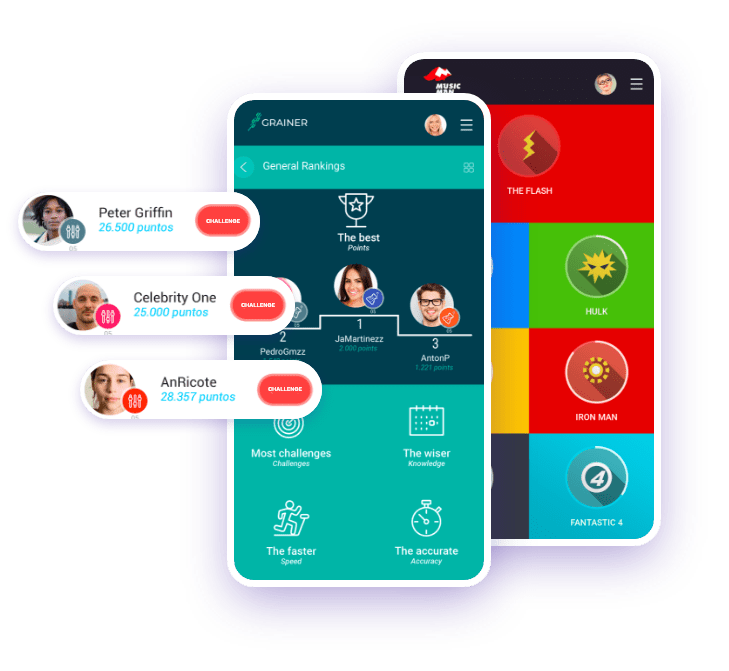
Also known as cooperative gamification, it is based on teamwork to overcome shared challenges. Employees join forces to achieve joint objectives, reinforcing a sense of belonging, cross-department communication and peer learning. It is the most appropriate type for corporate culture programmes, team integration and collective onboarding.
When to use it: in contexts where collaboration and communication are key competencies, or when you want to break down silos between departments.
It structures learning as a stepped journey: each level unlocks the next, and employees advance as they demonstrate mastery of previous competencies. This type generates a sense of constant, visible progress, maintaining motivation throughout extended training programmes.
When to use it: in professional development, upskilling or reskilling journeys and internal career paths where learning has a clear sequential logic.

It integrates a story as the throughline of the entire training programme. Employees do not just complete modules: they advance on a mission, solve a case or play a role with real consequences. This type is the most powerful for maintaining engagement over time because it connects learning with emotions and meaning. Storytelling in e-learning improves retention by up to 65% compared to decontextualised learning.
When to use it: in onboarding programmes, values and corporate culture training, or any journey where the user experience is a priority.
It focuses on individual rankings and leaderboards to stimulate personal improvement. Employees compete — against each other or against their own history — to climb positions. It activates extrinsic motivation more intensely than other types, but requires careful management: a poorly designed ranking can demotivate those who consistently appear in lower positions.
When to use it: in sales teams, customer service or short-term, time-bound challenges. Not recommended as the sole mechanism in long programmes.
It allows employees to make decisions in scenarios that replicate real work situations, with consequences depending on each choice. This is the type with the greatest impact on applicable learning: employees do not just memorise, they practise. Simulation training is the gamified modality with the highest transfer to real performance, especially in leadership, customer service and crisis management training.
When to use it: when the goal is for employees to make better decisions in complex situations. Highly effective in soft skills, consultative sales and regulatory compliance.
| Type of gamification | Main objective | Best for |
|---|---|---|
| Achievement and reward-based | Motivate completion and individual progress | Continuous training, regulatory compliance |
| Social and collaborative | Strengthen teamwork and corporate culture | Collective onboarding, team integration |
| Level and progression-based | Structure complex learning journeys | Upskilling, reskilling, career paths |
| Narrative or storytelling | Create emotional engagement and lasting retention | Onboarding, values and corporate culture |
| Competitive | Stimulate personal improvement and performance | Sales teams, short-term challenges |
| Simulation | Transfer learning to real performance | Leadership, customer service, crisis management |
There is no universally better type of gamification: the choice depends on four key factors you should assess before designing your training strategy.
Most successful training programmes combine two or three types. The most common mistake is committing to a single type without iterating: gamification needs data, feedback and continuous adjustment to maintain its motivational effect over time.
| Tool | Main focus | Best for |
|---|---|---|
| isEazy Game | Comprehensive corporate gamification: games, teams, analytics and social area | Corporate training, onboarding, organisational culture |
| Kahoot | Interactive quizzes and live-session assessments | Events, one-off training sessions, presentations |
| Centrical | Gamification + AI for productivity and performance management | Sales teams and customer service |
Clarel, a beauty and personal care retailer with over 1,000 points of sale across Spain, needed to train its store teams quickly and consistently across all locations. With isEazy Game, they implemented a strategy combining achievement-based gamification with social dynamics, achieving an 84% engagement rate in their training programmes and the ability to evaluate results simultaneously across the entire network. Find out how they did it →
The market offers different corporate gamification solutions, each with a distinct focus and target customer. Below, the three most prominent platforms in 2026 to help you make the most informed decision.
isEazy Game is a gamification app designed specifically for corporate training. It allows you to create individual games, team challenges (team vs. team) and multiplayer sessions, incorporating level dynamics, rankings, achievements and rewards. It includes a social and collaborative area with chat, notifications and comments, and a comprehensive dashboard with participation metrics, progress tracking and knowledge category analytics. It is the most complete solution for mid-sized and large companies looking for a scalable, 100% mobile platform with LMS integration.
Ideal for: corporate training, organisational culture, onboarding and skills development.

Features
Benefits
Subscription plans
Use cases
All plans include: levels and rankings, push notifications, knowledge challenges, help center and support, progress reports, 13 content types (audio, image, video, quizzes, games…), analysis by knowledge category, and custom help screens.
Features
Benefits
Subscription plans
All plans include: levels and rankings, push notifications, knowledge challenges, help center and support, progress reports, 13 content types (audio, image, video, quizzes, games…), analysis by knowledge category, and custom help screens.
Use cases
Kahoot is an online tool that allows you to create interactive assessments, games and quizzes with gamification elements. Widely used in educational settings, it can also be applied in professional training and corporate events. It offers rankings and podiums, content duplication, a collaborative area, and — in premium plans — an AI assistant for content creation. Its strengths are ease of use and immediacy for live sessions; its limitation is the depth of analytics and brand customisation for demanding corporate environments.
Ideal for: one-off training sessions, events and interactive presentations.

Features
Advantages
Plans and pricing
Features
Advantages
Plans and pricing
Centrical combines gamification with artificial intelligence to improve employee productivity and engagement. The platform integrates gamification, microlearning, performance management and AI-based coaching in a single environment. It offers competitions and recognition, different game narratives, personal and team challenges, performance metrics with data analysis, and AI-generated learning paths. It is particularly powerful for sales and customer service teams where individual performance is the key KPI.
Ideal for: sales teams, customer service and environments where individual productivity is the primary metric.

Features
Advantages
Pricing
Features
Advantages
Pricing
Gamification is one of the most effective strategies for improving the impact of corporate training, but its success depends on choosing the right type for each objective. As we have seen, it is not about applying game mechanics in a generic way — it is about understanding what drives your team, what you want to achieve, and which combination of types — achievements, collaboration, levels, narrative, competition or simulation — best meets that need. The implementation processes are just as important as the type chosen: without clear objectives, well-selected mechanics and continuous feedback, gamification quickly loses its motivational effect.
If you want to put this strategy into practice, isEazy Game is the tool designed so you can implement any of these types in a single environment, with all the analytics you need to measure and improve. Request a free demo and see how it works with your own content.
The main types of gamification in companies are: achievement and reward-based gamification (points, badges, rankings), social and collaborative gamification (team challenges, cooperation), level and progression-based gamification (stepped learning paths), narrative or storytelling gamification (learning through story), competitive gamification (individual leaderboards) and simulation gamification (decision-making scenarios). The right choice depends on the training objective, the team profile and the organizational culture.
Social gamification focuses on collaboration: teams work together to overcome shared challenges, reinforcing a sense of belonging and peer learning. Competitive gamification, on the other hand, creates individual rankings and fosters healthy rivalry among participants to motivate personal improvement. The main difference lies in the motivational driver: cooperating vs. outperforming. In practice, the most successful training programmes combine both approaches depending on the stage of the learning journey.
The four key processes for implementing gamification in corporate training are: (1) Objective definition and experience design, where you establish which behaviours or knowledge you want to reinforce and who the target audience is. (2) Selection of appropriate game mechanics aligned with the objective (points, challenges, rankings, narrative). (3) Incorporation of narrative or storytelling to maintain engagement over time. (4) Technical integration with the LMS and continuous feedback to measure results and adjust the strategy.
To choose the most suitable type of gamification for your company, consider four factors: (1) Training objective: if you want to reinforce knowledge, achievement-based or simulation gamification works well; if you are building corporate culture, social and collaborative is more effective. (2) Team profile: competitive teams respond better to rankings; creative teams, to narrative. (3) Technological maturity of the organisation: some types require more complex tools. (4) Programme duration: for long journeys, combine types to avoid gamification fatigue.

While your professionals have fun with the most addictive educational games
Request a demoContact us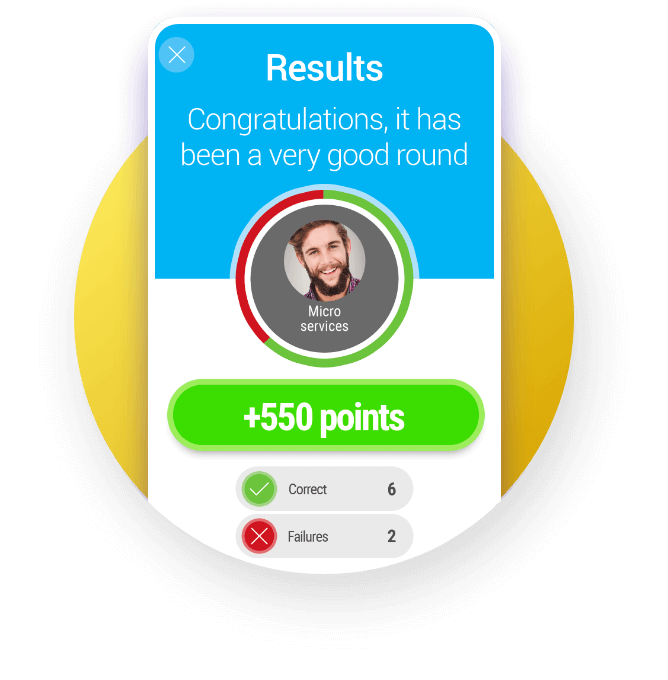


Transform your training into a unique experience
Discover how isEazy Game can transform your training content into attractive and effective games


Transform your training into a unique experience
Discover how isEazy Game can transform your training content into attractive and effective games