CASE STUDY
We helped AKRON Group to boost the skills development of its team

Brain
The first AI trained to teach

Author
The #1 AI-powered authoring tool on the market

Factory
Custom e-learning content factory

Skills
Comprehensive power skills course catalog

LMS
All-in-one LMS platform with AI

Engage
App for managing frontline teams
Product

What is Brain?
Everything you need to know about the first AI trained to teach.

How does it work?
Adaptive, conversational, and contextual. That’s learning with Brain.

Security
Why your company’s knowledge never leaves your environment or trains other models.

Comparison
Discover what sets isEazy Brain apart from other AI solutions.

Frequently Asked Questions
Want to learn more? Find answers to all your questions about isEazy Brain here.
FEATURES

AINew
Unlock your full potential and speed up course creation with artificial intelligence.

Accessibility
Automatically meet accessibility guidelines—without sacrificing interactivity!

Interactivity
Boost engagement with interactive, ready-to-use activities that make learning fun.

Course Creation
Reduce the time it takes to create your e-learning courses with our authoring tool.

Distribution
We offer you different distribution options, so that nothing can stop you.

SCORM
Publish your course in SCORM format and share it on any LMS.
SERVICES

Instrucional Design
Surprise your students with multimedia and interactive content.

Custom Courses
We create e-learning courses for you—tailored to your needs and hassle-free!

Virtual Reality
Turn learning into an immersive experience.

Custom Avatars
Give your courses and videos a unique touch with personalized avatars.

Audiovisual FactoryNew
Turn training into something dynamic and visual with engaging videos.
CATALOG

Course catalog
Over 600 skills and competency courses to help you adapt to your team's needs.
Microsoft Copilot AcademyNew
Your professionals will learn how to apply Copilot AI to key processes within your organization.

Artificial Intelligence Academy
Train your teams in the practical use of AI to boost productivity and innovation in your company.

Cybersecurity Academy
Capacita a tu empresa con el catálogo más completo en seguridad digital corporativa.
FEATURES

Learning platform
Manage all your training from one place

Analitycs
Measure the impact of your training

Learning Experience
Offer a unique learning experience to your team
Content Library
Choose from hundreds of expert-created courses
Authoring Tool
Create your own content—faster than ever

Use cases
Choose the solution that best fits your needs

Industries
Solutions for all types of industries
USE CASES

Onboarding
Facilitate the onboarding process, productivity and engagement of your new employees.

Upskilling
Boost your team's skills and prepare them for the challenges of the future with upskilling.

Microlearning
Discover all the advantages of microlearning and boost your training results.

Gamification
Enjoy addictive training that will get your professionals hooked.

Internal Communication
Improve communication in your company and enjoy an aligned and committed team.

Mobile learning
Agile, flexible, and interactive learning—built for today’s digital-first workforce.
INDUSTRIES

Banking and financial services
Training in compliance, cybersecurity, customer service, and key skills development.

Pharmaceuticals and healthcare
Digital onboarding, regulatory updates, and ongoing training for healthcare staff.

Retail and consumer
Agile and scalable training for in-store, operational, and customer service teams.

Industry and manufacturing
Training in processes, safety, and corporate culture for distributed teams.

Education and training
Digital solutions for training centers, internal academies, and corporate universities.

Technology and telecommunications
Development of technical talent, digital skills, and upskilling and reskilling programs.
CLIENTS

MAPFRE
How MAPFRE turn e-learning into sales with isEazy

Pepco
A personalised learning experience for a growing team.

BBVA
Digitisation and creation of high quality e-learning content.

Shiseido
We increase the engagement of the training with a social and gamified app.

Telefónica
Large-scale reskilling for the company's digital transformation.

Vodafone
A personalised learning experience for a growing team.
More than 1,000 companies already rely on isEazy.





MEET ISEAZY

Events
Discover our upcoming events and connect with the future of e-learning.

News
Find out the latest news about isEazy: press releases, partnerships, updates...

Contact
Leave us your personal details and we will contact you as soon as possible.
About isEazyNew
Find out more about our company.

Careers
We are looking for the best talent, join our team!

Partners
Become our partner and grow your business.
INTERESTING RESOURCES

Blog
The best content on e-learning: trends, tools and key strategies.

Whitepapers
Gain valuable insights and stay ahead of industry trends.

Product releases
The latest news and releases of our e-learning products and solutions.

Glossary
Definitions of the most commonly used terms and key industry concepts.

Guides
Discover the best step-by-step tips and tricks to optimize your L&D strategy.

Webinars
Video sessions on our products, trends and more

Comparatives
Compare e-learning solutions available on the market and choose the most suitable one.


WEBINAR
Master AI in isEazy Author in under an hour.




May 8, 2026

CONTENT CREATED BY:

Table of contents
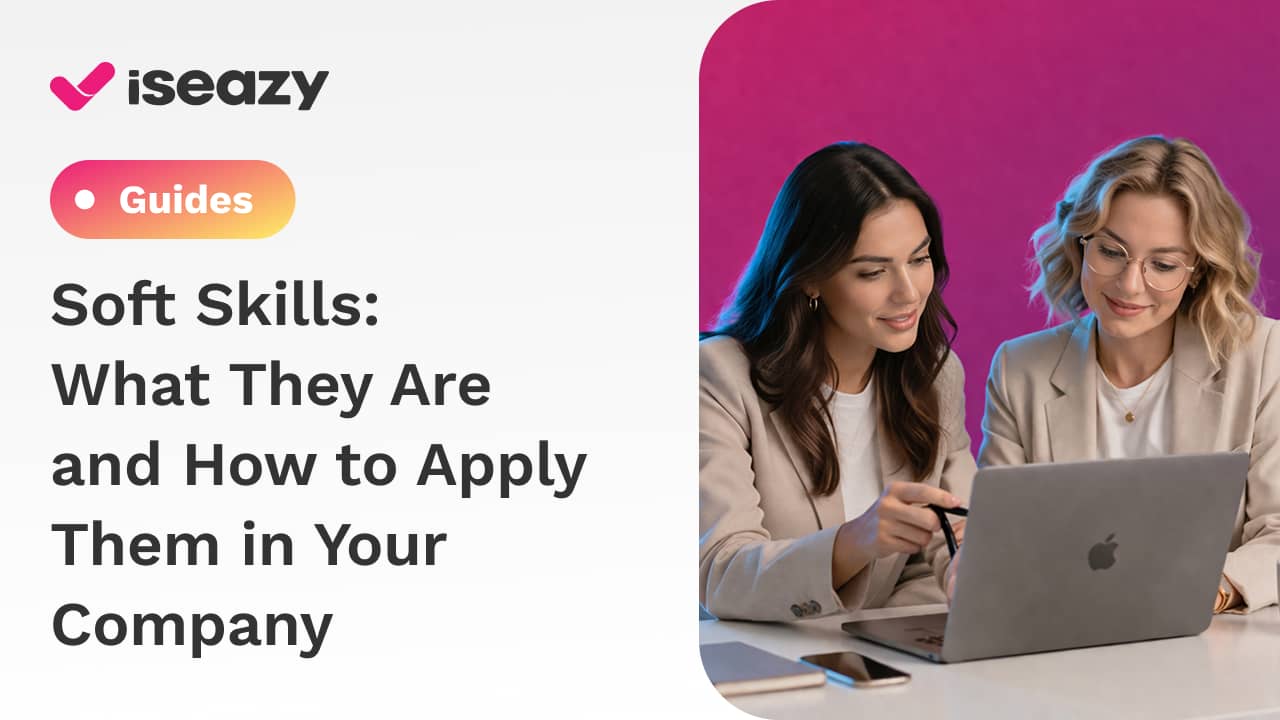
Soft skills — or interpersonal skills — are the personal, social, and emotional competencies that shape how we work, relate to others, and make decisions. Unlike technical knowledge, they can’t be learned from a manual: they develop through practice, reflection, and the right environment.
Soft skills are cross-functional competencies that directly influence performance, collaboration, and adaptability in professional settings. They range from emotional intelligence and effective communication to leadership, problem-solving, and time management.
The term “soft” doesn’t mean “easy” — it means they’re not role-specific; they apply across any position or industry. That’s precisely why, while hard skills become obsolete, soft skills grow more valuable over time.
Although there’s no single universal list, soft skills span three broad competency areas:
What’s the difference between having technical knowledge and being able to apply it effectively in a real team? Exactly that: soft skills. To better understand the necessary balance, this article by NestorUp on technical skills vs soft skills explains it clearly.
According to the World Economic Forum Future of Jobs 2025 report, 70% of employers consider collaboration and communication skills among the most critical for the next five years. The LinkedIn Workplace Learning Report 2024 reinforces this: analytical thinking and resilience are the most sought-after competencies in global hiring processes.
In the corporate environment, soft skills directly impact:
Because work has changed. Today’s environments are more volatile, collaborative, and digital than ever. Automation has eliminated much of the repetitive work, and what remains — creating, coordinating, deciding, persuading, adapting — requires precisely the skills no machine can replicate.
Moreover, organisations now operate through cross-functional projects, distributed teams, and flatter hierarchies. In that context, knowing how to collaborate, communicate, and lead without formal authority is an operational competency, not a nice-to-have on a CV.
A decade ago, standing out in soft skills was a bonus. Today it’s a filter. According to the WEF Future of Jobs Report 2025, six of the ten most in-demand skills are soft skills: analytical thinking, resilience, flexibility, motivation, curiosity, and lifelong learning orientation.
The direct implication for L&D teams: training in technical knowledge alone is no longer enough. Soft skill development must occupy a central place in any corporate learning strategy.
Hard skills are technical, measurable, and role-specific (speaking English, coding in Python, managing spreadsheets). Soft skills are cross-functional, harder to measure, and applicable in any professional context.
The best way to think about it: hard skills get you in the door; soft skills determine how far you go once you’re inside. In practice, the balance between the two defines real professional performance. For a deeper analysis, read our post on hard skills vs soft skills.
| Dimension | Hard Skills | Soft Skills |
|---|---|---|
| Nature | Technical and role-specific | Cross-functional, applicable in any context |
| How acquired | Formal training, certifications | Experience, feedback, mentoring, experiential learning |
| How measured | Technical tests, exams, certificates | 360° reviews, observation, assessment centres |
| Obsolescence | High: technology replaces or modifies them | Low: grow more valuable with experience |
| Examples | Excel, Java, financial analysis | Communication, resilience, empathy, critical thinking |
Not all soft skills are equally critical across every role. Here are the most relevant ones by function within the organisation:
| Role | Key soft skills | Why they matter |
|---|---|---|
| Manager / team leader | Leadership, communication, conflict management | Coordinates people and results without direct technical authority |
| Sales / commercial | Negotiation, empathy, active listening | Success depends on the client relationship |
| HR / L&D | Communication, influence, systems thinking | Designs experiences that impact the entire organisation |
| Operations / logistics | Problem-solving, adaptability, teamwork | High-pressure environments with constant change |
| Technical / specialist | Critical thinking, collaboration, time management | Must translate technical complexity into business value |
Most L&D organisations group soft skills into five major categories:
These govern how we relate to others: effective communication, active listening, empathy, negotiation, conflict management, and building trust. Essential in leadership, customer-facing, and team-based roles.
These enable effective planning, prioritisation, and execution: time management, decision-making, results orientation, problem-solving, and strategic thinking. Critical in management and project leadership roles.
These involve the ability to learn from experience: critical thinking, self-awareness, capacity to give and receive feedback, and openness to continuous learning. They are the engine of sustainable professional development.
These determine how people approach work and change: proactivity, initiative, resilience, realistic optimism, and intrinsic motivation. In volatile environments, they make the difference between adapting or falling behind.
These enable people to work effectively within complex structures: cross-departmental collaboration, cultural awareness, adapting to norms and processes, and internal customer orientation. Especially relevant in global or matrix organisations.
According to the LinkedIn Workplace Learning Report 2024 and the WEF Future of Jobs 2025, these are the soft skills organisations value most today:
The ability to perform effectively in changing environments is the most cited skill by talent managers in 2024. It’s not just about “accepting change” — it’s about anticipating it, learning quickly, and maintaining performance as the context shifts.
Analysing information, questioning assumptions, and reaching well-founded conclusions is increasingly valued in a data-saturated environment. Critical thinking separates professionals who make solid decisions from those who act on intuition.
Communicating clearly — verbally and in writing, in person and remotely — is a cross-functional competency that impacts every area. In distributed teams, asynchronous written communication has become a core professional skill.
No longer exclusive to managers. Leadership understood as the ability to influence, motivate, and guide others towards a shared goal is a soft skill increasingly expected at every level of the organisation.
Identifying the real problem (not just the symptom), proposing creative solutions, and executing them with limited resources. One of the most cited competencies in job postings across high-complexity sectors.
Collaborating across diverse environments, different roles, and often at a distance requires skills far beyond “getting along well”: managing expectations, shared accountability, coordination, and managing interdependence.
The ability to identify, understand, and manage one’s own emotions — and those of others — is a reliable predictor of performance and effective leadership. According to the Consortium for Research on Emotional Intelligence in Organizations, leaders with high EI have teams with 20% higher engagement.

Assessing soft skills is more complex than measuring a technical certification, but it’s entirely achievable. Here are the most effective methodologies for L&D managers:
To explore the criteria and measurement tools in depth, this post on soft skills assessment analyses each method in detail.
Developing soft skills doesn’t happen in a two-hour course. It requires a sustained strategy over time, combining formal and informal learning, embedded in the real workflow.
The first requirement isn’t a programme — it’s an environment. Organisations that make the most progress in soft skills are those where feedback is continuous, mistakes are treated as learning opportunities, and leadership models the behaviours it asks for. Without the right culture, any training is just a plaster.
Mentoring and coaching are among the most effective formats for soft skill development. The reason: they generate reflection on one’s own behaviour — something no e-learning content can do alone. A well-designed mentoring programme combines structured conversations, regular feedback, and measurable behavioural objectives.
The most effective learning happens at work, not away from it. Real situations — presentations, negotiations, conflict management, project leadership — are development opportunities when accompanied by structured reflection and feedback. The 70-20-10 model remains a useful guide: 70% of development comes from direct experience.
Structured training complements experience. The most effective formats for soft skills combine multiple approaches: microlearning to reinforce concepts at the right moment, blended learning to combine autonomous reflection with group practice, and gamification to boost engagement and retention.
To learn how to apply microlearning specifically to soft skill development, see this article on microlearning for soft skills.
An effective soft skills development plan has five phases:
To integrate this plan into a broader skills transformation strategy, this post gives you the complete framework.
Most soft skills programmes fail not for lack of budget, but because of how they’re designed. Here are the most common mistakes — and how to avoid them:
Grupo AKRON is a clear example of how a well-designed online training strategy can generate measurable results. With isEazy Skills, they launched an upskilling and reskilling programme that reached their entire workforce — driving competency development at scale across the organisation. Find out how they did it →
One of the biggest barriers to investing in soft skills is the difficulty of demonstrating return. But it is measurable — if you use the right indicators.
Behavioural indicators (Kirkpatrick Level 3): are employees applying what they’ve learned? Measured through direct observation, 360° reviews, and manager interviews.
Results indicators (Level 4): is the behaviour change generating outcomes? Some examples:
Recommended framework: the Kirkpatrick model complemented by the Phillips ROI Methodology, which adds the step of converting results into monetary value and comparing it against programme costs.
To explore the differences between hard and soft skills from the perspective of measurement and business impact, read our analysis of hard skills vs soft skills: what matters most.
The L&D field evolves quickly, and the formats for developing soft skills are no exception. Here are the trends having the most impact in 2024-2025:
Professionals no longer want to wait for a scheduled company training to access the knowledge they need. On-demand learning — with content accessible at the right moment, from any device — has become the expected standard. Skills platforms that combine curated catalogues with personalised pathways let each employee take ownership of their own development.

Microlearning is one of the most effective formats for soft skills because it respects how the brain actually learns: in small doses, frequently, and connected to real context. Pieces of 3-7 minutes, immediately applicable, generate far more impact than 2-hour sessions disconnected from daily work. Combined with spaced repetition, it combats the forgetting curve in a proven way. You can explore how to apply this methodology in our article on microlearning for soft skill development.

Blended learning combines autonomous digital learning with synchronous sessions (in-person or virtual) for discussion, practice, and feedback. Particularly effective for soft skills because it allows individual reflection first and group practice second — the most complete format for changing behaviour.
Applying gamification elements to soft skills training — challenges, badges, leaderboards, narratives — increases participant engagement and motivation. Especially useful for building competencies like strategic thinking, decision-making under pressure, or collaboration.

Every employee starts from a different level, has their own learning style, and needs to work on different competencies. Personalised learning — through prior diagnostics, adaptive pathways, or AI — makes it possible to design experiences that genuinely impact each individual, not just the statistical average of the team.
Podcast as a learning tool has gained ground in soft skills programmes. Its advantage: consumed any time (commuting, exercising, household tasks) and its conversational format is particularly suited to topics like leadership, communication, or emotional intelligence. More and more organisations are incorporating corporate podcasts as part of their learning offering.

The term “soft skills” is progressively being replaced by “power skills” — a name that better reflects reality: these competencies are not a soft add-on to a professional profile; they are the core of sustainable performance in any organisation.
The name change matters because it shifts perception. Calling them “power skills” means recognising that communication, leadership, or resilience aren’t secondary skills — they’re the ones that generate the most business impact when developed systematically.
To understand where these competencies are heading in the corporate world, explore the trends in soft skills transforming corporate training.
To make it easier to implement a soft skills development plan, you can use templates including: a competency diagnostic matrix by role, a behavioural objectives sheet per skill, and a simplified 360° assessment template.
There are several platforms on the market that help develop soft skills in corporate environments. Here’s a comparison of the most relevant ones so you can choose the solution that best fits your team’s needs:

Features
Benefits
Ratings
Specialized Schools
Features
Benefits
Ratings
Specialized Schools

Features
Advantages
Ratings
Features
Advantages
Ratings

Features
Advantages
Ratings
Features
Advantages
Ratings
isEazy Skills is a catalogue of over 300 power skills courses designed specifically for corporate environments: leadership, communication, time management, emotional intelligence, teamwork, and many more. The courses are short, interactive, and combine microlearning with gamification to maximise engagement and on-the-job transfer.
Want to see it in action? Request a free isEazy Skills demo and discover how it can transform skill development in your organisation.
Soft skills, or interpersonal skills, are a set of personal and social competencies that enable people to interact effectively with others. They include communication, teamwork, leadership, emotional intelligence, and problem-solving abilities — and they apply across every role and industry.
Soft skills are critical in today’s workplace because they complement technical expertise and drive professional success. Strong soft skills help you collaborate more effectively, communicate clearly, lead with confidence, and adapt to an ever-changing work environment.
Common examples of soft skills include effective communication, teamwork, empathy, adaptability, conflict resolution, creativity, and critical thinking. Discover how to develop these and many more with isEazy Skills — the most complete power skills course catalogue for corporate teams.
Improving your soft skills requires practice, self-awareness, and consistent feedback. Take part in structured training programmes, seek regular feedback from peers and managers, and use online learning tools. isEazy Skills offers an extensive catalogue of interactive, role-based courses designed to help you strengthen your soft skills effectively.
Yes — soft skills can have a significant impact on your career. They help you communicate more persuasively, solve problems creatively, lead teams with empathy, and work efficiently across departments. According to LinkedIn, 92% of talent professionals consider soft skills equally or more important than technical skills when hiring.
Absolutely. Online platforms like isEazy Skills offer a wide range of interactive courses that make it easy to develop soft skills at your own pace. From leadership and communication to emotional intelligence and critical thinking, you can build the competencies your organisation needs — anytime, anywhere.

Enhance your team's skills with isEazy Skills
Discover how isEazy Skills can transform your team’s skills with high-impact courses


WHITEPAPER
Discover the power skills that will transform your company
Download whitepaper
Enhance your team's skills with isEazy Skills
Discover how isEazy Skills can transform your team’s skills with high-impact courses