CASE STUDY
We helped STF Group achieve an 87% completion rate in its leadership program

Brain
The first AI trained to teach

Author
The #1 AI-powered authoring tool on the market

Factory
Custom e-learning content factory

Skills
Comprehensive power skills course catalog

LMS
All-in-one LMS platform with AI

Engage
App for managing frontline teams
FEATURES

AINew
Unlock your full potential and speed up course creation with artificial intelligence.

Accessibility
Automatically meet accessibility guidelines—without sacrificing interactivity!

Interactivity
Boost engagement with interactive, ready-to-use activities that make learning fun.

Course Creation
Reduce the time it takes to create your e-learning courses with our authoring tool.

Distribution
We offer you different distribution options, so that nothing can stop you.

SCORM
Publish your course in SCORM format and share it on any LMS.
SERVICES

Instrucional Design
Surprise your students with multimedia and interactive content.

Custom Courses
We create e-learning courses for you—tailored to your needs and hassle-free!

Virtual Reality
Turn learning into an immersive experience.

Custom Avatars
Give your courses and videos a unique touch with personalized avatars.

Audiovisual FactoryNew
Turn training into something dynamic and visual with engaging videos.
CATALOG

Course catalog
Over 600 skills and competency courses to help you adapt to your team's needs.
Microsoft Copilot AcademyNew
Your professionals will learn how to apply Copilot AI to key processes within your organization.

Artificial Intelligence Academy
Train your teams in the practical use of AI to boost productivity and innovation in your company.

Cybersecurity Academy
Capacita a tu empresa con el catálogo más completo en seguridad digital corporativa.

Use cases
Choose the solution that best fits your needs

Industries
Solutions for all types of industries
USE CASES

Onboarding
Facilitate the onboarding process, productivity and engagement of your new employees.

Upskilling
Boost your team's skills and prepare them for the challenges of the future with upskilling.

Microlearning
Discover all the advantages of microlearning and boost your training results.

Gamification
Enjoy addictive training that will get your professionals hooked.

Internal Communication
Improve communication in your company and enjoy an aligned and committed team.

Mobile learning
Agile, flexible, and interactive learning—built for today’s digital-first workforce.
INDUSTRIES

Banking and financial services
Training in compliance, cybersecurity, customer service, and key skills development.

Pharmaceuticals and healthcare
Digital onboarding, regulatory updates, and ongoing training for healthcare staff.

Retail and consumer
Agile and scalable training for in-store, operational, and customer service teams.

Industry and manufacturing
Training in processes, safety, and corporate culture for distributed teams.

Education and training
Digital solutions for training centers, internal academies, and corporate universities.

Technology and telecommunications
Development of technical talent, digital skills, and upskilling and reskilling programs.
CLIENTS

MAPFRE
How MAPFRE turn e-learning into sales with isEazy

Pepco
A personalised learning experience for a growing team.

BBVA
Digitisation and creation of high quality e-learning content.

Shiseido
We increase the engagement of the training with a social and gamified app.

Telefónica
Large-scale reskilling for the company's digital transformation.

Vodafone
A personalised learning experience for a growing team.
More than 1,000 companies already rely on isEazy.


MEET ISEAZY

Events
Discover our upcoming events and connect with the future of e-learning.

News
Find out the latest news about isEazy: press releases, partnerships, updates...

Contact
Leave us your personal details and we will contact you as soon as possible.
About isEazyNew
Find out more about our company.

Careers
We are looking for the best talent, join our team!

Partners
Become our partner and grow your business.
INTERESTING RESOURCES

Blog
The best content on e-learning: trends, tools and key strategies.

Whitepapers
Gain valuable insights and stay ahead of industry trends.

Product releases
The latest news and releases of our e-learning products and solutions.

Glossary
Definitions of the most commonly used terms and key industry concepts.

Guides
Discover the best step-by-step tips and tricks to optimize your L&D strategy.

Webinars
Video sessions on our products, trends and more

Comparatives
Compare e-learning solutions available on the market and choose the most suitable one.


November 20, 2026

CONTENT CREATED BY:

Table of contents
Almost every company that builds individual development plans builds them badly, and almost always for the same reason: the objective is written in a way that makes it impossible to tell whether it has been met. “Improve leadership”, “be more proactive”, “communicate better”. They sound reasonable and they cannot be evaluated.
This guide gives you the opposite: what an IDP is exactly and how it differs from the company training plan, the seven fields it must contain, how to write an objective that does work —with the evidence behind it—, a ready-to-copy template, three worked examples by profile and how to measure whether it is doing any good.
An individual development plan is a written agreement between a person and their manager about which specific capability they are going to develop, how, with what support and within what timeframe. It usually covers between three and twelve months, and it gets reviewed along the way.
What sets it apart from any other conversation about development is that it can be closed: when the date arrives, there is an agreed way of saying whether it has been achieved or not. If your IDP does not allow that, it is not a plan, it is an intention.
Three common confusions, and all three do damage:
They are two levels of the same system, not two names for the same thing. The company training plan answers what the organization needs; the IDP answers what this person needs. The first is decided once a year in committee; the second is agreed in an office, one person at a time.
If you want the collective level in detail, we cover it in employee development plans. Here we stay at the individual level:
| Company training plan | Individual development plan | |
|---|---|---|
| Who it covers | Groups: a department, a role, the whole workforce. | A single person, by name. |
| Where it comes from | From business strategy and aggregated needs analysis. | From a specific gap observed in the role and from that person's goals. |
| Who decides it | HR and management, usually once a year. | The person and their manager, in conversation, reviewed during the year. |
| What it contains | Programs, budget, calendar and suppliers. | An objective, development actions, evidence, deadlines and agreed support. |
| How it is measured | Coverage, participation, cost per employee and aggregate impact. | Whether the specific behavior has changed and the agreed evidence exists. |
| What happens if it fails | Next year's catalog is adjusted. | It is rebuilt with that person, usually because the objective was badly written. |
The usual argument is retention, and it has backing: according to LinkedIn’s Workplace Learning Report, 94% of employees say they would stay longer at a company that invested in their professional development. It is worth quoting it with its date —it is the 2018 report, even though it circulates as if it were from any year— and worth remembering that it is a statement of intent, not an observed behavior.
More interesting for whoever is about to write the plan is the Gallup finding on where to put the focus. Among employees whose manager focuses on their strengths, 67% are engaged. Among those whose manager focuses on their weaknesses, the figure drops to 31%.
That does not mean ignoring shortcomings: it means that an IDP built only on what someone does badly is twice as likely to demotivate as to develop. The sensible split is one gap to correct and one strength to take further, not a list of defects.
An IDP that works fits on one page. These are the essential fields, with the mistake people make in each one:
| Field | What it is for | Typical mistake |
|---|---|---|
| Gap | Describes what happens today in the role, with an observable fact. | Writing a label ("little initiative") instead of a fact ("does not propose improvements in team meetings"). |
| Objective | Defines the level to be reached and by when. | Writing "improve X". Without a level and without a date there is no objective. |
| Why it matters | Connects the objective with the role, the team or the person's career. | Leaving it out. It is what sustains the effort when a busy quarter arrives. |
| Development actions | What they are specifically going to do: assignments, coaching, training. | Reducing it to "take a course" and considering the plan closed. |
| Evidence | What will be visible on the date to say it has been achieved. | Confusing evidence with attendance: having taken the course is not having changed. |
| Support and deadlines | What the manager contributes, what time and budget there is, and on which dates it is reviewed. | Leaving the support implicit. If it is not written down, it does not happen. |
| Review | The dates on which progress is checked and whatever is needed gets adjusted. | A single final review, when there is no margin left to correct anything. |
Before writing anything, answer this: what exactly have you seen that makes you think this plan is needed? The answer has to be a fact that someone else could have observed too.
“They lack leadership” is not one. “In the last three incidents on their team they waited for me to decide” is one. The difference is not stylistic: the first cannot be resolved because nobody knows what would have to change; the second points straight at what needs training.
Useful sources for finding that gap: the training evaluation already carried out, follow-up conversations, feedback from colleagues and internal customers, and a skills taxonomy if your organization has one, because it gives you the vocabulary to name the same thing consistently across departments.
This is the step where it is decided whether the IDP will be good for anything, and there are sixty years of research explaining why. The reference work is Locke and Latham (2002), published in American Psychologist, which summarizes thirty-five years of studies on goal setting.
Their two central findings apply directly to an IDP. First: difficult goals produce more effort and better performance than easy ones, with effect sizes of between .52 and .82 in meta-analyses, and performance only stops rising when the limit of ability is reached or when the person abandons their commitment. Second, and this is the one that will serve you most: specific and difficult goals consistently outperform the typical “do your best”, with effects of between .42 and .80.
Translated into your template: replace the vague verb with an observable behavior, a level and a date.
And a warning that follows from the same work: difficult is not impossible. The effect disappears when the person stops believing they can achieve it. If, while agreeing the objective, you see there is no real commitment, bring it down a level; an accepted and demanding objective delivers more than an ambitious one abandoned in February.
This is where almost everyone applies the 70-20-10 split. In the next section you will see why you should not, but the alternative is simple: the type of action is decided by the type of gap.
Most soft skills gaps mix all three, and that is why an IDP with only a course inside almost never changes anything. An example of this split applied at scale: STF Group, the Colombian fashion group that owns brands such as Studio F, strengthened its teams’ performance by combining catalog training with continuous follow-up instead of isolated actions.
CASE STUDY
We helped STF Group achieve an 87% completion rate in its leadership program


The evidence is the answer to “what will we see that we do not see today?”. It has to be written down before starting, because agreeing it afterwards means agreeing it knowing the outcome.
These work: a finished deliverable, a task that used to be escalated and is now resolved alone, a specific third-party rating, an indicator from the role. These do not: having attended something, having read something, “they seem more confident”.
On timing, the pattern that works best is reviewing at 30, 60 and 90 days. Not through any magic in the number, but because thirty days is enough to detect that the plan is not being executed and early enough to correct it without having lost the quarter. A single review at the end only serves to certify failure.
An IDP that only lists the person’s tasks is a homework list. What turns it into an agreement is the other side: how many follow-up meetings, which assignments will be delegated, what budget and what protected hours there are, who that person will be introduced to.
If that column is empty, the plan will fail and nobody will know why. It is also the part that connects the IDP with team engagement: what people remember is not the course, it is that their manager set aside time for them.
At each review there are three possible exits and it is worth naming them: on track, needs adjusting —the objective was too high, the role changed, the support was missing— or needs stopping, because the priority is now something else. Stopping in time and saying so is better than dragging a dead plan to December.
And when closing, decide explicitly what comes next. An IDP closed with no next step is the fastest way to make sure the next one is not taken seriously. This is where the IDP links up with continuous training: it stops being an annual formality and becomes a cycle.

Practically every IDP guide you will find recommends splitting development into 70% on-the-job experience, 20% learning from others and 10% formal training. It is presented as an established fact. It is not.
The model comes from research in the eighties on how around 190 managers described, from memory, the episodes that had shaped their careers. It was neither a study on learning in general, nor did its authors put it forward as a recipe: the proportions were indicative. The Learning & Teaching portal of the University of Twente sums it up bluntly: 70-20-10 is a convincing story, but not a model with a scientific basis.
And when someone has tried to measure it, the result has not looked the same. The only empirical study usually cited on the matter (Enos et al., 2003) found a very different split:
| Learning route | What the 70-20-10 model says | What Enos et al. (2003) measured |
|---|---|---|
| On-the-job experience | 70% | 16% |
| Learning from other people | 20% | 44% |
| Formal training | 10% | 30% |
That study also has limits —84 managers from a single company, and self-reported data—, so it is not the good figure that replaces the bad one. That is exactly the point: there is no good figure. What there is is a useful reminder, which is that people learn on the job and from their colleagues, not only in a classroom.
The practical consequence for your IDP is the one we have already seen: do not split percentages, choose each action according to what that person is missing. If the gap is in regulatory knowledge, 10% formal training is a mistake; if it is in judgment, twenty hours of course will not solve it.
Copy this table and fill it in during the conversation, not before. An IDP written by the manager alone and handed over finished is complied with far less than one agreed at the table.
| Field | What to write |
|---|---|
| Person and role | Name, current role and owner of the plan. |
| Period | Start and end date. Between 3 and 12 months. |
| Observed gap | A specific fact seen in the role, not a label. |
| Strength being leveraged | What this person does well that the plan is going to use. |
| Objective | Observable behavior, level to be reached and date. |
| Why it matters | What improves in the role, the team or their career if it is achieved. |
| Development actions | Real assignments, coaching and training. Each with dates. |
| Evidence of achievement | What will be visible on the last day to say it is achieved. |
| Manager's commitment | Meetings, delegation, budget and protected hours. |
| Reviews | Dates at 30, 60 and 90 days, with the name of whoever calls them. |
| Closing outcome | Achieved, partial or stopped, with the reason and the next step. |
One piece of advice about the format: keep it to a single page and somewhere both of you can open it. An IDP that lives in a document only the manager has stops existing after two weeks.
And if you are also putting together the year’s training calendar and want to fit the IDPs inside it, we have a template ready for that:
TEMPLATE
2026 Training Calendar
12 months, 12 key courses to develop the skills your team needs.
Download calendar
Generic examples do not help, so these are complete and with the objective written the way it should be written.
| Field | IDP content |
|---|---|
| Observed gap | Closes deals of up to €15,000 well, but in the four proposals above €50,000 in the last half-year never got as far as presenting to the client committee. |
| Strength being leveraged | Excellent relationship with technical contacts: the one who secures the most follow-up meetings on the team. |
| Objective | Present and defend two proposals above €50,000 single-handedly to the client's management committee before June 30, with at least one advancing to the negotiation stage. |
| Actions | Shadow the sales director in three large presentations (February-March). Complex negotiation course from the catalog (March). Prepare and rehearse the two proposals with the manager (April-May). |
| Evidence | The two presentation minutes and the status of the opportunities in the CRM on June 30. |
| Manager's commitment | Hands over the two large accounts, joins three presentations and sets aside one hour every fortnight for preparation. |
| Field | IDP content |
|---|---|
| Observed gap | In the last three team incidents they resolved it themselves instead of assigning it, and they are the only one signing the weekly reports since taking the role. |
| Strength being leveraged | Deep technical knowledge of the process: the person the whole team asks. |
| Objective | Two people on the team resolve level 2 incidents autonomously and sign the weekly report on rotation, consistently during May and June. |
| Actions | Document the level 2 procedure with the team (March). Training in delegation and feedback (April). Rotation of the report signature from May, with their review before sending only for the first two weeks. |
| Evidence | The May and June incident log with the owner of each one, and the eight weekly reports signed on rotation. |
| Manager's commitment | Does not answer the team’s questions directly during the period: redirects them. Fortnightly review of how the rotation is going. |
This case matters because many IDPs assume that growing means managing people. Not always.
| Field | IDP content |
|---|---|
| Observed gap | Resolves assigned tasks very well, but does not take part in architecture decisions and nobody outside their team knows their judgment. |
| Strength being leveraged | Generates the fewest production incidents on the team and documents better than anyone. |
| Objective | Technically lead the migration of the billing module before September 30: write the proposal, defend it before the technical committee and support its rollout. |
| Actions | Joint review of two past architecture decisions with the reference architect (April). Systems design training (May). Draft the proposal with prior review (June). |
| Evidence | The proposal document approved in the technical committee minutes and the migration in production. |
| Manager's commitment | Includes them in the technical committee from April and frees up 20% of their workload during June and July. |
These six explain most of the plans that do not make it to December:
| Mistake | Why it happens | How to fix it |
|---|---|---|
| An objective impossible to evaluate | The language of the competency dictionary gets copied, and that dictionary is written to classify, not to act. | Rewrite it as observable behavior, with level and date, before signing anything. |
| The plan is only a course | It is the easiest action to approve and to justify in the budget. | Add at least one real assignment. If the gap is about practice, the course alone does not close it. |
| Built only on weaknesses | The conversation comes out of a review with a corrective tone. | Always include a strength that the plan takes further. |
| No written commitment from the manager | It is taken for granted that they will support it. | A column of its own with meetings, delegation, budget and protected hours. |
| A single review, at the end | Reviewing gets confused with evaluating. | Reviews at 30, 60 and 90 days, with adjusting or stopping on the table as options. |
| Attendance is measured, not change | It is the figure the platform gives with no extra work. | Agree the evidence at the start and look at it at the close, alongside completion. |
Measure at two levels and do not mix them. The individual plan level answers whether this person has changed; the aggregate level answers whether the IDP system is good for anything in your organization.
In the plan: the agreed evidence —the main criterion—, the percentage of actions executed on time and the number of reviews that actually took place. That last one is the best early predictor: a plan that loses its second review almost never gets closed.
Across the board: how many IDPs are closed against those opened, how many close as achieved, and the voluntary turnover and internal promotion of those who had a plan against those who did not. For training impact as such, the framework is in our guide to training evaluation, and for the performance side, in the one on employee performance.

The operational part —who has done what, when and with what result— should come out of the platform on its own, because if it has to be compiled by hand it does not get compiled. That is what happened to Pepco, the fashion and homeware chain with more than 4,000 stores across 18 countries: its Iberian subsidiary, with around 3,000 employees and weekly store openings, took the completion rate from 27% to almost 84% and cut the time spent preparing follow-up reports by 70%.
If you take a single idea from the whole guide, let it be this: the quality of an individual development plan is decided in the objective line. Everything else —the actions, the template, the reviews— is execution of that line. Written as a label, the plan cannot be closed; written as an observable behavior with a level and a date, the plan almost manages itself.
And the second thing: do not split percentages. Choose each action according to what that person is missing, and make sure the manager has their own column of commitments. An IDP is an agreement between two people, not a homework list for one.
To put it into practice, you can lean on isEazy Skills, with more than 600 courses ready to develop skills such as leadership and communication, and on isEazy LMS, which makes it easy to assign courses and track learning results. That way you will have the training resources and the data you need to complement the individual reviews.
Want to make your team’s development easier? Request a demo and find out how to bring these solutions into your training strategy.
It is a written agreement between a person and their manager about which specific capability they are going to develop, through which actions, with what support and within what timeframe. It usually covers between three and twelve months and gets reviewed along the way. What sets it apart from any ordinary conversation about development is that it can be closed: when the date arrives, there is a way, agreed beforehand, of saying whether it has been achieved or not. If the plan does not allow you to answer that question, it is not a development plan, it is a statement of intent.
In the level they operate at. The training plan answers what the organization needs and is decided in committee, usually once a year, for groups: a department, a role or the whole workforce. The IDP answers what one specific person needs, comes out of a gap observed in their role and is agreed in conversation with their manager. They are also measured differently: the training plan by coverage, participation and cost per employee; the IDP by whether the agreed behavior has changed and the agreed evidence exists. They do not compete: the IDP is the individual level of the same system.
By replacing the vague verb with an observable behavior, a level and a date. Instead of “improve their communication skills”, something like “present the monthly results to the committee without the manager’s support in the April, May and June meetings, with an average rating of 4 out of 5”. The research by Locke and Latham, which summarizes thirty-five years of studies on goal setting, found that specific and difficult goals consistently outperform “do your best”, with effect sizes of between .42 and .80 in meta-analyses. The reason is that a vague goal has no external referent and each person defines it in their own way.
No, and it is worth knowing where it comes from before using it. The 70-20-10 split comes from research in the eighties in which around 190 managers described from memory the episodes that had shaped their careers; it was neither a study on learning in general nor did its authors put it forward as a recipe. The Learning & Teaching portal of the University of Twente describes it as a convincing story with no scientific basis, and the only empirical study usually cited on the matter measured a very different split. The practical thing is to choose each action according to the nature of the gap: formal training if knowledge is missing, real assignments if practice is missing and coaching if judgment is missing.
The pattern that works best is reviewing at 30, 60 and 90 days, and then at the close. Thirty days is enough time to detect that the plan is not being executed and early enough to correct it without having lost the quarter. At each review it is worth putting three possible exits on the table: on track, needs adjusting, or needs stopping because the priority has changed. Stopping a plan in time and saying so is better than dragging it to the end of the year. In fact, the number of reviews actually held is the best early indicator: a plan that loses its second review almost never gets closed.
No, and confusing the two is one of the most expensive mistakes. An individual development plan commits to developing a specific capability, with specific support and within a specific timeframe. It does not commit to a job, which also depends on the vacancy existing, on the business moment and on the comparison with other people. When the plan is implicitly presented as the prelude to a promotion, the day the promotion does not arrive you lose two things at once: the plan and trust in the process. The honest thing is to say from minute one what the plan opens up and what it does not.
At two levels, without mixing them. In the specific plan, the main criterion is the evidence agreed at the start: a finished deliverable, a task that used to be escalated and is now resolved alone, a third-party rating or an indicator from the role. To that you add the percentage of actions executed on time and how many reviews were genuinely held. Across the organization, the useful indicators are how many IDPs are closed against those opened, how many close as achieved and what difference there is in voluntary turnover and internal promotion between those who had a plan and those who did not. What does not work as a measure is attendance: having taken the course is not having changed.

Streamline your training management
Experience the power of AI in an LMS that has it all


Automate processes, access 600+ ready-to-use courses, or create your own content with the help of AI.
Request a demoContact us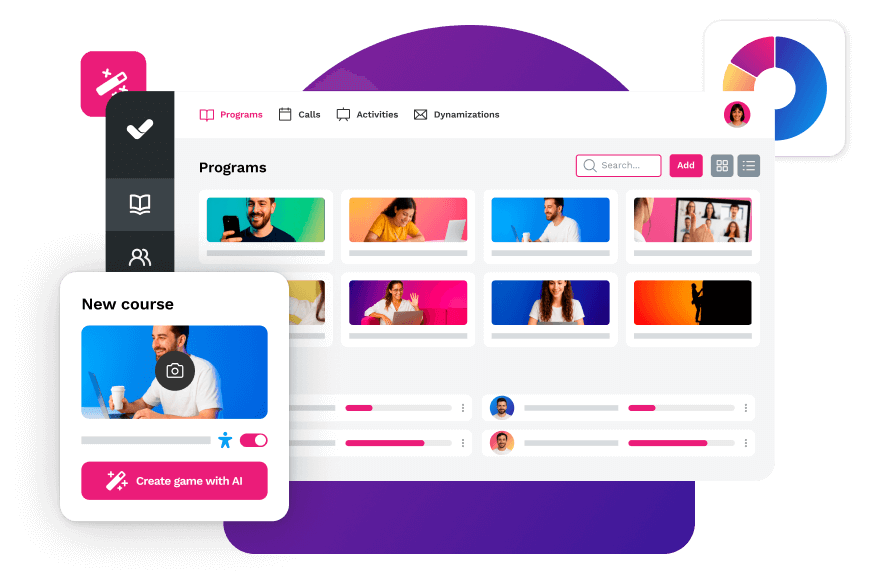
Streamline your training management
Experience the power of AI in an LMS that has it all