CASE STUDY
We boosted Shiseido’s training engagement with a social, gamified learning app.

Brain
The first AI trained to teach

Author
The #1 AI-powered authoring tool on the market

Factory
Custom e-learning content factory

Skills
Comprehensive power skills course catalog

LMS
All-in-one LMS platform with AI

Engage
App for managing frontline teams
Product

What is Brain?
Everything you need to know about the first AI trained to teach.

How does it work?
Adaptive, conversational, and contextual. That’s learning with Brain.

Security
Why your company’s knowledge never leaves your environment or trains other models.

Comparison
Discover what sets isEazy Brain apart from other AI solutions.

Frequently Asked Questions
Want to learn more? Find answers to all your questions about isEazy Brain here.
FEATURES

AINew
Unlock your full potential and speed up course creation with artificial intelligence.

Accessibility
Automatically meet accessibility guidelines—without sacrificing interactivity!

Interactivity
Boost engagement with interactive, ready-to-use activities that make learning fun.

Course Creation
Reduce the time it takes to create your e-learning courses with our authoring tool.

Distribution
We offer you different distribution options, so that nothing can stop you.

SCORM
Publish your course in SCORM format and share it on any LMS.
SERVICES

Instrucional Design
Surprise your students with multimedia and interactive content.

Custom Courses
We create e-learning courses for you—tailored to your needs and hassle-free!

Virtual Reality
Turn learning into an immersive experience.

Custom Avatars
Give your courses and videos a unique touch with personalized avatars.

Audiovisual FactoryNew
Turn training into something dynamic and visual with engaging videos.
CATALOG

Course catalog
Over 600 skills and competency courses to help you adapt to your team's needs.
Microsoft Copilot AcademyNew
Your professionals will learn how to apply Copilot AI to key processes within your organization.

Artificial Intelligence Academy
Train your teams in the practical use of AI to boost productivity and innovation in your company.

Cybersecurity Academy
Capacita a tu empresa con el catálogo más completo en seguridad digital corporativa.
FEATURES

Learning platform
Manage all your training from one place

Analitycs
Measure the impact of your training

Learning Experience
Offer a unique learning experience to your team
Content Library
Choose from hundreds of expert-created courses
Authoring Tool
Create your own content—faster than ever

Use cases
Choose the solution that best fits your needs

Industries
Solutions for all types of industries
USE CASES

Onboarding
Facilitate the onboarding process, productivity and engagement of your new employees.

Upskilling
Boost your team's skills and prepare them for the challenges of the future with upskilling.

Microlearning
Discover all the advantages of microlearning and boost your training results.

Gamification
Enjoy addictive training that will get your professionals hooked.

Internal Communication
Improve communication in your company and enjoy an aligned and committed team.

Mobile learning
Agile, flexible, and interactive learning—built for today’s digital-first workforce.
INDUSTRIES

Banking and financial services
Training in compliance, cybersecurity, customer service, and key skills development.

Pharmaceuticals and healthcare
Digital onboarding, regulatory updates, and ongoing training for healthcare staff.

Retail and consumer
Agile and scalable training for in-store, operational, and customer service teams.

Industry and manufacturing
Training in processes, safety, and corporate culture for distributed teams.

Education and training
Digital solutions for training centers, internal academies, and corporate universities.

Technology and telecommunications
Development of technical talent, digital skills, and upskilling and reskilling programs.
CLIENTS

MAPFRE
How MAPFRE turn e-learning into sales with isEazy

Pepco
A personalised learning experience for a growing team.

BBVA
Digitisation and creation of high quality e-learning content.

Shiseido
We increase the engagement of the training with a social and gamified app.

Telefónica
Large-scale reskilling for the company's digital transformation.

Vodafone
A personalised learning experience for a growing team.
More than 1,000 companies already rely on isEazy.





MEET ISEAZY

Events
Discover our upcoming events and connect with the future of e-learning.

News
Find out the latest news about isEazy: press releases, partnerships, updates...

Contact
Leave us your personal details and we will contact you as soon as possible.
About isEazyNew
Find out more about our company.

Careers
We are looking for the best talent, join our team!

Partners
Become our partner and grow your business.
INTERESTING RESOURCES

Blog
The best content on e-learning: trends, tools and key strategies.

Whitepapers
Gain valuable insights and stay ahead of industry trends.

Product releases
The latest news and releases of our e-learning products and solutions.

Glossary
Definitions of the most commonly used terms and key industry concepts.

Guides
Discover the best step-by-step tips and tricks to optimize your L&D strategy.

Webinars
Video sessions on our products, trends and more

Comparatives
Compare e-learning solutions available on the market and choose the most suitable one.


WEBINAR
Master AI in isEazy Author in under an hour.




July 23, 2026

CONTENT CREATED BY:

Table of contents
Only 10% of employees in Spain feel actively engaged with their work — the fourth lowest rate in Europe, according to Gallup’s State of the Global Workplace 2024 report. This figure has direct consequences: higher turnover, lower productivity, and a weaker customer experience. Improving employee engagement is not a wellbeing initiative; it is a strategic business lever. This guide covers what employee engagement really is, how to measure it, and which strategies actually work — with a particular focus on digital learning as an engine for sustained commitment.
Need a practical starting point? Check out our employee engagement tools comparison to find the solutions that best fit your organization.
The term employee engagement describes the degree of emotional, cognitive, and behavioral connection a person feels toward their organization. It is not the same as job satisfaction or workplace happiness, though the concepts are frequently confused:
This distinction matters because many organizations invest in wellbeing initiatives — breakout rooms, team events, bonuses — without moving the needle on genuine commitment. Engagement cannot be bought: it is built through clear purpose, consistent leadership, and real growth opportunities.
To fully understand what drives engagement, it is also useful to distinguish it from learner engagement: while employee engagement covers the full relationship between an employee and the organization, learner engagement focuses specifically on the level of involvement with learning programs. Both reinforce each other: training that genuinely hooks employees contributes directly to their overall organizational commitment.
The business impact of employee engagement is well documented. Some figures that illustrate it:
Beyond the numbers, engagement also impacts customer experience: engaged employees act as brand ambassadors, bring positive energy to every interaction, and are more likely to solve problems proactively. It also has a direct effect on employee performance management: when engagement rises, individual and collective performance improves in a sustained way.
For this reason, talent retention and engagement are deeply connected. Explore the implications further in our article on talent acquisition and retention strategies.

Gallup describes four employee profiles based on their level of commitment. Identifying them is the first step toward taking action:
They feel part of something bigger than their role. They show initiative, share knowledge, advocate for the employer brand, and go the extra mile without being asked. They are an organization’s most valuable asset — but also the most vulnerable to disengagement if neglected: when a high performer feels overlooked, their disconnection tends to be abrupt.
They do their job well but without passion or special involvement. They are not actively looking for another job, but they would not turn down a good offer. They represent the largest segment in most organizations and hold the greatest potential for improvement with targeted recognition and development interventions.
They do the minimum required. Their energy and attention are elsewhere. Common signals: arriving late to meetings, avoiding new projects, giving monosyllabic responses in reviews. They are often waiting for a reason to leave.
Not only are they uncommitted — they may actively work against the organization, generating a negative team climate, blocking initiatives, or spreading a negative image of the company. Identifying them early is critical to protecting organizational culture.
What doesn’t get measured can’t be improved. These are the most effective tools and methods for building a real picture of engagement across your organization:
The most widely used method. They can be annual (a comprehensive snapshot of organizational health) or quarterly / monthly pulse surveys (for continuous trend monitoring). The best surveys do not ask whether employees are “satisfied” — they ask whether they would recommend the company as a place to work, whether they see room to grow, or whether their work has a clear purpose. The Employee Net Promoter Score (eNPS) is a simple, comparable metric across periods.
When well designed, periodic performance reviews reveal engagement patterns: an employee who previously exceeded targets and now just meets them has probably lost motivation, not capability. Combining quantitative data (KPIs) with qualitative conversations gives the most complete picture.
Direct conversations — individual or in small groups — capture what surveys cannot: tone, unexpressed concerns, narratives circulating within the team. They are especially useful following major organizational changes or when quantitative data shows warning signs.
Voluntary attrition rate is one of the most objective engagement indicators available. If certain departments or employee profiles show significantly higher turnover, there is a localized engagement issue. Well-executed exit interviews add essential qualitative context.
Platforms that enable structured, continuous employee feedback provide real-time data that allows issues to be addressed before they escalate. The critical factor is that employees perceive their feedback generating real change — without that reciprocity, they stop responding honestly.

Voluntary participation rates in training, cross-functional projects, mentoring programs, or internal events are a reliable proxy for engagement level. An engaged employee participates; a disengaged one avoids any non-mandatory activity. For a broader view of available options, see our curated selection of employee engagement tools.

The table below summarizes observable signals and priority actions for each engagement profile — a useful starting point for a quick diagnostic:
| Engagement level | Observable signals | Priority action |
|---|---|---|
| High | Self-directed initiative, informal mentoring, employer brand advocacy | Recognition, challenging projects, clear career paths |
| Moderate | Meets objectives, participates when asked, no extra involvement | Development conversations, purposeful goals, frequent feedback |
| Low | Minimum effort, avoids new responsibilities, signs of active job searching | Direct one-on-one, role and fit review, improvement plan |
| Disengaged | Active negative attitude, damaging team climate | Direct conversation with HR, action plan or managed exit |
Identifying the obstacles is just as important as designing improvement initiatives. These are the most common:
Recognition is one of the strongest predictors of engagement — and one of the most undervalued. It is not just about annual awards: everyday recognition — a direct message from a manager, a shout-out in the team meeting — has a huge cumulative impact. Implementing peer recognition systems amplifies the effect beyond the hierarchy.
Communication that only informs but never listens creates disconnection. Employees need to understand why decisions are made, not just what is decided. Creating two-way channels where feedback leads to visible changes — and explicitly communicating what has changed as a result of an employee contribution — is what distinguishes real internal communication from mere broadcasting.
When employees cannot see a path for professional growth within the organization, they look for it elsewhere. Upskilling and reskilling programs, individualized career plans, and internal mobility are the most effective antidotes. Companies that post vacancies internally before externally and track internal promotions tend to see significantly lower attrition rates.
Team toxicity — whether from unresolved conflict, authoritarian leadership styles, or lack of psychological safety — destroys engagement faster than any other factor. Organizational culture is not declared: it is lived in every daily interaction between managers and employees.
Employees who have no control over how they organize their work or reach their objectives disengage. Autonomy does not mean absence of structure: it means trusting people to make decisions within their area of responsibility. Flexibility — of schedule, location, methodology — is a practical extension of that trust.
Employee engagement is not HR’s responsibility alone. It operates as a system where every level of the organization has a concrete role to play:
Defines the organization’s purpose and values — and makes them visible through everyday behavior. A CEO who communicates with transparency during difficult moments builds more trust than any engagement program. Senior leaders are also responsible for allocating real resources to engagement initiatives, not just including them in strategy documents.
Designs the system: active listening processes, development frameworks, flexibility and recognition policies, and measurement tools. The engagement manager — when it exists as a dedicated role — acts as the program architect and bridge between data and action. HR also delivers manager training so leaders know how to lead with engagement in mind.
The most decisive factor in individual-level engagement. The direct relationship between an employee and their manager accounts for up to 70% of team engagement variation, according to Gallup. A good manager holds frequent development conversations, recognizes achievements specifically, and shields the team from organizational noise.
Engagement is not something done to employees — it is done with them. Actively participating in surveys, focus groups, and improvement projects; sharing constructive feedback; and contributing to the team’s climate are concrete ways to co-create a culture of commitment.
Beyond removing barriers, these are the levers that proactively build commitment:
Employees who understand how their work contributes to something meaningful — for the organization, their clients, or society — consistently show higher engagement levels. Purpose is not imposed from above: it is built by helping each person connect their day-to-day role to the real impact it generates.
Sustained overload is one of the most common — and least recognized — engagement destroyers. Organizations that actively protect boundaries between work and personal life — not just through declared policies, but through consistent leadership behavior — build more sustainable and committed employees over the long term.
Leadership that combines high performance expectations with genuine interest in people’s development builds highly engaged teams. Coaching leadership — asking questions rather than giving answers — is particularly effective in activating intrinsic motivation.
Flexibility is not just remote work. It means people can organize their time with real autonomy, adapt their way of working to their current life stage, and have decision-making power over things that directly affect them. It is a signal of trust that employees notice and value.
Access to relevant, high-quality training is one of the most actionable engagement drivers available to L&D and HR teams. According to LinkedIn Learning’s Workplace Learning Report 2024, 94% of employees say they would stay at a company longer if it invested in their professional development. The key is offering training employees actually want to do — not just what the organization needs them to complete: personalized content, relevant to the employee’s current moment, accessible in the format they prefer.
Training is one of the most directly controllable engagement levers available to L&D teams. But not just any training: the key is designing learning experiences employees want to complete, not ones they feel obligated to do. These five tactics have consistently raised learner engagement levels in corporate environments:
Employees retain information better when they actively participate in the learning process. Quizzes with instant feedback, branching scenarios, simulations, and drag-and-drop activities raise cognitive involvement and reduce dropout. Interactivity is not an aesthetic choice — it is an effective learning mechanism.

Short modules — between 3 and 7 minutes — tailored to the employee’s moment at work have significantly higher completion rates than extended courses. Microlearning allows learning to be embedded in the daily workflow, without competing with operational workload.
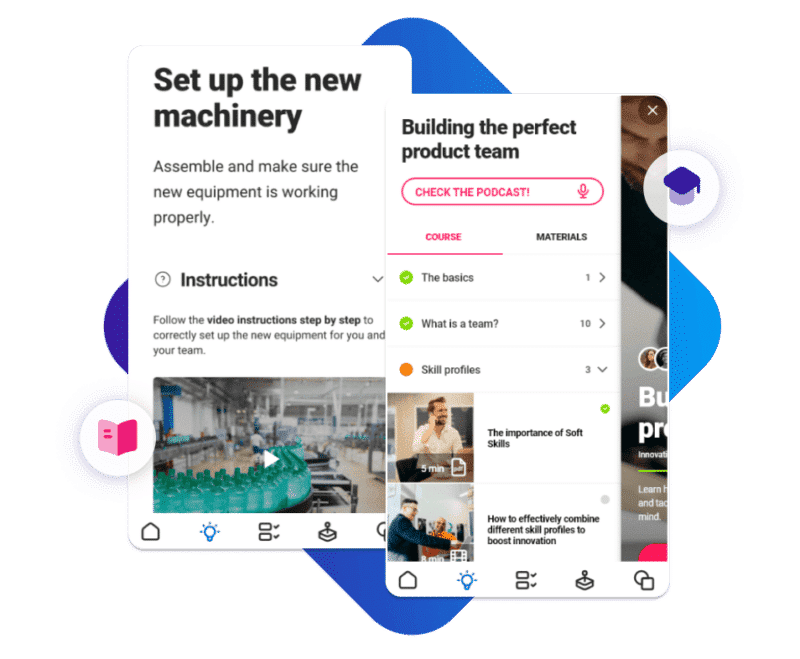
Access to learning from a mobile device removes barriers of place and time, especially for frontline, retail, or logistics teams. An employee who can complete a module during their commute or between client visits has a radically different — and more accessible — learning experience than one who must sit at a desk.
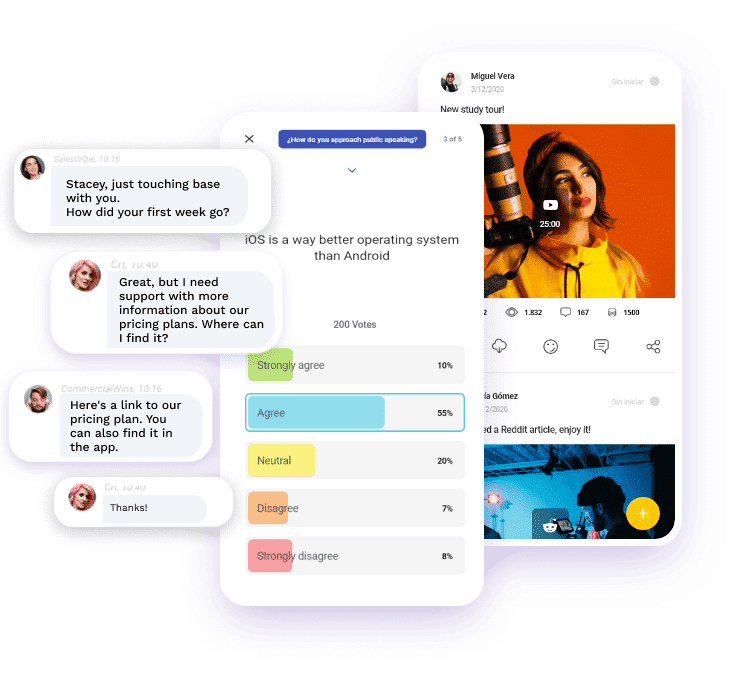
Game elements — points, leaderboards, challenges, rewards — activate intrinsic motivation and create a more memorable learning context. Gamification at work is not just entertainment: when well designed, it reinforces key behaviors and knowledge through an experience employees return to voluntarily.

An application that centralizes communication, training, and recognition creates a daily touchpoint with the organization. Employees who regularly interact with their company through an app show higher engagement levels, because the connection extends beyond formal working hours.

On top of these five tactics comes a more recent layer: AI-driven learning personalization. isEazy Brain is a native AI solution for corporate learning that adapts the training experience to each employee in real time — answering questions, adjusting learning paths, and turning the organization’s internal knowledge into an instantly accessible resource. Rather than delivering the same course to everyone, Brain enables each person to learn what they need, when they need it, and in the format that works best for them. The result is training that is more relevant, more used, and with a more direct impact on employee engagement.
Shiseido is a concrete example of how well-designed digital learning can transform team engagement. The company worked with isEazy to implement a social, gamified application for their sales teams — combining training content with community features and recognition. The result was a significant increase in learning engagement, and a training experience employees chose to use on their own initiative. Discover how they did it →
CASE STUDY
We boosted Shiseido’s training engagement with a social, gamified learning app.


Digital learning is a powerful lever, but sustained engagement requires acting on multiple fronts simultaneously. These are the strategies with the strongest evidence of impact:
To build a coherent long-term strategy, explore how to build employee loyalty by combining these levers, and how an effective learner marketing strategy can drive training adoption among employees themselves.
Employee engagement is not a one-off project or a wellbeing initiative: it is an organizational capability built through consistency, data, and genuine leadership. Companies that approach it systematically — measuring, acting, and communicating changes — do not just retain talent more effectively; they build a culture that attracts the best candidates.
Digital learning plays a central role in this ecosystem: when employees perceive that the organization is investing in their development in a personalized, accessible way, commitment grows naturally. Solutions like isEazy Engage help organizations create connected, motivated frontline teams through a platform designed for the way they actually work. And for organizations looking to take the next step, requesting a demo is the fastest way to see what it looks like in practice.
Employee engagement is fundamental to business success because it directly influences productivity, talent retention, and customer satisfaction. Engaged employees are more motivated to go the extra mile, translating into stronger business outcomes. According to Gallup’s State of the Global Workplace 2024 report, highly engaged teams achieve 23% higher profitability and reduce absenteeism by up to 81%. Moreover, engaged employees act as brand ambassadors, positively impacting every customer interaction.
Employee engagement can be measured through a combination of quantitative and qualitative methods: engagement surveys (annual or pulse), performance reviews, one-on-one interviews and focus groups, voluntary attrition rates, real-time feedback tools, and internal participation rates (training completion, events, cross-functional projects). The Employee Net Promoter Score (eNPS) is a simple, comparable baseline metric. The key is acting on the data — without visible follow-through, employees stop responding honestly.
The most impactful strategies include building a culture of meaningful recognition (both managerial and peer-to-peer), creating individual development plans with clear career paths, ensuring two-way internal communication where employee feedback leads to visible action, offering genuine flexibility, and providing personalized training that employees actually want to complete. The key is addressing multiple drivers simultaneously — engagement is a systemic outcome, not the result of a single initiative.
Managers are the single most important factor in individual-level engagement. According to Gallup, the direct relationship between an employee and their manager accounts for up to 70% of the variation in team engagement scores. An effective manager holds regular development conversations, gives specific and timely recognition, shields the team from organizational noise, and creates psychological safety. Training managers in engagement-oriented leadership is one of the highest-ROI investments an HR team can make.
Communication is one of the most powerful — and most frequently underestimated — levers of engagement. Employees who understand why decisions are made, not just what those decisions are, feel more connected to the organization’s direction. But communication must be bidirectional: creating channels where employees can express themselves and seeing that their input leads to real changes is what turns communication into a true engagement driver. Without that reciprocity, surveys become a formality and employees disengage from the process itself.
Technology enables engagement at scale in ways not previously possible. E-learning platforms integrating microlearning, mobile learning, gamification and social learning keep employees connected to development in the flow of work. Employee apps that centralize communication, training, and recognition create a daily touchpoint with the organization. AI-native solutions like isEazy Brain take this further by adapting the learning experience to each person in real time — making training more relevant, more used, and more impactful on commitment. The key is choosing tools that genuinely improve the employee experience rather than adding complexity.
Employee engagement should be measured on a continuous basis, not just through an annual survey. The most effective approach combines annual engagement surveys (for a comprehensive picture of organizational health) with quarterly or monthly pulse surveys (to track trends and detect issues early), complemented by ongoing listening mechanisms such as manager one-on-ones, exit interviews, and participation analytics. The frequency matters less than the follow-through: employees need to see that their feedback generates real action, or they will stop engaging with the measurement process itself.

Boost your team’s engagement and productivity
It brings together all communication, training, and task management into a single tool.

Discover isEazy's powerful tools!
Request a demoTry it free
Boost your team’s engagement and productivity
It brings together all communication, training, and task management into a single tool.