Brain
The first AI trained to teach

Author
The #1 AI-powered authoring tool on the market

Factory
Custom e-learning content factory

Skills
Comprehensive power skills course catalog

LMS
All-in-one LMS platform with AI

Engage
App for managing frontline teams


FEATURES

AINew
Unlock your full potential and speed up course creation with artificial intelligence.

Accessibility
Automatically meet accessibility guidelines—without sacrificing interactivity!

Interactivity
Boost engagement with interactive, ready-to-use activities that make learning fun.

Course Creation
Reduce the time it takes to create your e-learning courses with our authoring tool.

Distribution
We offer you different distribution options, so that nothing can stop you.

SCORM
Publish your course in SCORM format and share it on any LMS.

SERVICES

Instrucional Design
Surprise your students with multimedia and interactive content.

Custom Courses
We create e-learning courses for you—tailored to your needs and hassle-free!

Virtual Reality
Turn learning into an immersive experience.

Custom Avatars
Give your courses and videos a unique touch with personalized avatars.

Audiovisual FactoryNew
Turn training into something dynamic and visual with engaging videos.

CATALOG

Course catalog
Over 600 skills and competency courses to help you adapt to your team's needs.
Microsoft Copilot AcademyNew
Your professionals will learn how to apply Copilot AI to key processes within your organization.

Artificial Intelligence Academy
Train your teams in the practical use of AI to boost productivity and innovation in your company.

Cybersecurity Academy
Capacita a tu empresa con el catálogo más completo en seguridad digital corporativa.


Use cases
Choose the solution that best fits your needs

Industries
Solutions for all types of industries
USE CASES

Onboarding
Facilitate the onboarding process, productivity and engagement of your new employees.

Upskilling
Boost your team's skills and prepare them for the challenges of the future with upskilling.

Microlearning
Discover all the advantages of microlearning and boost your training results.

Gamification
Enjoy addictive training that will get your professionals hooked.

Internal Communication
Improve communication in your company and enjoy an aligned and committed team.

Mobile learning
Agile, flexible, and interactive learning—built for today’s digital-first workforce.
INDUSTRIES

Banking and financial services
Training in compliance, cybersecurity, customer service, and key skills development.

Pharmaceuticals and healthcare
Digital onboarding, regulatory updates, and ongoing training for healthcare staff.

Retail and consumer
Agile and scalable training for in-store, operational, and customer service teams.

Industry and manufacturing
Training in processes, safety, and corporate culture for distributed teams.

Education and training
Digital solutions for training centers, internal academies, and corporate universities.

Technology and telecommunications
Development of technical talent, digital skills, and upskilling and reskilling programs.
CLIENTS

MAPFRE
How MAPFRE turn e-learning into sales with isEazy

Pepco
A personalised learning experience for a growing team.

BBVA
Digitisation and creation of high quality e-learning content.

Shiseido
We increase the engagement of the training with a social and gamified app.

Telefónica
Large-scale reskilling for the company's digital transformation.

Vodafone
A personalised learning experience for a growing team.
More than 1,000 companies already rely on isEazy.





MEET ISEAZY

Events
Discover our upcoming events and connect with the future of e-learning.

News
Find out the latest news about isEazy: press releases, partnerships, updates...

Contact
Leave us your personal details and we will contact you as soon as possible.
About isEazyNew
Find out more about our company.

Careers
We are looking for the best talent, join our team!

Partners
Become our partner and grow your business.

INTERESTING RESOURCES

Blog
The best content on e-learning: trends, tools and key strategies.

Whitepapers
Gain valuable insights and stay ahead of industry trends.

Product releases
The latest news and releases of our e-learning products and solutions.

Glossary
Definitions of the most commonly used terms and key industry concepts.

Guides
Discover the best step-by-step tips and tricks to optimize your L&D strategy.

Webinars
Video sessions on our products, trends and more

Comparatives
Compare e-learning solutions available on the market and choose the most suitable one.




September 1, 2026
Multi-tenant LMS: what it is, how it works and when you need one

CONTENT CREATED BY:

Table of contents
A multi-tenant LMS is a learning platform architecture in which a single system instance serves multiple organizations or user groups — known as tenants — in a completely independent way. Each tenant has its own environment, its own brand, and its own data, while the central organization maintains global control and visibility from a single administration panel.
What is a multi-tenant LMS?
The term multi-tenant comes from cloud software architecture (SaaS). It literally means “multiple tenants”: picture a building where each tenant occupies their own private space, but all share the same structure and common services. In an LMS, each tenant corresponds to an organization, subsidiary, distribution network, or customer group that operates its own training platform without interfering with the rest.
Unlike a conventional LMS — designed for a single company with a single audience — the multi-tenant model allows a parent organization to simultaneously manage differentiated learning environments for, for example:
- Its different subsidiaries or brands
- Its distribution networks and commercial partners
- Its external customers who need product training
- Its franchisees or regional operators
Each tenant can have its own course catalog, its own visual identity, its own users, its own reports, and its own local administrator, with no access to other tenants’ data. The central organization, on the other hand, has visibility and control over all of them from a single point.
Single-tenant LMS vs. multi-tenant LMS: key differences
To understand when it makes sense to adopt a multi-tenant LMS, it helps to compare it with the traditional single-instance model:
| Feature | Single-tenant LMS | Multi-tenant LMS |
|---|---|---|
| Audiences | One organization | Multiple organizations or groups |
| Administration | Centralized | Central + delegated per tenant |
| Brand customization | Single brand | Own brand per tenant (white-label) |
| Reports | Global | Per tenant and consolidated |
| Infrastructure | One instance per company | One instance for all tenants |
| Scalability | Limited | High, no additional cost per tenant |
How does a multi-tenant LMS work?
From a technical standpoint, a multi-tenant LMS platform runs on a single software instance, but separates each tenant’s data, configurations, and experiences at a logical level. This means the codebase and infrastructure are shared, but each organization or user group sees and manages exclusively their own space.
The typical setup operates across three levels:
- Global administrator (superadmin): accesses all tenants, manages the general configuration, assigns resources, and pulls consolidated reports.
- Tenant administrator: manages exclusively their own environment — users, courses, learning paths, and reports — with no visibility into other tenants.
- Learner: accesses their personalized portal, with their organization’s brand and catalog, unaware that they share the platform with other groups.
Modern multi-tenant platforms also allow per-tenant configuration of aspects such as Single Sign-On (SSO), access permissions, available languages, and automated notifications, turning each environment into a truly independent experience.
When does your organization need a multi-tenant LMS?
Not every organization needs multi-tenancy. This is a capability that delivers real value when there is a need to train external audiences or differentiated groups that should not share an environment. These are the most common use cases in the corporate L&D space:
Training distribution networks and partners (Extended Enterprise)
When a company trains distributors, dealers, agents, or franchisees on its products and processes, it needs each network or country to have its own environment with its own catalog — with no cross-access to data. This model is known as Extended Enterprise Learning, and a multi-tenant LMS is the infrastructure that makes it possible at scale.
Corporate groups with multiple subsidiaries
A holding company with several brands or subsidiaries may need each one to manage its own training independently — with its own administrators, courses, and dashboards — while corporate leadership maintains global visibility. Multi-tenancy eliminates the need to contract and maintain separate platforms for each entity.
Training companies or consultancies that train their clients
Organizations that offer training as a service to third parties — corporate academies, L&D consultancies, or certification providers — use the multi-tenant model to give each client their own personalized learning portal without multiplying the technology infrastructure.
Customer education
Software companies, manufacturers, or service providers that need to ensure their customers know how to use their product use multi-tenant LMS platforms to deliver segment-specific training, with dedicated courses and certifications for each group.
Benefits of a multi-tenant LMS for L&D teams
Adopting an LMS with multi-tenant architecture delivers concrete benefits for both the training team and the organization as a whole:
- Reduced infrastructure costs: a single platform serves multiple audiences. There is no need to contract or maintain separate systems for each subsidiary or partner.
- Delegated administration without losing control: each tenant can self-manage its training, freeing up the central team’s workload without giving up global oversight.
- Brand customization (white-label): each environment can display each organization’s own logo, colors, and domain, improving the learner experience.
- Real scalability: adding a new tenant does not involve additional license costs or implementation work proportional to setting up an entirely new platform.
- Consolidated and granular reporting: the central team can see the training status across the entire network and, at the same time, extract specific data by tenant, region, or group.
- Security and data isolation: each organization’s data is logically separated, ensuring privacy and regulatory compliance (GDPR, for example).
According to the LinkedIn Workplace Learning Report 2024, 89% of organizations say that developing external talent — partners and distribution channels — is as much of a priority as internal training. A multi-tenant architecture makes it easier to scale that ambition without operational complexity.
A practical example: how it works in a distribution network
Imagine an industrial equipment manufacturer with 200 distributors across 15 countries. It needs each distributor to have a thorough understanding of the product catalog, installation protocols, and regulatory updates. With a multi-tenant LMS, it can:
- Create one tenant per country or region, with the language and catalog adapted to that market.
- Assign a local administrator in each tenant, who manages their own users without accessing other countries’ data.
- Publish courses from the central panel that are automatically distributed to all tenants or only to selected ones.
- Pull a global certification completion report to know what percentage of the network is qualified to sell or install each product.
The result: a coherent, controlled learning ecosystem that feels personalized for each distributor, but costs and operates like a single platform. This is exactly the kind of challenge a multi-tenant enterprise LMS is designed to address.
What to consider when evaluating a multi-tenant LMS
Not all LMS platforms that market themselves as “multi-tenant” offer the same level of functionality. Before making a decision, it is worth verifying the following aspects:
- Level of customization per tenant: can each tenant have its own URL, logo, and colors? Or is it just user segmentation?
- Permission granularity: what can and cannot a tenant administrator do? Can they create their own courses, or only manage content assigned from the center?
- Reporting models: do the reports allow consolidating data across all tenants and also breaking it down by organization?
- Content management: can centrally created content be selectively distributed to specific tenants? Can the tenant create their own content?
- Integrations: does the LMS support per-tenant integration of different HR systems, SSO, or business tools? Integration capabilities are critical in complex environments with multiple systems.
- Pricing model: is the price based on active users across the whole platform, or per tenant? A per-active-user model tends to be more favorable for organizations with uneven usage across tenants.
Frequently asked questions about multi-tenant LMS
What is the difference between a multi-tenant LMS and an LMS with portals or sub-portals?
The difference lies mainly in depth and isolation. Portals or sub-portals are, in many LMS platforms, a way to segment users within a single organization, but with limited access restrictions. A multi-tenant LMS goes further: each tenant is a completely independent environment, with its own administration, its own catalog, its own branding, and its own data space. The isolation is total, which guarantees real privacy and autonomy. In practice, portals tend to serve for segmenting internal audiences, while multi-tenancy is designed for external audiences or groups that require true operational independence.
Is a multi-tenant LMS only for large companies?
Not necessarily. Although organizations with large distribution networks or many subsidiaries benefit the most from multi-tenant architecture, there are valid use cases for mid-sized companies too. For example, a company with several differentiated brands may need each one to manage its own training without cross-access. Or a company that trains its B2B customers may need an independent portal per client. The criterion is not size, but the need to separate training environments in a real and scalable way. If the alternative is contracting several different platforms, multi-tenancy is the most efficient solution.
Can a multi-tenant LMS also be used for internal employee training?
Yes. Multi-tenancy is not incompatible with internal training. In fact, it is common for the main tenant of the platform to be precisely the one for internal employees, while other tenants are dedicated to partners, clients, or distributors. This coexistence on a single platform is one of its key advantages: a single system can cover both internal and external training, with differentiated environments for each audience and without the need to duplicate resources or tools.
How much does it cost to implement a multi-tenant LMS?
The cost depends on the LMS chosen and the licensing model. Most SaaS platforms with multi-tenancy charge based on active users across the entire platform, which allows adding tenants without additional cost per tenant. What varies is the initial configuration time — branding customization, user structures, per-tenant catalogs — and, in some cases, the level of support required during implementation. In any case, the cost of a multi-tenant LMS is usually significantly lower than maintaining separate platforms for each organization or user group.

The power of AI in a fully integrated training platform
Automate processes, access 600+ ready-to-use courses, or create your own content with the help of AI.
Request a demoContact us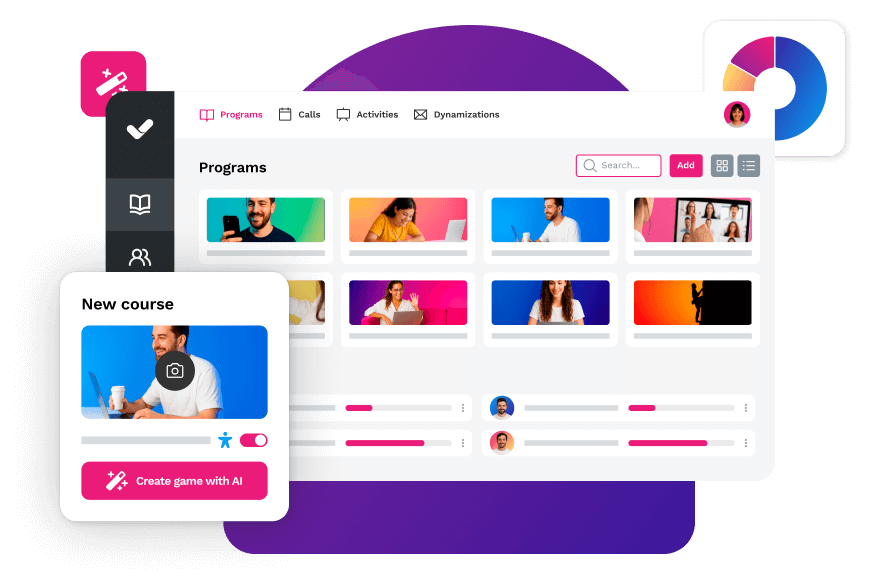


Streamline your training management
Experience the power of AI in an LMS that has it all