If you want training to make a real difference in your company, you need more than a list of courses: you need an online training software that makes the process simple, engaging and measurable. In this comparison, we analyse the 10 best online training software for companies in 2026: what sets each one apart, which profile it suits best, and what to consider before making your decision.
Online training software is a digital platform that enables organisations to create, distribute, manage and evaluate learning. It covers everything from LMS systems to authoring tools and LXPs, all aimed at turning training into a strategic business asset.
What is online training software for companies?
Online training software is a platform designed to deliver and manage e-learning within organisations. There are three main types worth distinguishing:
An LMS (Learning Management System) manages the distribution, tracking and administration of training: who does what, when and with what result.
An authoring tool produces the training content — interactive courses, videos, assessments — which is then hosted in the LMS.
Most organisations use a combination of all three. This comparison focuses on LMS platforms and integrated online training solutions.
Types of online training software
There are many types of online training software: microlearning apps, e-learning course platforms, virtual classrooms and authoring tools. Each serves a different purpose in the corporate learning world. Within learning management systems, the most relevant for companies are these five:
Cloud-based learning management systems
SaaS LMS platforms are hosted on external servers accessible via the internet. Unlike on-premise LMS solutions that require their own infrastructure, a SaaS solution includes maintenance, updates and technical support — reducing internal IT overhead and allowing training to scale quickly.
Open source or free learning management systems
Open source LMS platforms are free at the base licence level, making them attractive for organisations looking to launch a training programme without an upfront budget commitment. However, the real cost lies in infrastructure, maintenance and customisation — factors worth evaluating before choosing this route.
SCORM-compliant learning management systems
SCORM-compliant LMS platforms allow you to import and play content created with any authoring tool that outputs this standard. They are essential for organisations that already produce their own courses or need to guarantee content portability across platforms.
Experience-based learning management systems (LXP)
LXPs are the evolution of the traditional LMS. They offer all the same management features, but with a clear focus on the learner experience: personalised recommendations based on profile and history, self-directed learning and content aggregated from external sources. They are the best choice when personalisation and engagement are top priorities.
Learning management systems for blended learning
LMS platforms designed for blended learning combine online learning management with in-person session planning. They allow you to centralise digital resources, face-to-face training calendars and learner progress tracking all in one place.
What criteria should you use to choose the best online training software?
Before comparing tools, define your requirements. These are the criteria that most influence the decision, according to the L&D Technology 2025 report by Brandon Hall Group:
SCORM and xAPI compatibility: essential if you already have content or plan to create it with an authoring tool.
Ease of use: a platform that admins struggle to navigate or that employees abandon within ten minutes is worthless.
Analytics and reporting: completion rates, average scores, time spent and correlation with business KPIs.
AI and automation: automatic enrolments, profile-based assignments, content generation — a key differentiator in 2025-2026.
Support for blended learning: if you combine online and in-person training, the LMS must manage both natively.
Scalability and pricing: evaluate the model (per active user, per seat, flat rate) based on your team size and turnover.
Integrations: connection with HRIS, Active Directory or your own content tools.
The 10 best online training software for companies in 2026
Below we analyse each platform in detail. First, here is the comparison table to give you a quick overview:
Platform
Type
Best for
isEazy LMS
LMS + authoring tool + LXP
Companies looking for an all-in-one solution
Netex Learning
LMS + authoring tool
Custom content creation
Cornerstone OnDemand
Talent suite + LMS
Large organisations with complex talent management
Docebo
AI-powered LMS
Advanced learning automation
360Learning
Collaborative LMS
Peer-learning cultures
SumTotal
Talent suite + LMS
Organisations with complex HR processes
Open LMS
Moodle-based LMS
Moodle environments needing managed support
TalentLMS
Cloud LMS
SMEs with a tight budget
Moodle
Open source LMS
Institutions with in-house technical teams
Litmos
Cloud LMS (SAP)
Companies in the SAP ecosystem
1. isEazy LMS
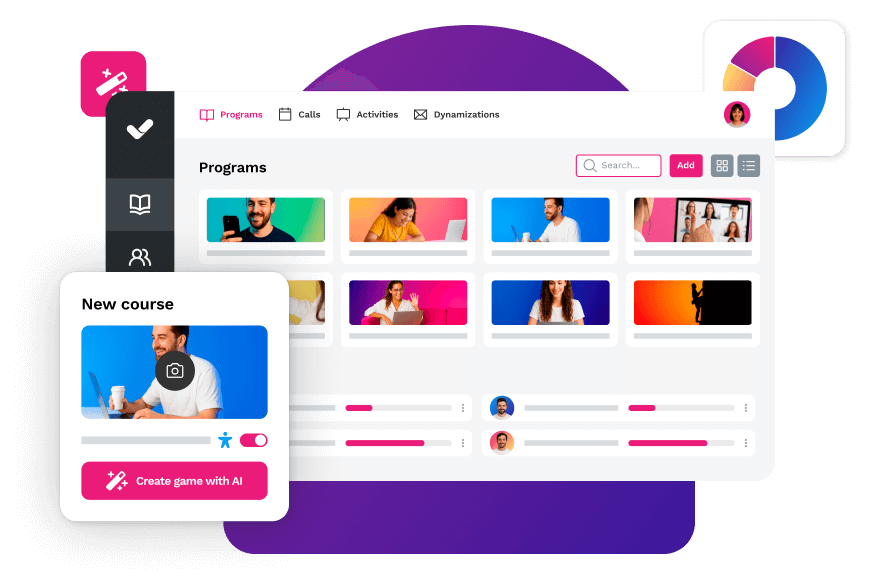
isEazy LMS combines learning management, an integrated authoring tool, AI-powered automation and advanced analytics in a single solution — something most LMS platforms on the market don’t offer as standard. Its AI module automates enrolments, assignments and content generation, while its interface is designed so that any HR manager — without a technical background — can manage training across the entire organisation. You can request a free demo to see it in action.
isEazy LMS
The all-in-one LMS platform powered by AI
Features
Benefits
Subscription plans
Industries
Use cases
All-in-one AI-powered LMS: combines learning management and tracking, a library of over 600 ready-to-use courses, and an AI-powered authoring tool for creating proprietary content in one solution.
Engagement and collaboration: includes gamification, mobile learning, certificates, a knowledge library, social learning, and communication channels for sharing relevant news and content.
Integrations and compatibility: connects the LMS with other business tools through SSO, APIs, and custom integrations. It supports SCORM 1.2 and SCORM 2004.
End-to-end learning management: manages learners, groups, roles, permissions, courses, programs, and learning paths from one environment. It automates training campaigns and engagement actions and supports annual learning plans with dynamic filters by audience, department, or company. It can also support administrative requirements such as FUNDAE-funded training in Spain and DC3 and DC4 records in Mexico.
Analytics and reporting: turns learning data into actionable information through visual dashboards and detailed reports. Organizations can review activity, progress, and results by learner, department, audience, subsidiary, or company.
Learning experience: provides an intuitive, customizable interface with content cards for urgent, new, recommended, or pending courses. It also includes news, announcements, and an AI-powered recommender that helps learners discover relevant content.
Content library: provides unlimited access to over 600 ready-to-use courses covering leadership, compliance, soft skills, productivity, artificial intelligence, cybersecurity, and other key areas. Content is available in 8 languages, multiple formats, and is continuously updated.
Built-in AI authoring tool: enables teams to build courses from scratch or import PowerPoint presentations and turn them into interactive content. AI supports translations, voice-overs, subtitles, images, avatar videos, exercises, and final assessments. Courses can be exported in SCORM format.
One solution for the entire learning cycle: brings management, content creation, delivery, a ready-to-use course catalog, and measurement together in one system, reducing the need for separate tools at each stage.
Proven operational capacity: provides a modern environment that helps learners find, resume, and complete assigned training. Its track record includes more than 1.5 million users, 88 million training hours, 400 learning programs, and 94,000 learning activities.
Time and resource efficiency: automates campaigns, assignments, communications, reminders, and reporting, while its AI-powered authoring tool streamlines content creation and updates. Support, consulting, outsourcing, and LMS management services are also available.
Multi-device access: provides learning access from desktop computers, phones, and tablets. Its multi-format library, available in 8 languages, supports international learning programs.
Scalable and flexible: serves both small and medium-sized businesses and large enterprises, with segmentation by department, role, company, location, or audience and plans ranging from 100 learners to enterprise deployments.
Highly customizable: allows organizations to configure colors, logos, messages, login pages, domains, structures, permissions, and learning environments according to their brand and requirements.
International recognition: isEazy LMS was included in Training Industry’s 2025 Top LMS Companies Watch List and received eLearning Industry’s “Most Effective Implementation of AI for Talent Development and Management 2026” recognition.
Professional: up to 100 users, with unlimited courses, unlimited administrators, and unlimited learning environments.
Business: up to 200 users. Includes all Professional features and adds a dedicated manager dashboard.
Enterprise: from 201 users. Includes all Business features, communication channels, a BI reporting module, a dedicated Customer Success Manager, and custom integrations.
Included capabilities: all plans include support, automation, learning management tools, customization, learning experience features, gamification, mobile learning, certificates, reporting, a training catalog, and a course recommender.
Additional services: outsourcing, consulting, custom training, and Training as a Service can be added according to project requirements.
Banking and financial services: manages compliance, cybersecurity, customer service, sales training, and skills development programs for branches, networks, and corporate teams.
Pharmaceutical and healthcare: centralizes onboarding, regulatory updates, product training, and continuous learning for healthcare, sales, and corporate employees.
Retail and consumer goods: delivers agile, segmented learning to store employees, regional managers, sales networks, operations teams, and customer service staff.
Technology and telecommunications: develops technical and digital capabilities through continuous onboarding, certification, upskilling, and reskilling programs.
Manufacturing: manages training on processes, safety, quality, technical skills, and company culture for plants, factories, and distributed teams.
Transportation and logistics: centralizes onboarding, procedural updates, operational safety, and continuous training for drivers, warehouses, and logistics networks.
Consulting and professional services: supports knowledge updates, technical learning, onboarding, and skills development for project- and client-focused teams.
Education and training: manages training providers, internal academies, certification programs, and corporate universities from a customizable environment.
Government and public sector: supports the management, segmentation, and traceability of learning programs for public employees and complex government organizations.
Insurance: keeps sales networks, agents, and back-office teams up to date on regulations, products, processes, and commercial skills.
Energy: manages safety, regulatory, sustainability, operational, and technical learning for internal teams, contractors, and external networks.
Corporate academies: centralizes programs, learning paths, resources, communications, and learning communities to build an internal academy aligned with the organization’s goals and culture.
Onboarding: creates personalized welcome journeys, automates resource assignments, and ensures each new hire receives the required training from day one.
Mandatory training: manages health and safety, equality, compliance, and regulatory programs with automated assignments, certificates, reminders, and full traceability.
Talent development: creates programs and learning paths for different roles, departments, and responsibility levels to support upskilling and reskilling.
Product training: keeps sales teams, customers, partners, and distributors up to date with practical content about products, services, and procedures.
Skills development: combines LMS management with a library of over 600 courses covering leadership, communication, productivity, digital capabilities, and other professional skills.
Features
All-in-one AI-powered LMS: combines learning management and tracking, a library of over 600 ready-to-use courses, and an AI-powered authoring tool for creating proprietary content in one solution.
Engagement and collaboration: includes gamification, mobile learning, certificates, a knowledge library, social learning, and communication channels for sharing relevant news and content.
Integrations and compatibility: connects the LMS with other business tools through SSO, APIs, and custom integrations. It supports SCORM 1.2 and SCORM 2004.
End-to-end learning management: manages learners, groups, roles, permissions, courses, programs, and learning paths from one environment. It automates training campaigns and engagement actions and supports annual learning plans with dynamic filters by audience, department, or company. It can also support administrative requirements such as FUNDAE-funded training in Spain and DC3 and DC4 records in Mexico.
Analytics and reporting: turns learning data into actionable information through visual dashboards and detailed reports. Organizations can review activity, progress, and results by learner, department, audience, subsidiary, or company.
Learning experience: provides an intuitive, customizable interface with content cards for urgent, new, recommended, or pending courses. It also includes news, announcements, and an AI-powered recommender that helps learners discover relevant content.
Content library: provides unlimited access to over 600 ready-to-use courses covering leadership, compliance, soft skills, productivity, artificial intelligence, cybersecurity, and other key areas. Content is available in 8 languages, multiple formats, and is continuously updated.
Built-in AI authoring tool: enables teams to build courses from scratch or import PowerPoint presentations and turn them into interactive content. AI supports translations, voice-overs, subtitles, images, avatar videos, exercises, and final assessments. Courses can be exported in SCORM format.
Benefits
One solution for the entire learning cycle: brings management, content creation, delivery, a ready-to-use course catalog, and measurement together in one system, reducing the need for separate tools at each stage.
Proven operational capacity: provides a modern environment that helps learners find, resume, and complete assigned training. Its track record includes more than 1.5 million users, 88 million training hours, 400 learning programs, and 94,000 learning activities.
Time and resource efficiency: automates campaigns, assignments, communications, reminders, and reporting, while its AI-powered authoring tool streamlines content creation and updates. Support, consulting, outsourcing, and LMS management services are also available.
Multi-device access: provides learning access from desktop computers, phones, and tablets. Its multi-format library, available in 8 languages, supports international learning programs.
Scalable and flexible: serves both small and medium-sized businesses and large enterprises, with segmentation by department, role, company, location, or audience and plans ranging from 100 learners to enterprise deployments.
Highly customizable: allows organizations to configure colors, logos, messages, login pages, domains, structures, permissions, and learning environments according to their brand and requirements.
International recognition: isEazy LMS was included in Training Industry’s 2025 Top LMS Companies Watch List and received eLearning Industry’s “Most Effective Implementation of AI for Talent Development and Management 2026” recognition.
Subscription plans
Professional: up to 100 users, with unlimited courses, unlimited administrators, and unlimited learning environments.
Business: up to 200 users. Includes all Professional features and adds a dedicated manager dashboard.
Enterprise: from 201 users. Includes all Business features, communication channels, a BI reporting module, a dedicated Customer Success Manager, and custom integrations.
Included capabilities: all plans include support, automation, learning management tools, customization, learning experience features, gamification, mobile learning, certificates, reporting, a training catalog, and a course recommender.
Additional services: outsourcing, consulting, custom training, and Training as a Service can be added according to project requirements.
Industries
Banking and financial services: manages compliance, cybersecurity, customer service, sales training, and skills development programs for branches, networks, and corporate teams.
Pharmaceutical and healthcare: centralizes onboarding, regulatory updates, product training, and continuous learning for healthcare, sales, and corporate employees.
Retail and consumer goods: delivers agile, segmented learning to store employees, regional managers, sales networks, operations teams, and customer service staff.
Technology and telecommunications: develops technical and digital capabilities through continuous onboarding, certification, upskilling, and reskilling programs.
Manufacturing: manages training on processes, safety, quality, technical skills, and company culture for plants, factories, and distributed teams.
Transportation and logistics: centralizes onboarding, procedural updates, operational safety, and continuous training for drivers, warehouses, and logistics networks.
Consulting and professional services: supports knowledge updates, technical learning, onboarding, and skills development for project- and client-focused teams.
Education and training: manages training providers, internal academies, certification programs, and corporate universities from a customizable environment.
Government and public sector: supports the management, segmentation, and traceability of learning programs for public employees and complex government organizations.
Insurance: keeps sales networks, agents, and back-office teams up to date on regulations, products, processes, and commercial skills.
Energy: manages safety, regulatory, sustainability, operational, and technical learning for internal teams, contractors, and external networks.
Use cases
Corporate academies: centralizes programs, learning paths, resources, communications, and learning communities to build an internal academy aligned with the organization’s goals and culture.
Onboarding: creates personalized welcome journeys, automates resource assignments, and ensures each new hire receives the required training from day one.
Mandatory training: manages health and safety, equality, compliance, and regulatory programs with automated assignments, certificates, reminders, and full traceability.
Talent development: creates programs and learning paths for different roles, departments, and responsibility levels to support upskilling and reskilling.
Product training: keeps sales teams, customers, partners, and distributors up to date with practical content about products, services, and procedures.
Skills development: combines LMS management with a library of over 600 courses covering leadership, communication, productivity, digital capabilities, and other professional skills.
MAPFRE transformed its commercial training with isEazy LMS, boosting engagement across its sales teams and connecting learning directly to business results. Find out how they did it →
Netex Learning is a company specialised in e-learning solutions that offers an integrated learning management platform called Learning Cloud. Designed to deliver engaging and personalised learning experiences, it supports corporate training and employee skills development across organisations of different sizes.
Netex Learning
Designed for corporate training in large organizations
Key features
Ratings
Plans & pricing
Key features of Netex Learning
Multi-organization and multilingual: create multiple organizations with their own training catalog and target users from a centralized administration. Compatible with 20 languages, including Chinese.
Scalable: SaaS platform based on Amazon Web Services (AWS), adaptable to organizations of any size.
Built-in authoring tool: create interactive courses directly on the platform. Compatible with SCORM and xAPI, with the ability to index content from third-party tools.
Analytics dashboards: adaptable tracking system with custom report templates for courses, events, and learning paths. Real-time data export.
Learning path editor: design structured learning journeys with Learning Programs and automatic recertification and diploma management.
Recommendation system: AI-powered intelligent playlist generation, automatically updated based on relevance, popularity, or learner behavior criteria.
Requirements system: prerequisite management and personalized expiration dates per learner, with automatic reminders and flexible content access.
Mobile learning, gamification, and social learning: mobile app with offline access, badges shareable on LinkedIn via Mozilla’s BADGR system, leaderboards, and collaboration tools between experts and learners.
Content marketing: tools to promote courses on the portal, with external catalogs integrable via SSO, deep linking, and progress synchronization.
Integrations: with spreadsheets, CRM, ERP, Microsoft Teams, Outlook, project management tools, and more. API available for custom integrations.
Netex Learning ratings
G2 rating: 4.5/5 stars.
Netex Learning plans & pricing
Per-user plans (billed for each user who uses the platform). Pricing on request based on organization size and needs.
Free trial environment available on request.
Key features
Key features of Netex Learning
Multi-organization and multilingual: create multiple organizations with their own training catalog and target users from a centralized administration. Compatible with 20 languages, including Chinese.
Scalable: SaaS platform based on Amazon Web Services (AWS), adaptable to organizations of any size.
Built-in authoring tool: create interactive courses directly on the platform. Compatible with SCORM and xAPI, with the ability to index content from third-party tools.
Analytics dashboards: adaptable tracking system with custom report templates for courses, events, and learning paths. Real-time data export.
Learning path editor: design structured learning journeys with Learning Programs and automatic recertification and diploma management.
Recommendation system: AI-powered intelligent playlist generation, automatically updated based on relevance, popularity, or learner behavior criteria.
Requirements system: prerequisite management and personalized expiration dates per learner, with automatic reminders and flexible content access.
Mobile learning, gamification, and social learning: mobile app with offline access, badges shareable on LinkedIn via Mozilla’s BADGR system, leaderboards, and collaboration tools between experts and learners.
Content marketing: tools to promote courses on the portal, with external catalogs integrable via SSO, deep linking, and progress synchronization.
Integrations: with spreadsheets, CRM, ERP, Microsoft Teams, Outlook, project management tools, and more. API available for custom integrations.
Ratings
Netex Learning ratings
G2 rating: 4.5/5 stars.
Plans & pricing
Netex Learning plans & pricing
Per-user plans (billed for each user who uses the platform). Pricing on request based on organization size and needs.
Free trial environment available on request.
3. Cornerstone OnDemand
Cornerstone OnDemand is a comprehensive cloud-based platform offering talent management solutions including training, development, recruitment and performance management. Designed for organisations of all sizes and sectors, it helps optimise the full employee lifecycle — from onboarding to continuous development.
Cornerstone on demand
Key features
Ratings
Plans and pricing
Workflows: automation of training processes, enrollments, and compliance tracking to keep the organization always audit-ready.
Talent management tools: personalized learning paths by role, department, or individual, with integrated skills management and career development.
Report generation: customizable dashboards with visibility into training progress, skill gap detection, and compliance tracking.
Exclusive content subscriptions: access to external content catalogs to complement internal training with specialized resources.
Mobile learning and gamification: training accessible from any device, with motivation mechanics to drive engagement and course completion.
Native LXP: personalized learning experience with AI-powered content recommendations tailored to each user’s profile, skills, and career aspirations.
Easy-to-use interface: platform designed to facilitate adoption by both administrators and learners.
Social learning: collaboration and knowledge-sharing tools between employees.
Compliance tracking: management and traceability of regulatory compliance, with automatic workflows and reporting for audits.
SaaS. Compatible with SCORM and xAPI for integration with any standard e-learning content.
Integrations with Salesforce, Microsoft Teams, Workday, and other enterprise HRIS, CRM, and ATS applications.
Capterra Rating: 4.3/5 stars.
G2 Rating: 4.1/5 stars.
Plans vary by institution, features, and number of users. Contact the sales team for a personalized quote.
Key features
Workflows: automation of training processes, enrollments, and compliance tracking to keep the organization always audit-ready.
Talent management tools: personalized learning paths by role, department, or individual, with integrated skills management and career development.
Report generation: customizable dashboards with visibility into training progress, skill gap detection, and compliance tracking.
Exclusive content subscriptions: access to external content catalogs to complement internal training with specialized resources.
Mobile learning and gamification: training accessible from any device, with motivation mechanics to drive engagement and course completion.
Native LXP: personalized learning experience with AI-powered content recommendations tailored to each user’s profile, skills, and career aspirations.
Easy-to-use interface: platform designed to facilitate adoption by both administrators and learners.
Social learning: collaboration and knowledge-sharing tools between employees.
Compliance tracking: management and traceability of regulatory compliance, with automatic workflows and reporting for audits.
SaaS. Compatible with SCORM and xAPI for integration with any standard e-learning content.
Integrations with Salesforce, Microsoft Teams, Workday, and other enterprise HRIS, CRM, and ATS applications.
Ratings
Capterra Rating: 4.3/5 stars.
G2 Rating: 4.1/5 stars.
Plans and pricing
Plans vary by institution, features, and number of users. Contact the sales team for a personalized quote.
4. Docebo
Docebo is a cloud-based learning management platform designed to facilitate corporate training and skills development in organisations of various sizes. Founded in 2005, Docebo has evolved to offer AI-powered features that automate learning path creation, content recommendations and programme administration.
Docebo Learn
Designed for large-scale corporate training
Features
Benefits
Pricing/Plans
Learning management (LMS): creation, organization, and tracking of courses and training programs for employees, customers, and partners from a single platform.
Content creation: tools to develop interactive learning materials, with an AI assistant to speed up content production.
Content marketplace: access to over 30,000 courses and certifications from external providers covering areas from leadership to digital skills.
Learning intelligence: AI algorithms to analyze user behavior and deliver personalized recommendations.
E-commerce: sell courses and training programs directly through the platform.
Integrations: with Salesforce, Microsoft Teams, Zoom, HRIS, CRM, and enterprise tools. Compatible with SSO, SCORM, and xAPI.
Customization: AI-driven learning experience tailored to each user, with learning paths based on profile and objectives.
Scalability: designed for large organizations, with the ability to manage multiple audiences from a single platform.
Automation: reduces administrative workload by automating tasks such as enrollments, progress tracking, and report generation.
User experience: intuitive interface with a native mobile app for access from any device.
Pricing based on annual active users and selected product tier. Rates are not publicly listed — contact the sales team for a personalized quote.
Features
Learning management (LMS): creation, organization, and tracking of courses and training programs for employees, customers, and partners from a single platform.
Content creation: tools to develop interactive learning materials, with an AI assistant to speed up content production.
Content marketplace: access to over 30,000 courses and certifications from external providers covering areas from leadership to digital skills.
Learning intelligence: AI algorithms to analyze user behavior and deliver personalized recommendations.
E-commerce: sell courses and training programs directly through the platform.
Integrations: with Salesforce, Microsoft Teams, Zoom, HRIS, CRM, and enterprise tools. Compatible with SSO, SCORM, and xAPI.
Benefits
Customization: AI-driven learning experience tailored to each user, with learning paths based on profile and objectives.
Scalability: designed for large organizations, with the ability to manage multiple audiences from a single platform.
Automation: reduces administrative workload by automating tasks such as enrollments, progress tracking, and report generation.
User experience: intuitive interface with a native mobile app for access from any device.
Pricing/Plans
Pricing based on annual active users and selected product tier. Rates are not publicly listed — contact the sales team for a personalized quote.
5. 360Learning
360Learning is a learning management platform focused on collaborative learning, enabling organisations to turn their internal experts into active contributors to training and skills development. Founded in 2013, the platform uses artificial intelligence and collaborative tools to facilitate content creation and distribution.
360Learning
Designed for internal expert-led content co-creation
Strengths
Ideal use cases
Plans
Agile and decentralized authoring: any internal subject matter expert can create courses without instructional design knowledge, accelerating the production and update of internal training content.
Peer collaboration: tools that facilitate knowledge sharing, active participation, and continuous content improvement by the teams themselves.
L&D team automation: built-in AI to reduce administrative tasks such as enrollments, tracking, and reporting, freeing up time for strategic initiatives.
Integration ecosystem: compatible with Microsoft 365/Teams, Google Workspace, Salesforce, SAP SuccessFactors, Zoom, Slack, LinkedIn Learning, Go1, and OpenSesame, among others. API and webhooks available for custom integrations.
Gamification: motivation mechanics to drive engagement and course completion rates.
Analytics and reporting: progress and performance metrics by groups, users, courses, and learning paths, with data export and automated weekly reports.
Internal content co-creation: companies looking to scale training creation by leveraging subject matter experts (SMEs) for fast and continuous updates.
Training agility: organizations that prioritize launching and maintaining training at the pace of the business, with automations and built-in authoring.
Onboarding and operational training: accelerating ramp-up and standardizing practices, including frontline team training.
External training: academies for customers, partners, and sales teams to drive adoption and message consistency.
Team: $8 per registered user per month, up to 100 users. Includes collaborative authoring, learning paths, gamification, integrations, and support with monthly collective onboarding sessions. Optional add-ons at $2/user/month: Coaching, Live (instructor-led training with Zoom/Teams), and Globalization (automatic multilingual support).
Business: custom pricing for large organizations. Includes all Team plan features plus enterprise capabilities, multiple audiences (employees, customers, partners), and dedicated professional services.
Strengths
Agile and decentralized authoring: any internal subject matter expert can create courses without instructional design knowledge, accelerating the production and update of internal training content.
Peer collaboration: tools that facilitate knowledge sharing, active participation, and continuous content improvement by the teams themselves.
L&D team automation: built-in AI to reduce administrative tasks such as enrollments, tracking, and reporting, freeing up time for strategic initiatives.
Integration ecosystem: compatible with Microsoft 365/Teams, Google Workspace, Salesforce, SAP SuccessFactors, Zoom, Slack, LinkedIn Learning, Go1, and OpenSesame, among others. API and webhooks available for custom integrations.
Gamification: motivation mechanics to drive engagement and course completion rates.
Analytics and reporting: progress and performance metrics by groups, users, courses, and learning paths, with data export and automated weekly reports.
Ideal use cases
Internal content co-creation: companies looking to scale training creation by leveraging subject matter experts (SMEs) for fast and continuous updates.
Training agility: organizations that prioritize launching and maintaining training at the pace of the business, with automations and built-in authoring.
Onboarding and operational training: accelerating ramp-up and standardizing practices, including frontline team training.
External training: academies for customers, partners, and sales teams to drive adoption and message consistency.
Plans
Team: $8 per registered user per month, up to 100 users. Includes collaborative authoring, learning paths, gamification, integrations, and support with monthly collective onboarding sessions. Optional add-ons at $2/user/month: Coaching, Live (instructor-led training with Zoom/Teams), and Globalization (automatic multilingual support).
Business: custom pricing for large organizations. Includes all Team plan features plus enterprise capabilities, multiple audiences (employees, customers, partners), and dedicated professional services.
6. SumTotal
SumTotal is a comprehensive talent management platform offering solutions for learning, development, performance management and employee compensation. Designed for organisations of various sizes and sectors, SumTotal helps companies improve productivity and workforce retention by providing tools that facilitate training, talent development and HR process management.
Sumtotal
Designed for talent management in large organizations
Features
Advantages
Pricing/Plans
Learning management (LMS): manages, delivers, and tracks training activities in complex and regulated environments, with a validated compliance solution and audit-ready reporting.
Talent development: learning and development plans integrated into the employee’s daily workflow, with personalized content recommendations based on profile and competencies.
Performance management: alignment of individual and organizational objectives, with automated review processes, 360-degree assessments, and rating calibration.
Compensation management: automation and optimization of compensation processes aligned with performance and retention strategies.
Succession planning: identification and development of future leaders within the organization, ensuring continuity in critical roles.
Analytics and reporting: tracking and analysis of training progress and performance, with customizable dashboards for informed decision-making.
Intuitive user experience: consumer-grade interface familiar to employees, with a mobile app to complete training from anywhere and on any device.
Content agnostic: compatible with content from multiple providers, including integrations with Skillsoft, Harvard Business Publishing, Udemy, LinkedIn Learning, and edX.
Process automation: reduces administrative workload by automating training, performance, and compensation tasks, including new hire assignments.
Scalability: solution designed for globally distributed organizations with complex and diverse learning needs.
Regulatory compliance: tracking, documentation, and reporting of training activities to meet regulations and industry standards in highly regulated environments.
SumTotal Pricing/Plans
Custom pricing plans based on each organization’s specific needs. Contact the sales team directly for a personalized quote.
Features
Learning management (LMS): manages, delivers, and tracks training activities in complex and regulated environments, with a validated compliance solution and audit-ready reporting.
Talent development: learning and development plans integrated into the employee’s daily workflow, with personalized content recommendations based on profile and competencies.
Performance management: alignment of individual and organizational objectives, with automated review processes, 360-degree assessments, and rating calibration.
Compensation management: automation and optimization of compensation processes aligned with performance and retention strategies.
Succession planning: identification and development of future leaders within the organization, ensuring continuity in critical roles.
Analytics and reporting: tracking and analysis of training progress and performance, with customizable dashboards for informed decision-making.
Advantages
Intuitive user experience: consumer-grade interface familiar to employees, with a mobile app to complete training from anywhere and on any device.
Content agnostic: compatible with content from multiple providers, including integrations with Skillsoft, Harvard Business Publishing, Udemy, LinkedIn Learning, and edX.
Process automation: reduces administrative workload by automating training, performance, and compensation tasks, including new hire assignments.
Scalability: solution designed for globally distributed organizations with complex and diverse learning needs.
Regulatory compliance: tracking, documentation, and reporting of training activities to meet regulations and industry standards in highly regulated environments.
Pricing/Plans
SumTotal Pricing/Plans
Custom pricing plans based on each organization’s specific needs. Contact the sales team directly for a personalized quote.
7. Open LMS
Open LMS is a Moodle-based learning management platform designed to provide flexible and customisable e-learning solutions for both businesses and educational institutions. It supports a wide range of content formats and integrates with the tools organisations already use. It is a solid option for organisations that work with SCORM-compliant content and want to maintain their Moodle ecosystem with managed professional support.
OpenLMS
Open-source LMS based on Moodle for education and businesses
Features
Advantages
Pricing/Plans
Advanced customization: adapt the interface with corporate logos, color palettes, and fonts. Each Open LMS instance is unique to the institution, with over 800 plugins available to extend functionality.
24/7 technical support: global team of experts with average response times of just 50 minutes, plus access to Open LMS Academy with professional development and functional training courses for teachers and administrators.
Integrated eCommerce suite: sell individual courses or subscriptions, manage catalogs for different market segments, and unlock new potential revenue streams.
Personalized Learning Designer (PLD): automates platform responses based on learner actions, with personalized feedback, reminders, and additional content recommendations.
Certification and recertification: automatic systems that guide learners through their certification processes, ensuring compliance with regulatory bodies and current legislation.
Offline mobile access: custom-branded mobile app for instructors and learners with offline access to content and messages, with automatic sync when back online.
Flexibility and adaptability: based on open-source Moodle, with the ability to expand all its features and add custom functionality while maintaining a competitive price.
Enhanced user experience: intuitive and customizable interface with integrated AI to improve teaching, optimize workflows, and enrich the learning experience.
Security and reliability: hosted on AWS with 99.9% uptime, high security standards, and compliance with data privacy regulations.
Comprehensive support: continuous technical assistance before, during, and after implementation, with access to Open LMS Academy and additional content creation services by expert partners.
Robust e-learning ecosystem: over 800 plugins and integrations to build a complete learning environment, with regular system updates.
Transparent and flexible pricing plans based on each organization’s specific needs and number of active users. Contact the sales team directly for a personalized quote.
Features
Advanced customization: adapt the interface with corporate logos, color palettes, and fonts. Each Open LMS instance is unique to the institution, with over 800 plugins available to extend functionality.
24/7 technical support: global team of experts with average response times of just 50 minutes, plus access to Open LMS Academy with professional development and functional training courses for teachers and administrators.
Integrated eCommerce suite: sell individual courses or subscriptions, manage catalogs for different market segments, and unlock new potential revenue streams.
Personalized Learning Designer (PLD): automates platform responses based on learner actions, with personalized feedback, reminders, and additional content recommendations.
Certification and recertification: automatic systems that guide learners through their certification processes, ensuring compliance with regulatory bodies and current legislation.
Offline mobile access: custom-branded mobile app for instructors and learners with offline access to content and messages, with automatic sync when back online.
Advantages
Flexibility and adaptability: based on open-source Moodle, with the ability to expand all its features and add custom functionality while maintaining a competitive price.
Enhanced user experience: intuitive and customizable interface with integrated AI to improve teaching, optimize workflows, and enrich the learning experience.
Security and reliability: hosted on AWS with 99.9% uptime, high security standards, and compliance with data privacy regulations.
Comprehensive support: continuous technical assistance before, during, and after implementation, with access to Open LMS Academy and additional content creation services by expert partners.
Robust e-learning ecosystem: over 800 plugins and integrations to build a complete learning environment, with regular system updates.
Pricing/Plans
Transparent and flexible pricing plans based on each organization’s specific needs and number of active users. Contact the sales team directly for a personalized quote.
8. TalentLMS
TalentLMS is a cloud-based e-learning platform compatible with SCORM, which facilitates the creation and management of courses and learning activities. It offers a user-friendly interface that supports both in-person and online course management, along with user administration tools, assessments and reporting.
TalentLMS
Designed for small businesses
Features
Benefits
Technology, compatibility, and integration
Pricing
Learning paths: step-by-step journeys with connected courses, unlockable in sequence to personalize learning and reinforce knowledge over time.
Detailed reports: real-time, scheduled, and custom reports on learner progress, completions, and certifications. Includes an activity timeline for audit purposes.
Social learning, mobile learning, and gamification: built-in discussion forums, native iOS and Android app with offline access, and gamification mechanics with points, badges, levels, and leaderboards.
Mass actions: update multiple users or courses in just a few clicks, including enrollments, deactivations, and group assignments.
Platform customization: white-labeling with custom logo, colors, and domain. Option for a custom mobile app with your company’s branding.
Blended learning: combine self-paced courses with in-person or virtual instructor-led training. Compatible with integrated videoconferencing tools.
E-commerce: sell individual courses or subscriptions with support for discounts, coupons, and payments via PayPal and Stripe.
Responsive design and intuitive interface: quick setup with no complex configuration, accessible from any device.
Scalability: flexible plans with a Flex option for unlimited users, with no hard limits on Pro and Enterprise plans.
Compatible with SCORM, xAPI, and cmi5 for full compatibility with standard e-learning content.
Integrations with HRIS, CRM, and communication tools via native connectors, REST API, and Zapier.
SSO for simplified access using existing corporate credentials.
SaaS, cloud-based.
Core: from $69 USD/month for up to 100 users.
Grow: from $109 USD/month for up to 500 users.
Pro: from $139 USD/month for up to 1,000 users.
Enterprise: from 1,000 users, custom plan.
Free plan available with basic features, no time limit.
Features
Learning paths: step-by-step journeys with connected courses, unlockable in sequence to personalize learning and reinforce knowledge over time.
Detailed reports: real-time, scheduled, and custom reports on learner progress, completions, and certifications. Includes an activity timeline for audit purposes.
Social learning, mobile learning, and gamification: built-in discussion forums, native iOS and Android app with offline access, and gamification mechanics with points, badges, levels, and leaderboards.
Mass actions: update multiple users or courses in just a few clicks, including enrollments, deactivations, and group assignments.
Platform customization: white-labeling with custom logo, colors, and domain. Option for a custom mobile app with your company’s branding.
Benefits
Blended learning: combine self-paced courses with in-person or virtual instructor-led training. Compatible with integrated videoconferencing tools.
E-commerce: sell individual courses or subscriptions with support for discounts, coupons, and payments via PayPal and Stripe.
Responsive design and intuitive interface: quick setup with no complex configuration, accessible from any device.
Scalability: flexible plans with a Flex option for unlimited users, with no hard limits on Pro and Enterprise plans.
Technology, compatibility, and integration
Compatible with SCORM, xAPI, and cmi5 for full compatibility with standard e-learning content.
Integrations with HRIS, CRM, and communication tools via native connectors, REST API, and Zapier.
SSO for simplified access using existing corporate credentials.
SaaS, cloud-based.
Pricing
Core: from $69 USD/month for up to 100 users.
Grow: from $109 USD/month for up to 500 users.
Pro: from $139 USD/month for up to 1,000 users.
Enterprise: from 1,000 users, custom plan.
Free plan available with basic features, no time limit.
9. Moodle
Moodle is an open source learning management platform widely used in educational institutions and organisations worldwide. Its flexibility and customisation options allow educators and L&D teams to build online learning environments tailored to diverse needs. As an open source solution, Moodle is free — though implementation typically involves costs related to hosting, maintenance and customisation.
Moodle
Designed for open source and higher education
Features
Benefits
Technology, compatibility, and integration
Pricing
Activity panel, with resources and interactive elements for creating online courses.
Notifications, search filters, student portal, and assessment management, including a gradebook and individual student progress tracking.
Online and in-person modes (higher education, vocational training, and corporate).
Analytics and reports to analyze student progress and course performance.
Social learning, gamification, and mobile learning: forums, workshops, peer review, badges, and mobile app.
Customization: visual themes with corporate colors and logo.
Competency frameworks and learning plans, assignable to individuals or groups.
Moodle Technology
Integrations with Microsoft 365, Google Workspace, H5P, BigBlueButton, and Meta.
SaaS available through MoodleCloud.
SCORM compatible.
Open source.
Open source: free download with self-hosting.
MoodleCloud: tiered paid plans by number of users for small teams and growing organizations.
Moodle Workplace: price based on hosting and contracted services, available through certified partners.
Features
Activity panel, with resources and interactive elements for creating online courses.
Notifications, search filters, student portal, and assessment management, including a gradebook and individual student progress tracking.
Online and in-person modes (higher education, vocational training, and corporate).
Analytics and reports to analyze student progress and course performance.
Benefits
Social learning, gamification, and mobile learning: forums, workshops, peer review, badges, and mobile app.
Customization: visual themes with corporate colors and logo.
Competency frameworks and learning plans, assignable to individuals or groups.
Technology, compatibility, and integration
Moodle Technology
Integrations with Microsoft 365, Google Workspace, H5P, BigBlueButton, and Meta.
SaaS available through MoodleCloud.
SCORM compatible.
Open source.
Pricing
Open source: free download with self-hosting.
MoodleCloud: tiered paid plans by number of users for small teams and growing organizations.
Moodle Workplace: price based on hosting and contracted services, available through certified partners.
10. Litmos
Litmos is a cloud-based learning management platform designed to facilitate corporate training and skills development in organisations of various sizes. Founded in 2007, Litmos has grown significantly — acquired by CallidusCloud in 2011 and subsequently by SAP in 2018 — consolidating its position as a robust e-learning solution.
SAP Litmos
Designed for corporate training with a focus on compliance
Strengths
Ideal use cases
Plans
Unified training administration: centralizes courses, users, and learning plans in a single environment, with learning paths, certification management, and expiration tracking.
Adaptable content: tailors training materials and experiences to specific profiles or needs, with over 2,000 soft skills and compliance courses available in the content library.
ILT/vILT support: manages instructor-led training in both in-person and virtual formats, with session management, attendance tracking, and integrated video conferencing.
Analytics and dashboards: panels and reports to measure participation, progress, and results, with electronic signatures and audit-friendly reporting for regulated environments.
Gamification: elements such as points, badges, and discussion forums to drive engagement and course completion.
Integrations: with Salesforce, Zoom, ADP, DocuSign, Shopify, Box, and more. API, webhooks, and SSO available. Compatible with SCORM, xAPI, and LTI.
Compliance and risk management: organizations with a strong focus on regulatory compliance that need to automate assignments, manage expirations and certifications, and have audit-friendly reporting.
Frontline and distributed team training: companies with a mobile workforce that require access from any device (iOS and Android) to ensure completion in the field.
Extended enterprise: companies that train partners, customers, and contractors with differentiated portals and audiences through multiple branded experiences.
Fast time-to-value: teams looking for agile implementation supported by a SaaS platform with a ready-to-use content library.
Foundation: core LMS features, learning paths, SSO, mobile (iOS and Android), reporting and dashboards, gamification, and communications. Pricing on request.
Platinum: all Foundation plan features plus custom domain with SSL, multiple branded experiences, competencies and skills, social learning, and advanced engagement capabilities. Pricing on request.
Platinum AI: all Platinum plan features plus AI assistant, AI content authoring, AI video assessments, and AI playlists. Pricing on request.
14-day free trial available.
Strengths
Unified training administration: centralizes courses, users, and learning plans in a single environment, with learning paths, certification management, and expiration tracking.
Adaptable content: tailors training materials and experiences to specific profiles or needs, with over 2,000 soft skills and compliance courses available in the content library.
ILT/vILT support: manages instructor-led training in both in-person and virtual formats, with session management, attendance tracking, and integrated video conferencing.
Analytics and dashboards: panels and reports to measure participation, progress, and results, with electronic signatures and audit-friendly reporting for regulated environments.
Gamification: elements such as points, badges, and discussion forums to drive engagement and course completion.
Integrations: with Salesforce, Zoom, ADP, DocuSign, Shopify, Box, and more. API, webhooks, and SSO available. Compatible with SCORM, xAPI, and LTI.
Ideal use cases
Compliance and risk management: organizations with a strong focus on regulatory compliance that need to automate assignments, manage expirations and certifications, and have audit-friendly reporting.
Frontline and distributed team training: companies with a mobile workforce that require access from any device (iOS and Android) to ensure completion in the field.
Extended enterprise: companies that train partners, customers, and contractors with differentiated portals and audiences through multiple branded experiences.
Fast time-to-value: teams looking for agile implementation supported by a SaaS platform with a ready-to-use content library.
Plans
Foundation: core LMS features, learning paths, SSO, mobile (iOS and Android), reporting and dashboards, gamification, and communications. Pricing on request.
Platinum: all Foundation plan features plus custom domain with SSL, multiple branded experiences, competencies and skills, social learning, and advanced engagement capabilities. Pricing on request.
Platinum AI: all Platinum plan features plus AI assistant, AI content authoring, AI video assessments, and AI playlists. Pricing on request.
14-day free trial available.
Start training your team with isEazy LMS, the all-in-one AI-powered platform for corporate learning
Now that you know all the options, it’s time to choose a solution that truly fits your company. If you need a platform that’s easy to use and has everything you need to start training from day one, isEazy LMS is your best option.
Thanks to its focus on automation, artificial intelligence and an intuitive user experience, you can launch your training plan without friction, scale it effortlessly and see real results in no time. You also get flexible plans and a support team that’s with you throughout the entire process — from initial setup to measuring training impact. Because training doesn’t have to be complex: with isEazy LMS, it becomes the engine that drives your team’s growth. Request a demo.
Frequently asked questions about online training software
What’s the difference between an LMS and other online training tools?
An LMS (Learning Management System) is the core platform for managing, distributing and tracking training in an organisation. It handles user management, course assignments, progress tracking and reporting. Other tools — such as authoring tools or virtual classroom platforms — serve a different purpose: they create or deliver specific types of content but don’t manage the overall training programme. In practice, most organisations combine an LMS with an authoring tool to cover the full e-learning cycle.
How do I know which LMS is right for my company?
Start by defining your key requirements: number of users, languages, content types you want to deliver (SCORM, video, live sessions), integrations with existing HR systems, and budget. Then shortlist platforms that meet those requirements and test them with a demo or free trial. The most important factor is ease of use — both for administrators and learners. A technically powerful LMS that no one uses doesn’t deliver results.
Does an LMS need to be SCORM compatible?
SCORM compatibility is essential if you plan to create your own e-learning content with an authoring tool, or if you already have a library of SCORM courses. SCORM ensures that content created in one tool works correctly in any compatible LMS, tracking completion and scores reliably. If your content strategy is based entirely on videos, PDFs or built-in course creation tools, SCORM becomes less critical — but it’s still a good indicator of a platform’s technical maturity.
What are the advantages of a cloud-based LMS over an on-premise one?
A cloud-based LMS is hosted and maintained by the provider, which means no infrastructure costs, automatic updates and access from any device. On-premise solutions give you more control over data and customisation, but require IT resources for maintenance and tend to have higher upfront costs. For most mid-size and large companies, a cloud SaaS LMS offers the best balance of flexibility, scalability and total cost of ownership.
What are the most important features an LMS for employees should have?
The key features are: intuitive interface for both admins and learners, mobile-responsive design, support for multiple content formats (SCORM, xAPI, video, assessments), advanced reporting and analytics, automated notifications and assignments, social and collaborative learning tools, and integration with HR systems. AI-powered features — such as personalised learning paths and automated content generation — are increasingly becoming standard in 2025-2026.
How can I measure the impact of training in my company with an LMS?
A good LMS should provide detailed analytics on participation, progress and performance: completion rates, average scores, time spent and drop-off points. isEazy LMS, for example, includes a Business Intelligence module that visualises key data in real time, making it easier to assess whether training is meeting its development objectives and to optimise the learning strategy based on actual results.
What’s the difference between an LMS, an authoring tool and an LXP?
They are three complementary — not interchangeable — types of software. An LMS manages the distribution, tracking and administration of training: who completes what, when and with what result. An authoring tool is the application used to create training content: interactive courses, videos and assessments. An LXP (Learning Experience Platform) focuses on the learner experience, with personalised recommendations and self-directed learning. Many organisations use all three: they create content with the authoring tool, distribute it via the LMS and offer an enriched experience through the LXP.
What criteria should I prioritise when comparing online training software?
The key criteria are: SCORM and xAPI compatibility, ease of use for admins and learners, analytics and reporting capabilities, customisation and branding options, integrations with existing systems (HRIS, Active Directory), scalability based on team size, customer support quality, and pricing model (per active user, per seat or flat rate). If your company produces its own content, native integration with an authoring tool is also a major factor to simplify the workflow.
Streamline your training management
Experience the power of AI in an LMS that has it all
Here you can assess and customize the services that we'd like to use on this website. You're in charge! Enable or disable services as you see fit. To learn more, please read our .
We have to include them in order for certain web pages to function securely. These cookies are strictly necessary, so they cannot be rejected or modified.
Cookie
Duration
Description
_ga
2 years
The _ga cookie, installed by Google Analytics, calculates visitor, session and campaign data and also keeps track of site usage for the site's analytics report. The cookie stores information anonymously and assigns a randomly generated number to recognize unique visitors.
_ga_YW3LY84JY6
2 years
This cookie is installed by Google Analytics.
_gat_gtag_UA_90425332_3
1 minute
Set by Google to distinguish users.
_gat_UA-26043609-7
1 minute
A variation of the _gat cookie set by Google Analytics and Google Tag Manager to allow website owners to track visitor behaviour and measure site performance. The pattern element in the name contains the unique identity number of the account or website it relates to.
_gat_UA-90425332-3
1 minute
A variation of the _gat cookie set by Google Analytics and Google Tag Manager to allow website owners to track visitor behaviour and measure site performance. The pattern element in the name contains the unique identity number of the account or website it relates to.
_gcl_au
3 months
Provided by Google Tag Manager to experiment advertisement efficiency of websites using their services.
_gid
1 day
Installed by Google Analytics, _gid cookie stores information on how visitors use a website, while also creating an analytics report of the website's performance. Some of the data that are collected include the number of visitors, their source, and the pages they visit anonymously.
_icl_visitor_lang_js
1 day
This cookie is stored by WPML WordPress plugin. The purpose of the cookie is to store the redirected language.
Bootstrap
11 months
Bootstrap code
cookielawinfo-checkbox-advertisement
1 year
Set by the GDPR Cookie Consent plugin, this cookie is used to record the user consent for the cookies in the "Advertisement" category .
cookielawinfo-checkbox-analytics
11 months
This cookie is set by GDPR Cookie Consent plugin. The cookie is used to store the user consent for the cookies in the category "Analytics".
cookielawinfo-checkbox-functional
11 months
The cookie is set by GDPR cookie consent to record the user consent for the cookies in the category "Functional".
cookielawinfo-checkbox-nece
1 year
Cookie law info
cookielawinfo-checkbox-necessary
11 months
This cookie is set by GDPR Cookie Consent plugin. The cookies is used to store the user consent for the cookies in the category "Necessary".
cookielawinfo-checkbox-others
11 months
This cookie is set by GDPR Cookie Consent plugin. The cookie is used to store the user consent for the cookies in the category "Other.
cookielawinfo-checkbox-performance
11 months
This cookie is set by GDPR Cookie Consent plugin. The cookie is used to store the user consent for the cookies in the category "Performance".
CookieLawInfoConsent
1 year
Records the default button state of the corresponding category & the status of CCPA. It works only in coordination with the primary cookie.
Google Font API
11 months
Google Font API
IDE
1 year 24 days
Google DoubleClick IDE cookies are used to store information about how the user uses the website to present them with relevant ads and according to the user profile.
Pardot
11 months
The pardot cookie is set while the visitor is logged in as a Pardot user. The cookie indicates an active session and is not used for tracking.
test_cookie
15 minutes
The test_cookie is set by doubleclick.net and is used to determine if the user's browser supports cookies.
viewed_cookie_policy
11 months
The cookie is set by the GDPR Cookie Consent plugin and is used to store whether or not user has consented to the use of cookies. It does not store any personal data.
wp-wpml_current_language
session
Language cookies
wpml_browser_redirect_test
session
This cookie is set by WPML WordPress plugin and is used to test if cookies are enabled on the browser.
They collect information in order to measure, evaluate performance, and improve the quality of your experience on our site.
Cookie
Duration
Description
_ga
2 years
The _ga cookie, installed by Google Analytics, calculates visitor, session and campaign data and also keeps track of site usage for the site's analytics report. The cookie stores information anonymously and assigns a randomly generated number to recognize unique visitors.
_ga_YW3LY84JY6
2 years
This cookie is installed by Google Analytics.
_gat_gtag_UA_90425332_3
1 minute
Set by Google to distinguish users.
_gat_UA-26043609-7
1 minute
A variation of the _gat cookie set by Google Analytics and Google Tag Manager to allow website owners to track visitor behaviour and measure site performance. The pattern element in the name contains the unique identity number of the account or website it relates to.
_gat_UA-90425332-3
1 minute
A variation of the _gat cookie set by Google Analytics and Google Tag Manager to allow website owners to track visitor behaviour and measure site performance. The pattern element in the name contains the unique identity number of the account or website it relates to.
_gcl_au
3 months
Provided by Google Tag Manager to experiment advertisement efficiency of websites using their services.
_gid
1 day
Installed by Google Analytics, _gid cookie stores information on how visitors use a website, while also creating an analytics report of the website's performance. Some of the data that are collected include the number of visitors, their source, and the pages they visit anonymously.
_icl_visitor_lang_js
1 day
This cookie is stored by WPML WordPress plugin. The purpose of the cookie is to store the redirected language.
wpml_browser_redirect_test
session
This cookie is set by WPML WordPress plugin and is used to test if cookies are enabled on the browser.
We use them to provide you with efficient and personalized advertisements that we believe are relevant to your interests. You may see them on other sites that you visit.
Cookie
Duration
Description
IDE
1 year 24 days
Google DoubleClick IDE cookies are used to store information about how the user uses the website to present them with relevant ads and according to the user profile.
test_cookie
15 minutes
The test_cookie is set by doubleclick.net and is used to determine if the user's browser supports cookies.