CASE STUDY
How Pepco was able to comprehensively manage employee training with an LMS

Brain
The first AI trained to teach

Author
The #1 AI-powered authoring tool on the market

Factory
Custom e-learning content factory

Skills
Comprehensive power skills course catalog

LMS
All-in-one LMS platform with AI

Engage
App for managing frontline teams
Product

What is Brain?
Everything you need to know about the first AI trained to teach.

How does it work?
Adaptive, conversational, and contextual. That’s learning with Brain.

Security
Why your company’s knowledge never leaves your environment or trains other models.

Comparison
Discover what sets isEazy Brain apart from other AI solutions.

Frequently Asked Questions
Want to learn more? Find answers to all your questions about isEazy Brain here.
FEATURES

AINew
Unlock your full potential and speed up course creation with artificial intelligence.

Accessibility
Automatically meet accessibility guidelines—without sacrificing interactivity!

Interactivity
Boost engagement with interactive, ready-to-use activities that make learning fun.

Course Creation
Reduce the time it takes to create your e-learning courses with our authoring tool.

Distribution
We offer you different distribution options, so that nothing can stop you.

SCORM
Publish your course in SCORM format and share it on any LMS.
SERVICES

Instrucional Design
Surprise your students with multimedia and interactive content.

Custom Courses
We create e-learning courses for you—tailored to your needs and hassle-free!

Virtual Reality
Turn learning into an immersive experience.

Custom Avatars
Give your courses and videos a unique touch with personalized avatars.

Audiovisual FactoryNew
Turn training into something dynamic and visual with engaging videos.
CATALOG

Course catalog
Over 600 skills and competency courses to help you adapt to your team's needs.
Microsoft Copilot AcademyNew
Your professionals will learn how to apply Copilot AI to key processes within your organization.

Artificial Intelligence Academy
Train your teams in the practical use of AI to boost productivity and innovation in your company.

Cybersecurity Academy
Capacita a tu empresa con el catálogo más completo en seguridad digital corporativa.
FEATURES

Learning platform
Manage all your training from one place

Analitycs
Measure the impact of your training

Learning Experience
Offer a unique learning experience to your team
Content Library
Choose from hundreds of expert-created courses
Authoring Tool
Create your own content—faster than ever

Use cases
Choose the solution that best fits your needs

Industries
Solutions for all types of industries
USE CASES

Onboarding
Facilitate the onboarding process, productivity and engagement of your new employees.

Upskilling
Boost your team's skills and prepare them for the challenges of the future with upskilling.

Microlearning
Discover all the advantages of microlearning and boost your training results.

Gamification
Enjoy addictive training that will get your professionals hooked.

Internal Communication
Improve communication in your company and enjoy an aligned and committed team.

Mobile learning
Agile, flexible, and interactive learning—built for today’s digital-first workforce.
INDUSTRIES

Banking and financial services
Training in compliance, cybersecurity, customer service, and key skills development.

Pharmaceuticals and healthcare
Digital onboarding, regulatory updates, and ongoing training for healthcare staff.

Retail and consumer
Agile and scalable training for in-store, operational, and customer service teams.

Industry and manufacturing
Training in processes, safety, and corporate culture for distributed teams.

Education and training
Digital solutions for training centers, internal academies, and corporate universities.

Technology and telecommunications
Development of technical talent, digital skills, and upskilling and reskilling programs.
CLIENTS

MAPFRE
How MAPFRE turn e-learning into sales with isEazy

Pepco
A personalised learning experience for a growing team.

BBVA
Digitisation and creation of high quality e-learning content.

Shiseido
We increase the engagement of the training with a social and gamified app.

Telefónica
Large-scale reskilling for the company's digital transformation.

Vodafone
A personalised learning experience for a growing team.
More than 1,000 companies already rely on isEazy.


MEET ISEAZY

Events
Discover our upcoming events and connect with the future of e-learning.

News
Find out the latest news about isEazy: press releases, partnerships, updates...

Contact
Leave us your personal details and we will contact you as soon as possible.
About isEazyNew
Find out more about our company.

Careers
We are looking for the best talent, join our team!

Partners
Become our partner and grow your business.
INTERESTING RESOURCES

Blog
The best content on e-learning: trends, tools and key strategies.

Whitepapers
Gain valuable insights and stay ahead of industry trends.

Product releases
The latest news and releases of our e-learning products and solutions.

Glossary
Definitions of the most commonly used terms and key industry concepts.

Guides
Discover the best step-by-step tips and tricks to optimize your L&D strategy.

Webinars
Video sessions on our products, trends and more

Comparatives
Compare e-learning solutions available on the market and choose the most suitable one.


July 31, 2026

CONTENT CREATED BY:

Table of contents
A white label LMS is a learning management platform that a company can customize with its own visual identity: logo, corporate colors, typography, custom domain, and platform name. The technology provider stays in the background, while the organization delivers a fully branded training experience to employees, clients, or partners.
In the context of corporate training, white label LMS platforms have gained traction because L&D teams want the training platform to reflect the culture and values of the company, not those of the software provider. Not all organizations searching for a white label LMS have the same goal, however: some need to distribute training under their brand to external clients or partners, while others simply want their internal platform to project their corporate identity to their own employees. These are different needs that call for different answers.
Before evaluating platforms, it is worth identifying which of these two profiles fits your organization, because the decision criteria are very different:
Profile A: companies that distribute training to third parties. Training providers, consulting firms, and corporate academies that sell or license courses to clients, franchisees, or partners. For this profile, a 100% custom domain is non-negotiable.
Profile B: companies that train their own employees. Organizations that manage internal training and want the platform to reflect their corporate culture and identity. For this profile, what matters is that employees perceive the platform as part of their company’s work ecosystem. A custom domain can be a bonus, but it is rarely the deciding factor.
What many Profile B companies fail to anticipate is the functional cost of choosing a pure white-label LMS. These platforms are optimized for training distribution and resale, not for corporate learning management at scale. They often lack built-in AI, a ready-to-use soft skills catalog, a native authoring tool, or advanced analytics tied to talent development. If your priority is training your own employees, sacrificing those features for a 100% custom domain may not be a worthwhile trade-off.
| Use case | Recommended profile | Why |
|---|---|---|
| Training internal employees with a corporate look and feel | Profile B — isEazy LMS | Visual customization is enough; you keep AI, catalog, and authoring tool |
| Selling courses to clients under your brand | Profile A — White-label LMS | A custom domain and invisible provider are part of the product you deliver |
| Training a distributor or franchise network | Profile A — White-label LMS | Each franchisee can perceive the platform as exclusively their own |
| Corporate academy with multiple internal audiences | Profile B — isEazy LMS | Segmented portals + AI + catalog in one environment without sacrificing features |
| Consulting firm reselling training to its clients | Profile A — White-label LMS | The end client cannot see the technology provider under any circumstances |
| Company needing built-in AI, soft skills catalog, and authoring tool | Profile B — isEazy LMS | Pure white-label LMS platforms rarely include these features as standard |
These two concepts are often confused, but they address different needs. A custom LMS focuses on adapting the platform’s features and training workflows to the company’s internal processes: custom learning paths, HR integrations, tailored dashboards, or specific content structures. The customization is functional and operational.
A white label LMS goes a step further on the identity layer: it allows the platform to carry the organization’s name, colors, and domain, making it visually indistinguishable from a proprietary solution. The best platforms on the market combine both capabilities: functionally adaptable and fully brandable.
To explore the functional dimension in more depth, check out our complete guide to what an LMS is and how to choose the best one for your organization.
| Aspect | White label LMS | Custom LMS |
|---|---|---|
| Main goal | The platform carries the company brand without revealing the provider | Adapt the platform to the company's internal processes and training culture |
| Visual identity | Complete: logo, colors, typography, favicon, branded emails and app | Also available, though the level varies by provider and plan |
| Custom domain | Yes, a defining feature (corporate subdomain, no provider URL) | Depends on the provider and plan contracted |
| Functional customization | Limited in pure white-label solutions; focus is on branding | High: learning paths, roles, assessments, reports, and custom workflows |
| Integrations | Basic or via add-ons; SSO available on higher-tier plans | Native or deeply configurable with HRIS, CRM, ERP, and BI tools |
| Ideal profile | Companies that need the platform to be visually indistinguishable from a proprietary solution | L&D teams with complex training processes requiring high functional adaptability |
Not every platform marketed as “white label” offers the same level of customization. Before evaluating options, keep in mind that some criteria matter for all profiles while others depend on your specific use case:
Complete visual identity: logo, colors, typography, and favicon. Some platforms only allow changing the logo; the best ones let you apply a full corporate palette. Relevant for all profiles.
Branded emails and notifications: welcome messages, reminders, and certificates should be sent from the company domain, not the provider’s.
SCORM and standards compatibility: essential for importing and exporting courses built with authoring tools. Make sure you understand what SCORM is before evaluating each platform’s compatibility.
Custom domain: the platform is hosted under a dedicated subdomain with no provider URL visible. Critical for Profile A (training distributors); for Profile B, a branded experience can be achieved with a provider-managed subdomain.
Multiple portals: if you train different audiences, the ability to create separate portals with their own branding is a key differentiator.
Corporate integrations: SSO, connection with HRIS, CRM, or internal communication tools. Without these, the brand experience breaks at login.
Branded mobile app: for operational or frontline employees, a branded mobile app (not the provider’s generic one) can be decisive for adoption.
| Criterion | What to evaluate | Why it matters |
|---|---|---|
| Custom domain | Does it allow a dedicated subdomain? Critical for Profile A? | Prevents employees or clients from seeing the provider's URL |
| Visual identity | Logo, colors, typography, favicon | Brand consistency throughout the entire training experience |
| Multiple portals | Number of portals? Independent customization? | Essential for companies with multiple audiences or subsidiaries |
| SCORM and standards | SCORM 1.2, SCORM 2004, xAPI, AICC | Ensures compatibility with internal and external content |
| SSO and integrations | SAML, OAuth, API with HRIS/CRM | Seamless user experience without multiple logins |
| Branded mobile app | Dedicated branded app or provider's generic app? | Adoption among operational and frontline teams |
If your goal is Profile B — training your own employees with a platform that reflects your company’s identity — you do not need a white label LMS in the strict sense. You need a platform that makes employees perceive training as part of their everyday work life, not as an external tool.
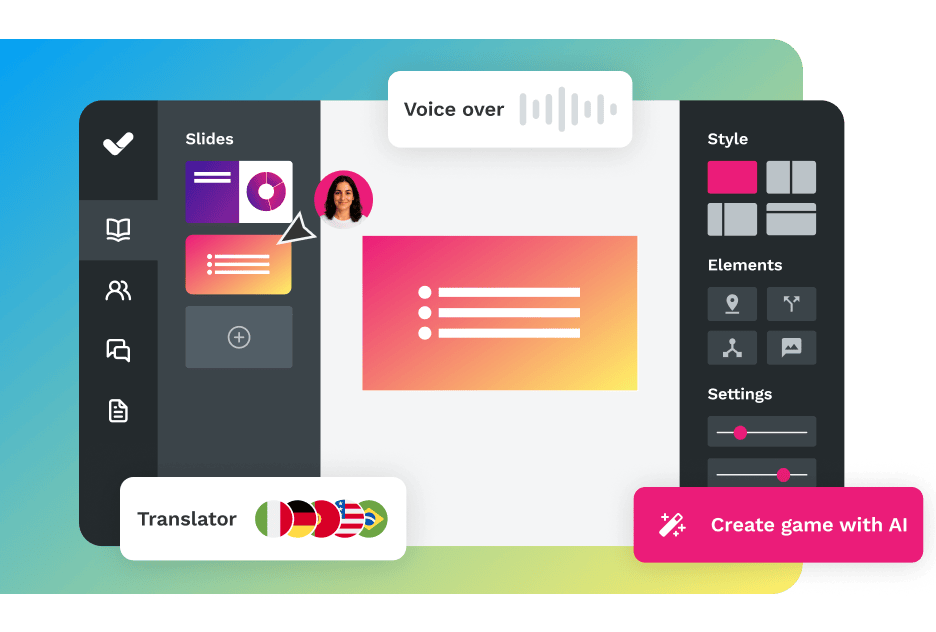
isEazy LMS is not a standard white label LMS, and that is precisely why it can be the best choice for corporate L&D teams. Here is what it offers in terms of customization and identity:
Autonomous visual customization: logo, primary color, login images, and favicon. Clients can apply these changes independently from within the platform itself, without depending on a technical team for every adjustment.
Subdomain with your company name: isEazy configures a corporate subdomain, so employees access training from a recognizable URL. Configuration is handled by the isEazy technical team during onboarding.
Built-in authoring tool: isEazy includes isEazy Author in the same environment. Create, distribute, and manage courses without leaving the platform or purchasing an additional license.
Native AI: content recommendations, automated learning paths, and predictive reporting — all built in, with no add-ons or external tools required.
Ready-to-use content catalog: over 600 skills courses available directly on your platform, at no additional production cost.
Native SSO and integrations: connections with leading HRIS platforms (Workday, SAP SuccessFactors), CRM tools, and communication apps. Employees log in with their usual corporate credentials, with no friction that breaks the brand experience.
Request a free demo and discover how isEazy LMS can bring your company’s brand to every training screen.
Pepco, the fashion and home retail chain expanding across Europe, needed a training platform that would function as part of its corporate ecosystem in every country where it operates. With isEazy LMS, Pepco deployed a branded training experience for more than 25,000 employees across multiple markets, maintaining visual consistency and centralized management. Discover how they did it →
If your use case is Profile A — distributing or selling training under your brand to clients, partners, or franchisees — you need a platform with pure white-label capabilities: a 100% custom domain, complete removal of the provider’s branding, and in many cases a branded mobile app in the app stores under your name. Here are the most relevant options currently available.
TalentLMS is a corporate LMS that offers white label options from its Business and higher plans. It allows you to customize the subdomain, logo, and interface colors, remove TalentLMS branding, and configure a branded mobile app. It is a popular choice for mid-sized companies due to its ease of implementation.

Features
Benefits
Technology, compatibility, and integration
Pricing
Features
Benefits
Technology, compatibility, and integration
Pricing
iSpring Learn stands out for its native integration with iSpring Suite (a PowerPoint-based authoring tool), making it an appealing option for teams that already create content in that environment. It offers a fully branded learning portal, a custom domain, corporate domain notifications, and a branded mobile app published under the client’s name and icon on Google Play and the App Store.

Features
Benefits
Technology, compatibility, and integration
Pricing
Features
Benefits
Technology, compatibility, and integration
Pricing
Adobe Learning Manager (formerly Captivate Prime) offers advanced brand customization with multiple portals each carrying independent visual identities for different audiences. Custom domain functionality is available as an enterprise feature at additional cost and requires coordination with Adobe’s technical team. Designed for large organizations with complex learning needs.

Features
Benefits
Technology, compatibility, and integration
Pricing
Features
Benefits
Technology, compatibility, and integration
Pricing
Moodle is the world’s most widely used open source LMS, with total freedom to customize branding since the code is fully open. You can adapt everything: domain, interface, features, and data. However, this flexibility comes at a cost: it requires a dedicated technical team for installation and maintenance, or a certified Moodle partner, which raises the true total cost of ownership compared to SaaS solutions.

Features
Benefits
Technology, compatibility, and integration
Pricing
Features
Benefits
Technology, compatibility, and integration
Pricing
The decision depends on several factors worth analyzing before evaluating providers:
Start by defining your use case profile: if you distribute training to external clients or partners, a custom domain and complete removal of the provider’s branding are non-negotiable. If you train your own workforce, prioritize visual customization and employee experience over domain control.
Company size and structure: a single-brand organization with one internal audience has different needs from one with multiple subsidiaries, partners, or external clients. If you need separate portals for different audiences, make sure the platform supports this in accessible plans.
Internal technical capability: open source solutions like Moodle offer maximum flexibility but require a dedicated technical team. SaaS cloud platforms remove that burden and offer automatic updates and specialized support.
Technology ecosystem: verify the integrations available with your HRIS, corporate directory, and communication tools. A weak integration breaks the brand experience at the moment of login.
Content and authoring tool: if your L&D team creates its own courses, an LMS that includes a built-in authoring tool can save an additional license and simplify the entire workflow in a single branded environment.
Scalability: make sure the platform can grow with the company without disruptive changes, in both user count and feature set.
“White label LMS” does not mean the same thing for every company. If you need to distribute training under your brand to external clients, partners, or franchisees, the platforms reviewed — TalentLMS, iSpring Learn, Adobe Learning Manager, and Moodle — offer different levels of real white-labeling, each with its own optimal profile in terms of size, technical capability, and budget. If your goal is for your own employees to perceive the training platform as part of the corporate ecosystem, a custom domain stops being the key criterion and visual and functional customization takes center stage.
For this second profile, isEazy LMS offers autonomous visual customization — colors, logo, and login images — a corporate subdomain, a built-in authoring tool, native AI, and a catalog of over 600 ready-to-use courses. All in a single platform designed for L&D teams who want training to carry their company’s name. Request a free demo and see it for yourself.
A white label LMS is a learning management platform that a company can customize with its own visual identity: logo, corporate colors, typography, custom domain, and platform name. The technology provider stays in the background, while the organization delivers a training experience fully aligned with its brand to employees, customers, or partners.
A custom LMS focuses on adapting the platform’s features and training workflows to the company’s internal processes: custom learning paths, HR integrations, tailored dashboards, or specific content structures. A white label LMS goes a step further on the identity layer: it allows the platform to carry the organization’s name, colors, and domain, making it visually indistinguishable from a proprietary solution. The best platforms on the market combine both capabilities: functionally adaptable and fully brandable.
The organizations that benefit most from a white label LMS are those that train multiple audiences under their brand umbrella: companies with a distributor or partner network that require unified training, organizations with multiple brands or subsidiaries, consulting firms and corporate academies that resell training to clients, and any organization where brand consistency directly impacts the employee or customer experience.
Custom domain configuration varies by provider, but generally involves three steps: the LMS provider enables the custom domain option on the contracted plan, the company creates a subdomain (e.g., training.mycompany.com) pointing to the LMS server via a CNAME record with their DNS provider, and the provider manages the SSL certificate. Platforms like isEazy LMS include this process as part of onboarding with technical support, without requiring intervention from the company’s IT team.
It depends on the use case. If your company trains its own employees, the answer is usually no. What truly impacts the employee experience is that the platform carries the corporate image: the logo, colors, login images, and the organization’s name. A custom domain is critical, however, for companies that distribute or sell training under their brand to external clients, franchisees, or partners, where the URL is part of the product being delivered.
For internal corporate training, platforms like isEazy LMS allow you to configure a subdomain with your company name and autonomously customize the full visual identity: corporate colors, logo, and login images. The result is a platform that employees perceive as belonging to their organization, without the need to manage additional domain infrastructure.

Streamline your training management
Experience the power of AI in an LMS that has it all


Automate processes, access 600+ ready-to-use courses, or create your own content with the help of AI.
Request a demoContact us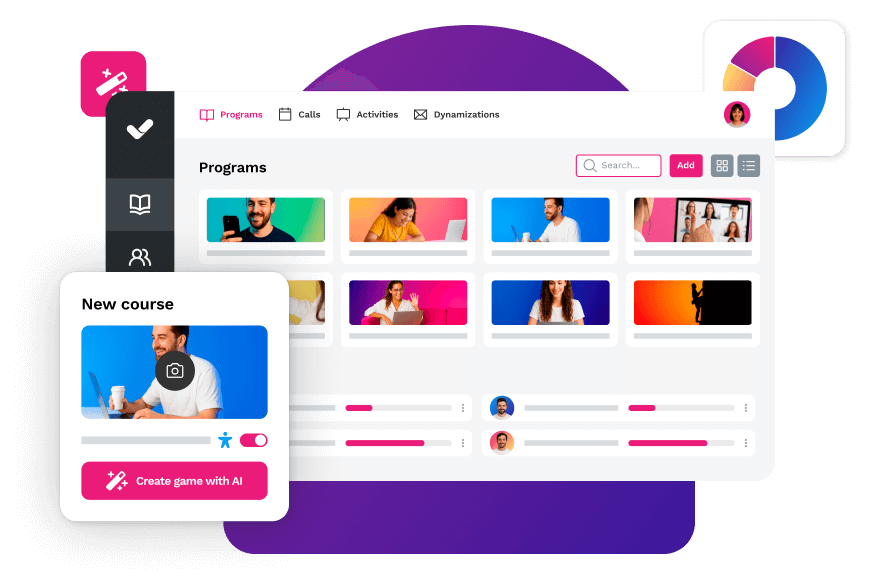
Streamline your training management
Experience the power of AI in an LMS that has it all