CASE STUDY
How Pepco was able to comprehensively manage employee training with an LMS

Brain
The first AI trained to teach

Author
The #1 AI-powered authoring tool on the market

Factory
Custom e-learning content factory

Skills
Comprehensive power skills course catalog

LMS
All-in-one LMS platform with AI

Engage
App for managing frontline teams
Product

What is Brain?
Everything you need to know about the first AI trained to teach.

How does it work?
Adaptive, conversational, and contextual. That’s learning with Brain.

Security
Why your company’s knowledge never leaves your environment or trains other models.

Comparison
Discover what sets isEazy Brain apart from other AI solutions.

Frequently Asked Questions
Want to learn more? Find answers to all your questions about isEazy Brain here.
FEATURES

AINew
Unlock your full potential and speed up course creation with artificial intelligence.

Accessibility
Automatically meet accessibility guidelines—without sacrificing interactivity!

Interactivity
Boost engagement with interactive, ready-to-use activities that make learning fun.

Course Creation
Reduce the time it takes to create your e-learning courses with our authoring tool.

Distribution
We offer you different distribution options, so that nothing can stop you.

SCORM
Publish your course in SCORM format and share it on any LMS.
SERVICES

Instrucional Design
Surprise your students with multimedia and interactive content.

Custom Courses
We create e-learning courses for you—tailored to your needs and hassle-free!

Virtual Reality
Turn learning into an immersive experience.

Custom Avatars
Give your courses and videos a unique touch with personalized avatars.

Audiovisual FactoryNew
Turn training into something dynamic and visual with engaging videos.
CATALOG

Course catalog
Over 600 skills and competency courses to help you adapt to your team's needs.
Microsoft Copilot AcademyNew
Your professionals will learn how to apply Copilot AI to key processes within your organization.

Artificial Intelligence Academy
Train your teams in the practical use of AI to boost productivity and innovation in your company.

Cybersecurity Academy
Capacita a tu empresa con el catálogo más completo en seguridad digital corporativa.
FEATURES

Learning platform
Manage all your training from one place

Analitycs
Measure the impact of your training

Learning Experience
Offer a unique learning experience to your team
Content Library
Choose from hundreds of expert-created courses
Authoring Tool
Create your own content—faster than ever

Use cases
Choose the solution that best fits your needs

Industries
Solutions for all types of industries
USE CASES

Onboarding
Facilitate the onboarding process, productivity and engagement of your new employees.

Upskilling
Boost your team's skills and prepare them for the challenges of the future with upskilling.

Microlearning
Discover all the advantages of microlearning and boost your training results.

Gamification
Enjoy addictive training that will get your professionals hooked.

Internal Communication
Improve communication in your company and enjoy an aligned and committed team.

Mobile learning
Agile, flexible, and interactive learning—built for today’s digital-first workforce.
INDUSTRIES

Banking and financial services
Training in compliance, cybersecurity, customer service, and key skills development.

Pharmaceuticals and healthcare
Digital onboarding, regulatory updates, and ongoing training for healthcare staff.

Retail and consumer
Agile and scalable training for in-store, operational, and customer service teams.

Industry and manufacturing
Training in processes, safety, and corporate culture for distributed teams.

Education and training
Digital solutions for training centers, internal academies, and corporate universities.

Technology and telecommunications
Development of technical talent, digital skills, and upskilling and reskilling programs.
CLIENTS

MAPFRE
How MAPFRE turn e-learning into sales with isEazy

Pepco
A personalised learning experience for a growing team.

BBVA
Digitisation and creation of high quality e-learning content.

Shiseido
We increase the engagement of the training with a social and gamified app.

Telefónica
Large-scale reskilling for the company's digital transformation.

Vodafone
A personalised learning experience for a growing team.
More than 1,000 companies already rely on isEazy.




MEET ISEAZY

Events
Discover our upcoming events and connect with the future of e-learning.

News
Find out the latest news about isEazy: press releases, partnerships, updates...

Contact
Leave us your personal details and we will contact you as soon as possible.
About isEazyNew
Find out more about our company.

Careers
We are looking for the best talent, join our team!

Partners
Become our partner and grow your business.
INTERESTING RESOURCES

Blog
The best content on e-learning: trends, tools and key strategies.

Whitepapers
Gain valuable insights and stay ahead of industry trends.

Product releases
The latest news and releases of our e-learning products and solutions.

Glossary
Definitions of the most commonly used terms and key industry concepts.

Guides
Discover the best step-by-step tips and tricks to optimize your L&D strategy.

Webinars
Video sessions on our products, trends and more

Comparatives
Compare e-learning solutions available on the market and choose the most suitable one.


June 8, 2026

CONTENT CREATED BY:

Table of contents
Choosing the right LMS can make the difference between a training strategy that scales and one that depends on multiple tools and opaque budgets. isEazy LMS and Docebo are two of the most highly regarded platforms on the market, but they follow different philosophies: one bets on being an all-in-one solution with integrated AI and transparent pricing; the other, on enterprise power with a quote-based pricing model. This comparison analyzes their real differences to help you choose based on your team and your needs.
Docebo is a cloud-based learning management system (LMS) primarily aimed at large organizations and enterprise environments. Founded in 2005 and publicly listed since 2019, it serves more than 3,900 clients worldwide. Its value proposition focuses on advanced customization, integration with corporate systems (HRIS, CRM, Salesforce), and the use of AI for content recommendations and search. Pricing is not public: it is negotiated by contract based on the number of users and modules.
isEazy LMS is an all-in-one platform designed for corporate L&D teams that need learning management, ready-to-use content, and an AI-powered authoring tool in a single environment. No installation required, 100% cloud, with public and scalable pricing. Its differentiator is that it eliminates the need to contract multiple vendors: from the same dashboard you manage users, assign learning paths, access over 600 expert courses, and create personalized content with AI. Companies such as MAPFRE, BBVA, Telefónica, and Pepco rely on isEazy LMS to scale their corporate training. Discover isEazy LMS →
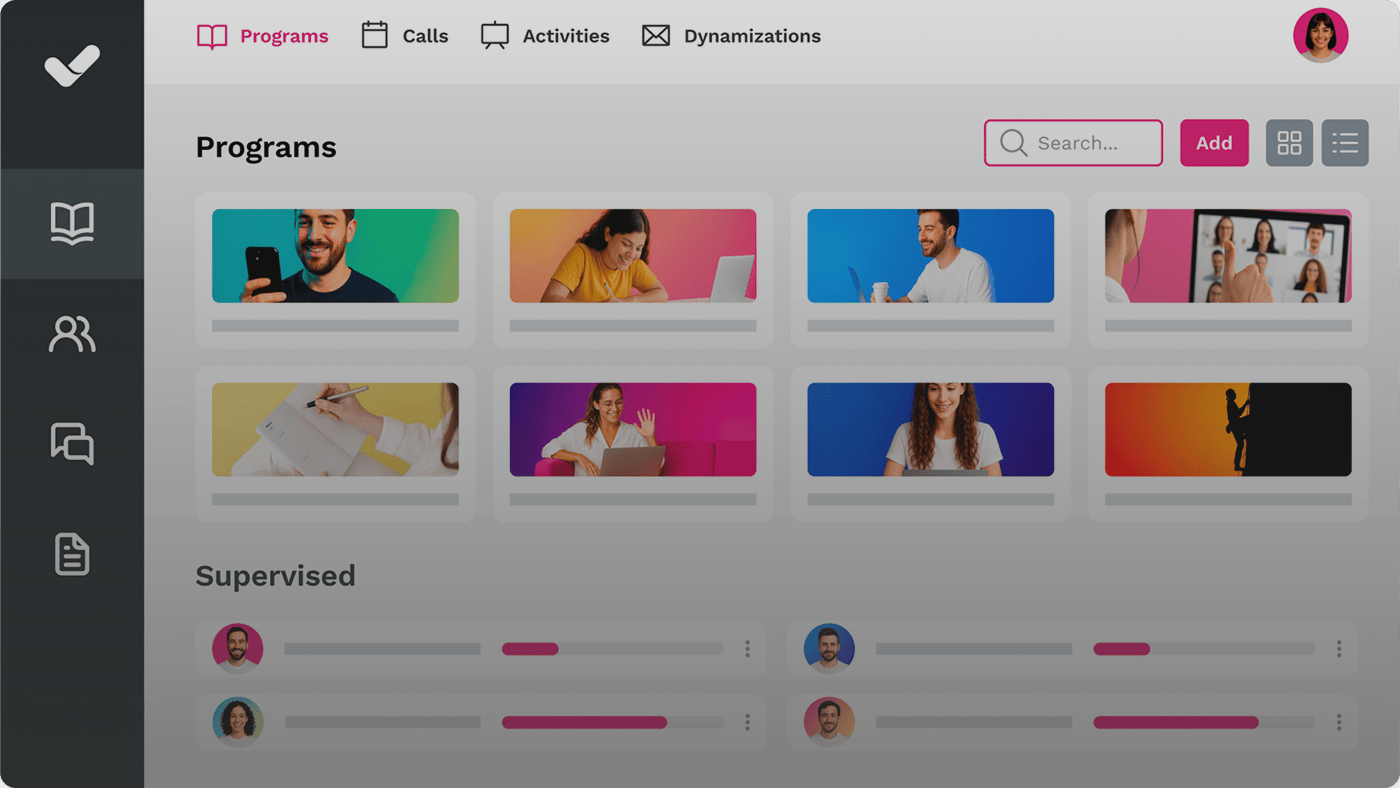
Before going into detail by feature, this table summarizes the most relevant aspects for making a decision:
| Aspect | isEazy LMS | Docebo |
|---|---|---|
| Type of solution | All-in-one platform (LMS + authoring tool + content library) | Specialized enterprise LMS |
| Deployment model | 100% cloud SaaS, no installation | Cloud SaaS |
| Content library | 600+ ready-to-use courses included | No native content library included |
| Integrated authoring tool | Yes, with AI Autopilot | Not native (requires external integration) |
| AI applied | Course creation, AI-powered search, automation | Recommendations, search, skills matching |
| Target | Mid-size and large companies, all industries | Large corporations and multinationals |
| Support | 24/7 | Varies by contracted plan |
Both platforms cover the core features of a modern LMS, although with different levels of depth and accessibility for the L&D team.
isEazy LMS lets you centralize users, courses, and results in a single dashboard, with automated scheduling, notifications, and segmentation of training by profile, area, or group. Its dashboard includes charts and clear reports to measure results and identify training gaps. It supports SCORM 1.2 and 2004, and web formats for importing external content, and features an AI-powered course search that reduces the time needed to find the right content. New employee onboarding can be automated with personalized welcome learning paths from day one. See all isEazy LMS features →
Docebo offers advanced learning path management, with the ability to handle formal and informal learning, employee-generated content, and social learning formats. Its enterprise features include multitenant management, native Salesforce integration for sales network training, and Extended Enterprise capabilities to train external partners and customers. Its weak point: the configuration learning curve is steeper and requires more technical involvement to get full value out of it.
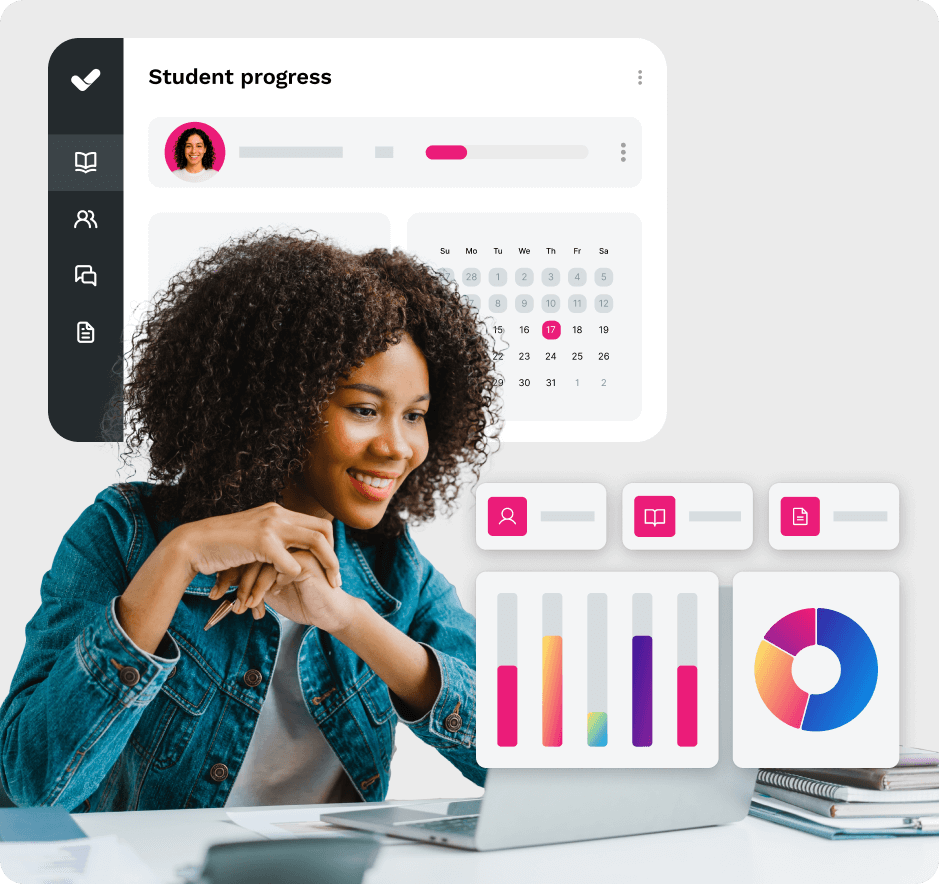
This is one of the most relevant differentiators in this comparison. isEazy LMS includes a library of more than 600 expert courses ready to use, across all key areas of corporate training: compliance and regulations, leadership and communication, digital skills, artificial intelligence, sustainability, occupational health and safety, and much more. The courses are available in multiple languages and are continuously updated to stay aligned with regulatory changes and market trends.
Docebo does not include a native content library. To have ready-to-use courses, it is necessary to integrate an external content provider (such as LinkedIn Learning, Go1, or similar), which implies additional cost, contract management, and an extra layer of operational complexity. For L&D teams that need to cover immediate training needs without time to create content from scratch, this difference is critical.
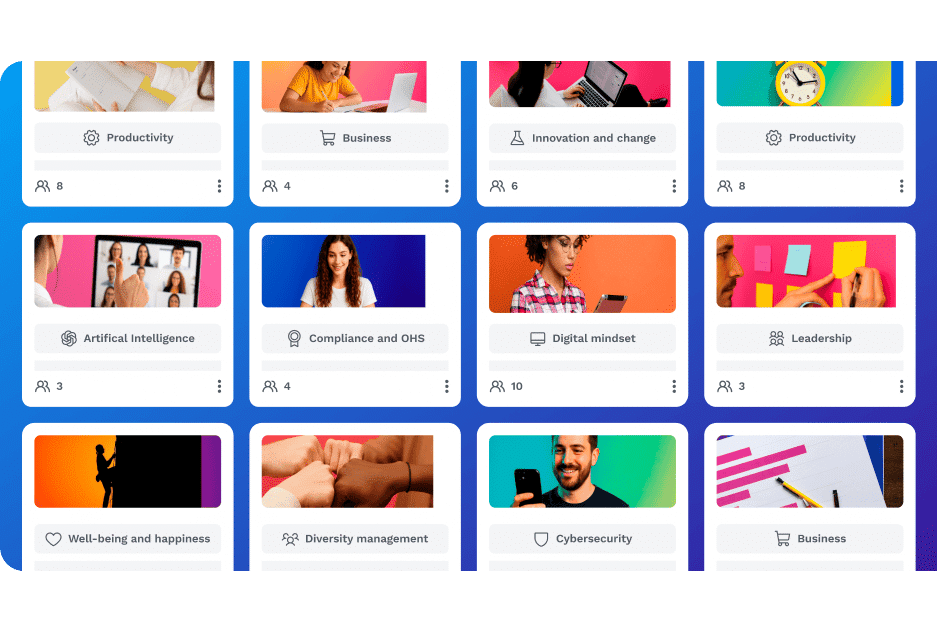
Artificial intelligence is in 2026 one of the most relevant criteria for evaluating an LMS platform. Both incorporate it, but with very different scopes.
AI in isEazy LMS acts across the entire training value chain. In content creation, AI Autopilot generates complete courses —with pedagogical structure, visual design, and interactions— from existing internal documents (PDFs, presentations, manuals). In management, it automates training assignment and notifications. In the employee experience, an AI-powered search instantly finds the most relevant course across the entire library. It also automatically generates images, videos, avatars, and interactive exercises, and translates and localizes content to multiple languages.
Docebo’s AI focuses mainly on three areas: personalized content recommendations, semantic search within the catalog, and skills matching (identifying competency gaps and suggesting aligned training). It is robust AI for talent management, but it does not generate training content: that capability requires integration with external tools. According to the Learning Technology Compass 2025 report by Fosway Group, platforms that combine content creation and management in the same AI-powered environment have adoption rates 40% higher than those that separate both layers.
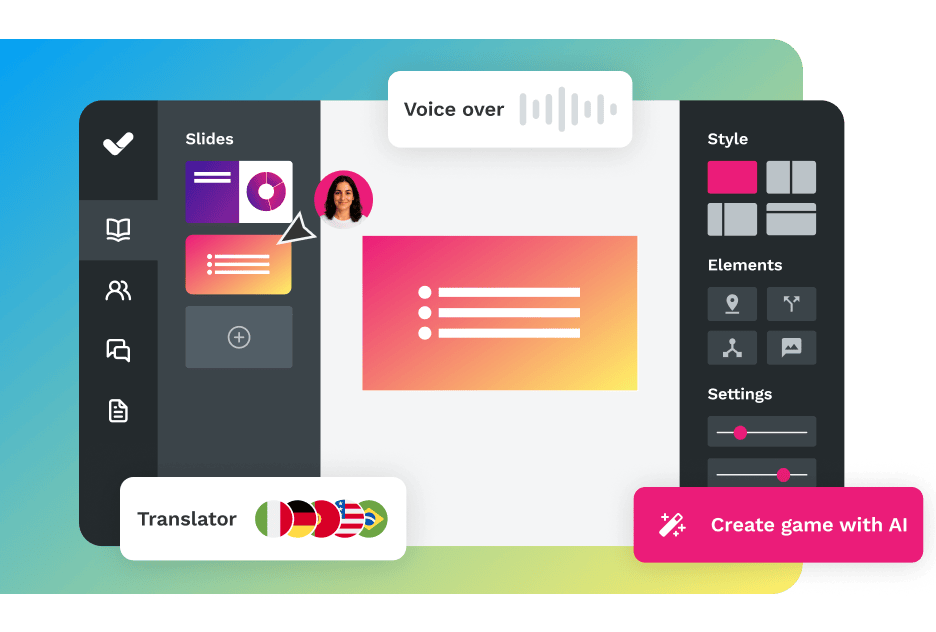
Integrations with the corporate ecosystem are a key criterion for large organizations with established systems.
isEazy LMS integrates with the leading HRIS systems on the market (SAP SuccessFactors, Workday, BambooHR), supports SSO (Single Sign-On) with SAML and OAuth, and is compatible with the most widely used e-learning standards: SCORM 1.2 and SCORM 2004. Its open API allows connection with communication, HR, and analytics tools according to client needs. Integration with Microsoft Teams facilitates access to training within the usual work environment.
Docebo stands out in this area with a very broad ecosystem of integrations: more than 400 native connectors with enterprise tools such as Salesforce, Workday, SAP, Zoom, Slack, and others. Its integration capability is one of its strong points, especially for organizations with complex IT architectures or data flows between multiple systems. If your organization needs to connect the LMS with a sales CRM or a very specific HRIS natively, Docebo may offer more out-of-the-box options.

Pepco is a great example of how a rapidly expanding company can scale its corporate training with isEazy LMS. Thanks to the platform, Pepco successfully automated its onboarding processes, centralized training for thousands of employees across multiple countries, and created personalized e-learning content with AI from its own internal team. Find out how they did it →
In addition to isEazy LMS and Docebo, there are other relevant LMS platforms in the corporate training market:
Adobe Learning Manager (formerly known as Adobe Captivate Prime) is a cloud-based LMS. It enables companies to create, deliver, and manage online training courses for employees, customers, and business partners, integrating interactive content and performance tracking.

Features
Benefits
Technology, compatibility, and integration
Pricing
Features
Benefits
Technology, compatibility, and integration
Pricing
iSpring Learn is a cloud-based LMS. It allows companies and organizations to create, organize, automate, and track online or blended training programs in a simple and technically straightforward way.

Features
Benefits
Technology, compatibility, and integration
Pricing
Features
Benefits
Technology, compatibility, and integration
Pricing
TalentLMS is a cloud-based LMS designed to create, manage, and administer online training courses. It is primarily used for employee, partner, and customer training in companies of all sizes, and is well known for its ease of use and quick setup.

Features
Benefits
Technology, compatibility, and integration
Pricing
Features
Benefits
Technology, compatibility, and integration
Pricing
Canvas LMS is a cloud-based learning management system developed by Instructure. It allows schools, universities, and companies to create, manage, and deliver online courses, manage assessments, facilitate communication, and track academic performance.

Features
Benefits
Technology, compatibility and integration
Pricing
Features
Benefits
Technology, compatibility and integration
Pricing
If you are looking for a complete LMS platform with AI integrated into content creation and management, a ready-to-use course library, certified accessibility, and transparent pricing, isEazy LMS is the most complete choice for most corporate L&D teams in 2026. Docebo is a solid option if your organization has more than 10,000 users, a highly complex enterprise IT architecture with multiple native integrations such as Salesforce, or already has an external content provider and only needs an advanced management LMS. Outside of that specific profile, isEazy LMS wins on virtually every criterion that matters today: all-in-one, autonomy, AI, accessibility, and pricing flexibility. Request a demo and see for yourself, no commitment required →
| Criterion | isEazy LMS | Docebo |
|---|---|---|
| Ease of use for L&D teams | ⭐⭐⭐⭐⭐ | ⭐⭐⭐ |
| AI for content creation | ⭐⭐⭐⭐⭐ | ⭐⭐⭐ |
| Integrated course library (600+) | ⭐⭐⭐⭐⭐ | ⭐⭐ |
| Digital accessibility (WCAG) | ⭐⭐⭐⭐⭐ | ⭐⭐ |
| Pricing transparency | ⭐⭐⭐⭐⭐ | ⭐⭐ |
| All-in-one suite (LMS + authoring + skills) | ⭐⭐⭐⭐⭐ | ⭐⭐⭐ |
| Implementation speed | ⭐⭐⭐⭐⭐ | ⭐⭐⭐ |
| Enterprise scalability (10k+ users) | ⭐⭐⭐⭐ | ⭐⭐⭐⭐⭐ |
| Advanced integrations (HRIS, Salesforce) | ⭐⭐⭐ | ⭐⭐⭐⭐⭐ |
| Support and onboarding | ⭐⭐⭐⭐ | ⭐⭐⭐⭐ |
The main difference lies in the solution’s approach. Docebo is an enterprise LMS aimed at large organizations, with a quote-based pricing model and a strong focus on HRIS and Salesforce integrations. isEazy LMS is an all-in-one platform that combines LMS, a library of over 600 ready-to-use courses, and an AI-powered authoring tool in a single subscription, with transparent public pricing. For L&D teams looking for autonomy, speed, and a complete solution without relying on multiple vendors, isEazy LMS is the most comprehensive option in 2026.
isEazy LMS is designed for companies of any size, from SMEs to large corporations. Clients such as MAPFRE, BBVA, Telefónica, and Pepco use isEazy LMS to manage training programs at scale. The platform allows segmentation of training by department, role, or location, automates scheduling, and measures results with advanced dashboards. The difference from Docebo is that isEazy offers all this capability with faster implementation and an accessible pricing model from day one.
isEazy LMS is the only platform on the market that complies with 100% of AA-level criteria and 80% of AAA-level criteria of the Web Content Accessibility Guidelines (WCAG). This means that all courses created or managed on the platform are accessible to people with visual, hearing, or motor disabilities, without additional intervention from the L&D team. Docebo offers basic accessibility features but does not reach the WCAG certification level that isEazy provides. For public sector, educational, or healthcare organizations where digital accessibility legislation is stringent, this can be a decisive factor.
isEazy LMS offers transparent, public pricing accessible on its official website, with plans adapted to different company sizes. Docebo, on the other hand, does not publish its prices: the cost is determined on request based on the number of users, contracted modules, and support level, making direct comparison difficult. As a market reference, according to Capterra and G2 data, Docebo is typically aimed at enterprise budgets with annual contracts worth several thousand euros. isEazy LMS allows you to start with a more accessible investment and scale progressively, with full transparency from the first contact.

Streamline your training management
Experience the power of AI in an LMS that has it all


Automate processes, access 600+ ready-to-use courses, or create your own content with the help of AI.
Request a demoContact us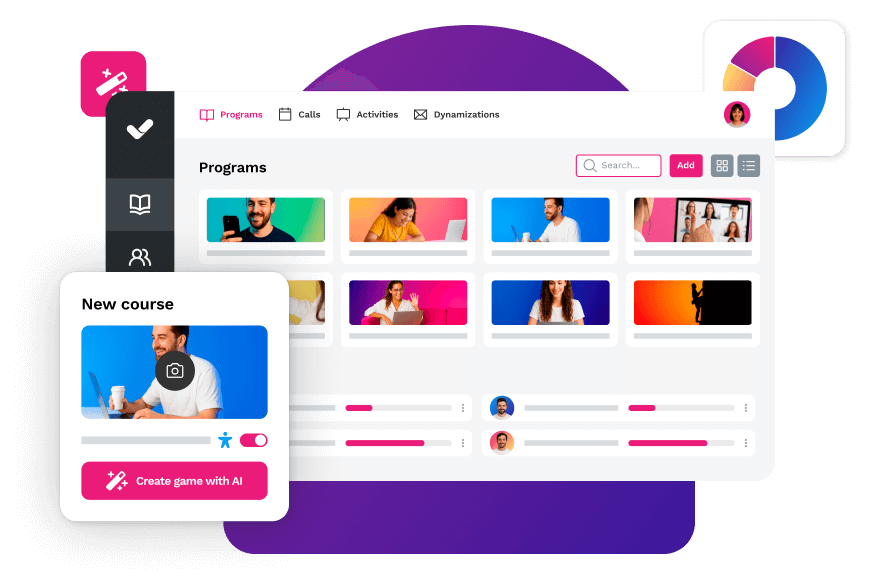
Streamline your training management
Experience the power of AI in an LMS that has it all