CASE STUDY
How STF Group strengthened the performance of its team through e-learning.

Brain
The first AI trained to teach

Author
The #1 AI-powered authoring tool on the market

Factory
Custom e-learning content factory

Skills
Comprehensive power skills course catalog

LMS
All-in-one LMS platform with AI

Engage
App for managing frontline teams
Product

What is Brain?
Everything you need to know about the first AI trained to teach.

How does it work?
Adaptive, conversational, and contextual. That’s learning with Brain.

Security
Why your company’s knowledge never leaves your environment or trains other models.

Comparison
Discover what sets isEazy Brain apart from other AI solutions.

Frequently Asked Questions
Want to learn more? Find answers to all your questions about isEazy Brain here.
FEATURES

AINew
Unlock your full potential and speed up course creation with artificial intelligence.

Accessibility
Automatically meet accessibility guidelines—without sacrificing interactivity!

Interactivity
Boost engagement with interactive, ready-to-use activities that make learning fun.

Course Creation
Reduce the time it takes to create your e-learning courses with our authoring tool.

Distribution
We offer you different distribution options, so that nothing can stop you.

SCORM
Publish your course in SCORM format and share it on any LMS.
SERVICES

Instrucional Design
Surprise your students with multimedia and interactive content.

Custom Courses
We create e-learning courses for you—tailored to your needs and hassle-free!

Virtual Reality
Turn learning into an immersive experience.

Custom Avatars
Give your courses and videos a unique touch with personalized avatars.

Audiovisual FactoryNew
Turn training into something dynamic and visual with engaging videos.
CATALOG

Course catalog
Over 600 skills and competency courses to help you adapt to your team's needs.
Microsoft Copilot AcademyNew
Your professionals will learn how to apply Copilot AI to key processes within your organization.

Artificial Intelligence Academy
Train your teams in the practical use of AI to boost productivity and innovation in your company.

Cybersecurity Academy
Capacita a tu empresa con el catálogo más completo en seguridad digital corporativa.
FEATURES

Learning platform
Manage all your training from one place

Analitycs
Measure the impact of your training

Learning Experience
Offer a unique learning experience to your team
Content Library
Choose from hundreds of expert-created courses
Authoring Tool
Create your own content—faster than ever

Use cases
Choose the solution that best fits your needs

Industries
Solutions for all types of industries
USE CASES

Onboarding
Facilitate the onboarding process, productivity and engagement of your new employees.

Upskilling
Boost your team's skills and prepare them for the challenges of the future with upskilling.

Microlearning
Discover all the advantages of microlearning and boost your training results.

Gamification
Enjoy addictive training that will get your professionals hooked.

Internal Communication
Improve communication in your company and enjoy an aligned and committed team.

Mobile learning
Agile, flexible, and interactive learning—built for today’s digital-first workforce.
INDUSTRIES

Banking and financial services
Training in compliance, cybersecurity, customer service, and key skills development.

Pharmaceuticals and healthcare
Digital onboarding, regulatory updates, and ongoing training for healthcare staff.

Retail and consumer
Agile and scalable training for in-store, operational, and customer service teams.

Industry and manufacturing
Training in processes, safety, and corporate culture for distributed teams.

Education and training
Digital solutions for training centers, internal academies, and corporate universities.

Technology and telecommunications
Development of technical talent, digital skills, and upskilling and reskilling programs.
CLIENTS

MAPFRE
How MAPFRE turn e-learning into sales with isEazy

Pepco
A personalised learning experience for a growing team.

BBVA
Digitisation and creation of high quality e-learning content.

Shiseido
We increase the engagement of the training with a social and gamified app.

Telefónica
Large-scale reskilling for the company's digital transformation.

Vodafone
A personalised learning experience for a growing team.
More than 1,000 companies already rely on isEazy.





MEET ISEAZY

Events
Discover our upcoming events and connect with the future of e-learning.

News
Find out the latest news about isEazy: press releases, partnerships, updates...

Contact
Leave us your personal details and we will contact you as soon as possible.
About isEazyNew
Find out more about our company.

Careers
We are looking for the best talent, join our team!

Partners
Become our partner and grow your business.
INTERESTING RESOURCES

Blog
The best content on e-learning: trends, tools and key strategies.

Whitepapers
Gain valuable insights and stay ahead of industry trends.

Product releases
The latest news and releases of our e-learning products and solutions.

Glossary
Definitions of the most commonly used terms and key industry concepts.

Guides
Discover the best step-by-step tips and tricks to optimize your L&D strategy.

Webinars
Video sessions on our products, trends and more

Comparatives
Compare e-learning solutions available on the market and choose the most suitable one.


July 3, 2026

CONTENT CREATED BY:

Table of contents
isEazy Skills is a flat-rate corporate course catalog designed for companies to train their entire workforce in professional skills with no user limits. Coursera for Business is Coursera’s enterprise plan, offering access to academic content from universities and certifications through a per-user licensing model.
The choice between the two depends on the type of training your organization needs: whether you’re looking for immediate applicability to the job role with short, gamified formats, or you prioritize university certifications and extensive academic content. According to LinkedIn Learning’s Workplace Learning Report 2024, 83% of organizations want to build a more agile learning culture — a goal that favors corporate catalog models with unlimited access.
isEazy Skills is isEazy’s training catalog platform. It offers a library of ready-to-use courses focused on professional skills applicable to the corporate environment: leadership, communication, change management, digital competencies, compliance, sustainability, and more. Its flat-rate model allows any employee in the organization to access the full catalog at no additional per-user cost.
isEazy Skills courses are adapted to new digital learning formats and the needs of new generations of employees. They are agile and interactive courses based on microlearning, designed to capture attention and help learners retain information more effectively. As part of the isEazy ecosystem, it integrates natively with isEazy LMS, isEazy Author, and isEazy Game, enabling a comprehensive training experience.

Features
Benefits
Ratings
Specialized Schools
Features
Benefits
Ratings
Specialized Schools
Coursera for Business is the enterprise plan from Coursera, the online education platform founded by Stanford professors. It provides access to over 5,800 courses, specializations, and professional certificates from universities like Yale, and companies such as Google, IBM, and Meta. Its catalog is broad and diverse, with a strong academic component.
Coursera for Business operates on a per-user licensing model (generally starting at $125/user/year on the Team plan), meaning the total cost scales proportionally with the number of employees. Courses tend to follow longer formats (weeks or months), oriented toward earning internationally recognized certifications.

Features
Advantages
Ratings
Features
Advantages
Ratings
Although both platforms offer training catalogs for businesses, their approaches are fundamentally different. isEazy Skills was born in the corporate world and prioritizes immediate applicability, employee engagement, and cost-free scalability. Coursera for Business comes from the academic world and focuses on depth, certifications, and university prestige.
The most relevant differences center around five areas: pricing model, course format, customization, technology integration, and support. Below, we break them down in a summary table and then dive deeper into each one.
| Aspect | isEazy Skills | Coursera for Business |
|---|---|---|
| Agile and engaging courses based on microlearning | Flat rate, unlimited users | Per-user license (from ~$125/user/year) |
| Content type | Agile courses | University academic courses |
| Format | Microlearning (10-20 min), gamified | Extensive courses (weeks/months) |
| Customization | Personalized learning paths | Limited paths, no branding |
| Certifications | Internal corporate certificates | Recognized university certifications |
| Support | Dedicated Customer Success, multilingual support | Standard support, primarily in English |
| Catalog languages | Multilingual, available in 8 languages | Primarily English, partial translations |
The isEazy Skills catalog is composed of courses designed specifically for the corporate environment. Each course addresses a concrete training need tied to the job role: from soft skills like leadership or team management, to technical competencies like cybersecurity, applied AI, or Microsoft Copilot. Content is updated regularly and structured into learning paths that allow L&D teams to align training with the organization’s strategic objectives.
The Coursera for Business catalog is significantly larger in raw course count (5,800+), with content produced by prestigious universities and tech companies. However, this breadth comes with a caveat: much of the content is academic and generalist, not always directly applicable to a corporate context. A Stanford machine learning course may be excellent for a technical profile, but it doesn’t address the needs of a mid-level manager looking to improve their feedback skills.
In summary: isEazy Skills prioritizes relevance and immediate applicability to the job role; Coursera prioritizes breadth and academic prestige. For most corporate training programs — where the goal is to improve performance, not earn a degree — the isEazy Skills approach proves more effective.
The ability to adapt training to a company’s specific needs is one of the most valued factors for L&D teams. Here, the differences between the two platforms are notable.
isEazy Skills allows you to configure personalized learning paths by department, role, or competency level. Companies can incorporate their corporate branding, combine catalog courses with custom content created in isEazy Author, and design tailored learning experiences without technical development. This flexibility is especially useful during onboarding, where each department needs a different path.
Coursera for Business offers the ability to create SkillSets (course groupings), but customization is limited: it doesn’t allow corporate branding, path creation is less flexible, and there’s no option to integrate proprietary content within the same platform. The experience is Coursera’s, not your company’s.
Employee engagement with training is a permanent challenge for L&D teams. And the content format directly influences completion rates.
isEazy Skills focuses on agile, interactive courses with built-in interactivity and practical exercises in formats such as podcasts and microlearning. This format adapts to real work rhythms — employees can complete a lesson between meetings — and generates significantly higher completion rates than longer formats. According to isEazy’s internal data, programs with gamification achieve up to an 87% completion rate.
Coursera for Business maintains the academic format of its consumer platform: multi-week courses with 30-60 minute videos, readings, and multiple-choice assessments. While the content is rigorous, this format presents a well-documented dropout challenge: completion rates on corporate MOOC platforms rarely exceed 20-30%, according to Class Central’s State of Online Learning 2023 report.
The pricing model is one of the most strategically impactful differences. It’s not just about how much it costs, but how the cost scales as the training program grows.
isEazy Skills operates on a flat-rate basis: a fixed cost that provides access to the entire catalog for all employees in the organization. This means training 100 or 10,000 people has the same base cost. For growing companies or those with broad training programs, this model offers total budget predictability and a per-employee cost that decreases the more it’s used.
Coursera for Business operates on per-user licenses. The Team plan (5-125 users) starts at ~$125/user/year. The Enterprise plan (125+ users) has custom pricing but follows a per-seat model. This means each new employee who accesses the platform increases the total cost, which can create budget friction when the goal is to democratize access to training.
For a company with 500 employees, the economic difference can be substantial: with Coursera, the minimum indicative cost would be ~$62,500/year in licenses alone (not counting implementation costs). With isEazy Skills, the flat rate covers the entire workforce without the budget being affected by growth.
| Aspect | isEazy Skills | Coursera for Business |
|---|---|---|
| Model | Flat rate | Per-user license |
| Base cost | Fixed, regardless of user count | From ~$125/user/year (Team) |
| Scalability | Unit cost decreases with more users | Cost grows linearly with each user |
| Catalog access | Full access from day one | Full on Team; partial on lower plans |
| Predictability | Total — closed budget | Variable — depends on active users |
| Ideal for | Companies looking to train the entire workforce | Small teams with academic needs |
There is no one-size-fits-all answer: the best platform depends on your organization’s context. However, for most corporate training scenarios, isEazy Skills offers a more aligned proposition with the real needs of L&D teams.
| Profile / Need | Recommendation | Why |
|---|---|---|
| Train the entire workforce in soft skills | isEazy Skills ✅ | Flat rate + microlearning + gamification |
| Massive onboarding of new employees | isEazy Skills ✅ | Personalized paths + native LMS integration |
| University certifications for technical profiles | Coursera ✅ | Academic catalog from prestigious universities |
| Compliance and corporate regulations | isEazy Skills ✅ | Specific courses + detailed tracking via LMS |
| Leadership and management development | isEazy Skills ✅ | Applicable corporate content + gamification |
| Advanced technical specialization programs (AI, data) | Coursera ✅ | In-depth courses from Google, IBM, Meta |
| Limited budget with a large workforce | isEazy Skills ✅ | Flat rate with no per-user cost |
| Integrated training ecosystem (LMS + content + gamification) | isEazy Skills ✅ | Native integration with isEazy LMS, Author, Game |
STF Group is a great example of how a well-implemented corporate training catalog can deliver exceptional results. With isEazy Skills, STF Group achieved an 87% completion rate in their leadership program — a figure that stands in stark contrast to the typical 20-30% rates seen on platforms with extensive academic formats. Discover how they did it →
Beyond isEazy Skills and Coursera, there are other training catalog platforms worth knowing about to make an informed decision.
Udemy Business offers a catalog of over 24,000 courses on a per-user license. Its content is primarily created by independent instructors, which generates great variety but with uneven quality. The format is more informal than Coursera’s but less structured than isEazy Skills. It does not offer native integration with authoring tools or gamification.

Features
Advantages
Ratings
Features
Advantages
Ratings
LinkedIn Learning (formerly Lynda.com) offers over 21,000 courses focused on professional and technical skills. Its main advantage is integration with the employee’s LinkedIn profile, which facilitates content recommendations based on role. However, its pricing model also works on individual licenses, courses follow a passive video format with little interactivity, and it offers neither gamification nor integration with content creation tools.
Both platforms are legitimate solutions, but they solve different problems. Coursera for Business is a good option if your priority is university certifications and extensive academic programs for a small group of technical profiles.
However, for the majority of corporate training needs — training the entire workforce in practical skills, keeping engagement high, scaling without budget friction, and having an integrated training ecosystem — isEazy Skills offers a more complete, efficient, and cost-effective proposition.
The combination of flat-rate pricing, gamified microlearning, corporate customization, native integration with LMS and Author, and dedicated multilingual support makes isEazy Skills the option most aligned with what L&D teams need in 2026: agile, measurable training that impacts business outcomes.
👉 Request a demo of isEazy Skills and discover how it can transform training in your organization. You can also request a general demo to explore the full isEazy ecosystem.
| Criterion | isEazy Skills | Coursera for Business |
|---|---|---|
| Applicable corporate catalog | ⭐⭐⭐⭐⭐ | ⭐⭐⭐ |
| Agile and engaging courses based on microlearning | ⭐⭐ | ⭐⭐⭐⭐⭐ |
| Engagement and gamification | ⭐⭐⭐⭐⭐ | ⭐⭐ |
| Customization and branding | ⭐⭐⭐⭐⭐ | ⭐⭐ |
| Pricing model | ⭐⭐⭐⭐⭐ | ⭐⭐⭐ |
| Integrations and ecosystem | ⭐⭐⭐⭐⭐ | ⭐⭐⭐ |
| Multilingual support | ⭐⭐⭐⭐⭐ | ⭐⭐ |
| University certifications | ⭐⭐⭐ | ⭐⭐⭐⭐⭐ |
The fundamental difference lies in their approach and business model. isEazy Skills is a flat-rate corporate course catalog designed specifically for L&D teams that need to train their entire workforce without user limits or individual licensing costs. Coursera for Business, on the other hand, is built on an academic model offering university content and certifications, with pricing based on the number of active users. While isEazy Skills prioritizes immediate applicability to the job role with short, gamified formats, Coursera focuses on academic depth with longer courses oriented toward degree-level qualifications.
It depends on the goal. If a company is looking for university certifications or extensive academic programs for a small group of employees, Coursera can be a valid option. However, for corporate training at scale — where the objective is to train the entire workforce in practical skills with short, gamified, easy-to-consume content within the flow of work — isEazy Skills offers clear advantages: flat-rate pricing with no per-user cost, courses designed for immediate workplace application, higher engagement through gamification dynamics, and native integration with the isEazy ecosystem (LMS, Author, Game).
isEazy Skills operates on a flat-rate model: the company gets access to the entire course catalog with no user limits or additional per-employee costs. This simplifies budget planning and allows organizations to scale training without worrying about the marginal cost of each new user. Coursera for Business uses a per-user licensing model where the total cost grows proportionally with the number of employees accessing the platform, which can become significantly more expensive as the organization scales its training program.
Yes. isEazy Skills integrates natively with isEazy LMS, but it is also compatible with other learning management systems through standards like SCORM and xAPI. This allows companies to incorporate the isEazy Skills course catalog into their existing training infrastructure without needing to migrate platforms. Additionally, as part of the isEazy ecosystem, organizations can combine Skills with Author (for custom content creation) and Game (for advanced gamification), creating a comprehensive training solution that Coursera does not offer natively.

Enhance your team's skills with isEazy Skills
Discover how isEazy Skills can transform your team’s skills with high-impact courses


WHITEPAPER
Discover the power skills that will transform your company
Download whitepaper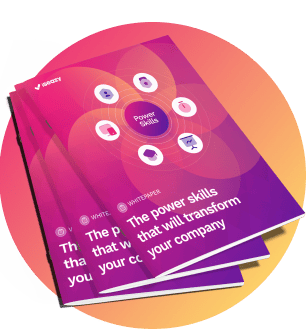
Enhance your team's skills with isEazy Skills
Discover how isEazy Skills can transform your team’s skills with high-impact courses