Brain
The first AI trained to teach

Author
The #1 AI-powered authoring tool on the market

Factory
Custom e-learning content factory

Skills
Comprehensive power skills course catalog

LMS
All-in-one LMS platform with AI

Engage
App for managing frontline teams
Product

What is Brain?
Everything you need to know about the first AI trained to teach.

How does it work?
Adaptive, conversational, and contextual. That’s learning with Brain.

Security
Why your company’s knowledge never leaves your environment or trains other models.

Comparison
Discover what sets isEazy Brain apart from other AI solutions.

Frequently Asked Questions
Want to learn more? Find answers to all your questions about isEazy Brain here.

FEATURES

AINew
Unlock your full potential and speed up course creation with artificial intelligence.

Accessibility
Automatically meet accessibility guidelines—without sacrificing interactivity!

Interactivity
Boost engagement with interactive, ready-to-use activities that make learning fun.

Course Creation
Reduce the time it takes to create your e-learning courses with our authoring tool.

Distribution
We offer you different distribution options, so that nothing can stop you.

SCORM
Publish your course in SCORM format and share it on any LMS.

SERVICES

Instrucional Design
Surprise your students with multimedia and interactive content.

Custom Courses
We create e-learning courses for you—tailored to your needs and hassle-free!

Virtual Reality
Turn learning into an immersive experience.

Custom Avatars
Give your courses and videos a unique touch with personalized avatars.

Audiovisual FactoryNew
Turn training into something dynamic and visual with engaging videos.

CATALOG

Course catalog
Over 600 skills and competency courses to help you adapt to your team's needs.
Microsoft Copilot AcademyNew
Your professionals will learn how to apply Copilot AI to key processes within your organization.

Artificial Intelligence Academy
Train your teams in the practical use of AI to boost productivity and innovation in your company.

Cybersecurity Academy
Capacita a tu empresa con el catálogo más completo en seguridad digital corporativa.
FEATURES

Learning platform
Manage all your training from one place

Analitycs
Measure the impact of your training

Learning Experience
Offer a unique learning experience to your team
Content Library
Choose from hundreds of expert-created courses
Authoring Tool
Create your own content—faster than ever


Use cases
Choose the solution that best fits your needs

Industries
Solutions for all types of industries
USE CASES

Onboarding
Facilitate the onboarding process, productivity and engagement of your new employees.

Upskilling
Boost your team's skills and prepare them for the challenges of the future with upskilling.

Microlearning
Discover all the advantages of microlearning and boost your training results.

Gamification
Enjoy addictive training that will get your professionals hooked.

Internal Communication
Improve communication in your company and enjoy an aligned and committed team.

Mobile learning
Agile, flexible, and interactive learning—built for today’s digital-first workforce.
INDUSTRIES

Banking and financial services
Training in compliance, cybersecurity, customer service, and key skills development.

Pharmaceuticals and healthcare
Digital onboarding, regulatory updates, and ongoing training for healthcare staff.

Retail and consumer
Agile and scalable training for in-store, operational, and customer service teams.

Industry and manufacturing
Training in processes, safety, and corporate culture for distributed teams.

Education and training
Digital solutions for training centers, internal academies, and corporate universities.

Technology and telecommunications
Development of technical talent, digital skills, and upskilling and reskilling programs.
CLIENTS

MAPFRE
How MAPFRE turn e-learning into sales with isEazy

Pepco
A personalised learning experience for a growing team.

BBVA
Digitisation and creation of high quality e-learning content.

Shiseido
We increase the engagement of the training with a social and gamified app.

Telefónica
Large-scale reskilling for the company's digital transformation.

Vodafone
A personalised learning experience for a growing team.
More than 1,000 companies already rely on isEazy.





MEET ISEAZY

Events
Discover our upcoming events and connect with the future of e-learning.

News
Find out the latest news about isEazy: press releases, partnerships, updates...

Contact
Leave us your personal details and we will contact you as soon as possible.
About isEazyNew
Find out more about our company.

Careers
We are looking for the best talent, join our team!

Partners
Become our partner and grow your business.

INTERESTING RESOURCES

Blog
The best content on e-learning: trends, tools and key strategies.

Whitepapers
Gain valuable insights and stay ahead of industry trends.

Product releases
The latest news and releases of our e-learning products and solutions.

Glossary
Definitions of the most commonly used terms and key industry concepts.

Guides
Discover the best step-by-step tips and tricks to optimize your L&D strategy.

Webinars
Video sessions on our products, trends and more

Comparatives
Compare e-learning solutions available on the market and choose the most suitable one.




July 22, 2026
Common Cartridge

CONTENT CREATED BY:

Table of contents
Common Cartridge is an open e-learning standard that allows digital learning content — text, assessments, external tools, and multimedia resources — to be packaged in a single, interchangeable format compatible with different LMS platforms. It was developed in 2008 by the IMS Global Learning Consortium, now known as 1EdTech, with the goal of ensuring that training materials can move between platforms without needing to be adapted each time.
How Common Cartridge works
A Common Cartridge package is a compressed file (.zip) that contains all the elements a compatible LMS needs to import and run the content natively. Unlike SCORM, where content plays inside a “container” that communicates with the LMS in real time, Common Cartridge transforms each element of the package into native resources within the platform: a web page becomes an LMS page, a QTI test becomes a system quiz, and a forum becomes a collaborative activity.
The core component is the manifest file (imsmanifest.xml), which describes the entire package structure: the standard version, included resources, metadata, and relationships between elements. The LMS reads this manifest and distributes the content within its own environment.
There is also a variant called Thin Common Cartridge, which does not package content directly but instead includes only LTI links to resources hosted on external servers. This allows the content provider to update materials without the training manager having to reimport anything into the LMS.
What a Common Cartridge package can include
The standard defines six types of content that can form part of a CC package:
- Web content — HTML pages, images, videos, PDFs, and ePub files.
- QTI assessments — tests and question banks in IMS Question & Test Interoperability format, importable as native LMS activities.
- Discussion forums — predefined discussion topics for instructor-led courses.
- LTI tools — external applications connected via the Learning Tools Interoperability protocol, with secure user authorization.
- Resources with curriculum metadata — content tagged with competency standards, level, topic, and learning object type.
- Weblinks — links to external resources with associated metadata.
Each element can be packaged inside the file or referenced externally via LTI, providing flexibility to combine in-house and third-party content within the same package.
Common Cartridge vs SCORM vs xAPI: what are the differences?
These three standards coexist in the e-learning ecosystem and are not mutually exclusive. Each one solves a different problem, and the right choice depends on the content type, the platform, and the tracking objectives of the L&D team.
| Criteria | SCORM | Common Cartridge |
|---|---|---|
| Year of creation | 2000 (ADL / US Dept. of Defense) | 2008 (IMS Global / 1EdTech) |
| Main purpose | Portability of self-paced training | Exchange of materials between publishers and LMS |
| LMS communication | Real-time during course playback | Delegated to the LMS (no runtime) |
| Assessment support | Limited (completion and score only) | Native via IMS QTI |
| External tools | Not included | Yes, via LTI protocol |
| Content updates | Requires reimporting the package | Thin CC enables automatic updates |
| Corporate LMS compatibility | Universal (>90% of LMS platforms) | Growing, more widespread in academia |
| Compatible authoring tools | Wide (Articulate, Adobe, isEazy…) | Fewer options currently available |
When it makes sense to use Common Cartridge in corporate training
For L&D teams and training managers in organizations, Common Cartridge is especially useful in three scenarios:
- Third-party content: when the organization acquires training materials from publishers, external vendors, or corporate universities that distribute in CC format. It allows integrating them into the corporate LMS without custom development.
- Frequently updated content: thanks to Thin Common Cartridge and LTI, the provider can modify materials on their own server and changes are automatically reflected in the LMS without reimporting the package. Ideal for constantly evolving training catalogs.
- Academic-corporate ecosystems: companies with training programs linked to universities or educational institutions using academic LMS platforms (Moodle, Canvas, Blackboard) will find in Common Cartridge a natural bridge for exchanging materials.
For training developed internally using corporate LMS platforms and standard authoring tools, SCORM remains the most compatible and practical option: broader authoring tool support, more granular tracking, and universal LMS compatibility.
Common Cartridge limitations worth knowing
Like any technical standard, Common Cartridge has important constraints that training teams should evaluate before adopting it:
- Limited compatibility with corporate LMS platforms: while academic LMS platforms such as Moodle or Canvas support it natively, not all enterprise LMS systems implement the standard fully, especially in its most recent versions (1.3 and 1.4).
- Fewer compatible authoring tools: the ecosystem of tools for creating CC packages is smaller than that for SCORM. Most corporate authoring tools prioritize SCORM or xAPI export.
- No real-time LMS communication: Common Cartridge has no runtime component of its own. Learner progress tracking depends entirely on how the LMS implements it, which can limit the granularity of available data.
- Migration from SCORM is complex: converting existing SCORM content to Common Cartridge is not straightforward, as SCORM does not support all CC content structures and may require rewriting parts of the course.
According to the official 1EdTech FAQ, Common Cartridge was not designed as a replacement for SCORM, but as a complement for interoperability scenarios between publishers and platforms that SCORM was not built to handle.
Frequently asked questions about Common Cartridge
Is Common Cartridge the same as SCORM?
They are not the same, although both are e-learning standards. SCORM was designed to package self-paced corporate training and track learner progress within the LMS. Common Cartridge, on the other hand, was developed to facilitate the exchange of digital materials between different platforms, with a particular focus on assessments (QTI), external tools (LTI), and collaborative forums. While SCORM communicates with the LMS in real time during course playback, Common Cartridge delegates that logic to the learning system itself. In practice, many organizations use SCORM for internal courses and Common Cartridge when working with external content publishers or universities.
Which LMS platforms are compatible with Common Cartridge?
Most modern academic and corporate LMS platforms support Common Cartridge in at least one of its versions. Moodle, Canvas, Blackboard, and Brightspace are natively compatible. In the corporate space, adoption is more uneven: some enterprise LMS platforms support CC package imports, but not all guarantee full compatibility with the most recent versions (1.3 or 1.4). Before adopting this standard in a corporate training project, it is worth verifying with your LMS provider which version of Common Cartridge it supports and whether it includes support for LTI and QTI assessments.
When does it make sense to use Common Cartridge in corporate training?
Common Cartridge is particularly useful when an organization works with third-party content —publishers, external vendors, corporate universities— that needs to be integrated into the LMS without custom development. It is also a good option when content is updated frequently: thanks to Thin Common Cartridge, the provider can modify materials on their own server and changes are automatically reflected in the LMS without needing to reimport the package. For training developed internally with standard authoring tools, SCORM remains the most compatible and practical choice.

The power of AI in a fully integrated training platform
Automate processes, access 600+ ready-to-use courses, or create your own content with the help of AI.
Request a demoContact us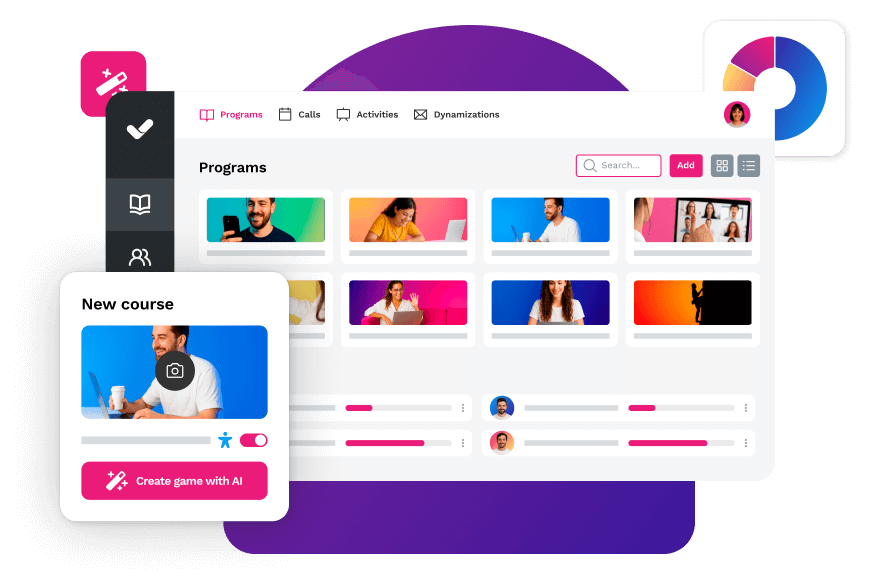


Streamline your training management
Experience the power of AI in an LMS that has it all